

Oyster mushrooms are grown from bought spawn mixed into pasteurized straw or a similar farm by-product, packed into bags, left in the dark until the bags are white, then given cool, very humid, fresh air and light to fruit. UF/IFAS Extension's home method pasteurizes chopped straw at 165°F for 1 to 2 hours and adds 5 to 10% spawn, and its bags carry grown clusters about 25 days after they go in to incubate. UC Cooperative Extension gives the numbers for each stage: 95% humidity at 55 to 60°F while pins form, then 85 to 92% at 60 to 64°F while the mushrooms grow, with carbon dioxide under 600 ppm.
What it is and why grow it
Oyster mushrooms are species of Pleurotus that feed on dead wood and other plant material. UC Cooperative Extension sums up why they suit a small grower: they fruit on a single-ingredient substrate, grow through straw quickly while tolerating high carbon dioxide, and give abundant crops in a short time. ATTRA calls them the most accessible way into mushroom growing, fast-growing, forgiving and highly productive, and notes that they tolerate pasteurized rather than fully sterilized substrate, which keeps the equipment simple.
What it grows on
Straw is the usual start. UF/IFAS calls wheat straw an excellent substrate for oyster mushrooms and lists others that work: rice stalks, corn cobs, coffee grounds, cotton pulp, peanut shells, some plant leaves such as banana and plantain, and paper. ICAR-DMR grows its oyster species on wheat or paddy straw and sugar cane bagasse.
Commercial growers in the United States use chopped wheat straw, cottonseed hulls, or both. Penn State gives one of the most common mixes as 75% cottonseed hulls, 24% wheat straw and 1% ground limestone, wetted to 67 to 69% moisture, with the limestone raising the pH to about 7.5 or higher to hold back Trichoderma green mold. Richer mixes of sawdust and bran also grow oyster mushrooms but need sterilizing; the substrate page covers both, and the substrate recipe tool scales the UF/IFAS straw recipe and the Penn State mix to your bags.
Step by step, from spawn to harvest
These steps follow UF/IFAS Extension's home straw method, with UC Cooperative Extension's stage figures where they add to it. Each step links the page that explains it in full.
- Buy spawn. UF/IFAS says the fastest and simplest way, short of a kit, is to buy oyster spawn rather than make it. How to start compares the ways in.
- Prepare the straw. Cut it into 4 to 5 inch pieces and soak it overnight (UF/IFAS).
- Pasteurize it. Drain the straw, hold it in a water bath at 165°F for 1 to 2 hours, then drain it for an hour (UF/IFAS). Hot water and steam can scald; the sterilize or pasteurize page covers the methods and their safety.
- Add the spawn. As soon as the straw has drained and cooled, mix in spawn at 5 to 10% by volume or weight, in a clean space (UF/IFAS). Either mix it all and then fill the bags, or layer straw and spawn straight into the bags. Spawn and inoculation covers clean work.
- Fill and close the bags. Pack bags about 10 to 12 by 20 to 24 inches tightly, with no big gaps, until each feels like a firm pillow. Close the top, then cut 10 to 15 small cross cuts about 1/4 inch long, 4 to 6 inches apart, in two rings a few inches from the top and bottom (UF/IFAS).
- Incubate in the dark. UF/IFAS keeps the bags off the floor in a clean, dark place at 75 to 77°F (24 to 25°C) and 80 to 90% humidity. UC gives the substrate's fastest growth as 78 to 84°F, with no fresh air needed. Because a bag runs warmer inside than the room, Cornell Small Farms keeps the room near 70°F and never above 80°F. Our suggestion for a first grow: hold the room between Cornell's 70°F and UF/IFAS's 77°F, which leaves room for the bag to run warmer inside without passing Cornell's 80°F limit for the room. See incubation.
- Wait for white. The bag is ready when the whole of it has turned white: two to three weeks in UF/IFAS's guide, 10 to 14 days in UC's figures, 14 to 28 days for oyster on straw in Cornell's. Plan on two to four weeks and go by the colour of the bag, not the calendar (our summary of the three).
- Start fruiting. Lower the temperature, add light, and raise humidity and fresh air together. UC gives 55 to 60°F and 95% humidity while pins form, with carbon dioxide under 600 ppm, 4 air changes an hour and about 2,000 lux for 12 hours a day; diffuse daylight is enough. UF/IFAS's simpler home chamber runs at about 68°F and 90%. Agromisa notes that some Pleurotus ostreatus strains fruit reliably after a cold shock, a drop of 5 to 10°C (9 to 18°F). The fruiting page explains each change.
- Grow them on. Once pins form, UC gives 60 to 64°F, 85 to 92% humidity and 4 to 6 air changes an hour, and mists once or twice a day until the mushrooms reach 30 to 40% of harvest size. Pins take 7 to 14 days to appear (UC).
- Pick, then let the bag rest. Pick each cluster just before the curled-under edge of the caps flattens out (UC), twisting it off gently or cutting it flush with the substrate (UF/IFAS). The bag fruits again in about 10 days (UC). Harvest and storage covers picking and cooling.
Conditions by stage
UC Cooperative Extension gives a figure for each stage of an oyster grow, and it is the spine of this guide. The other sources state close figures for their own methods, shown below the table.
| Stage | Temperature, humidity, time | Fresh air and light | Source |
|---|---|---|---|
| Colonizing (spawn run) | Substrate fastest at 78 to 84°F; dies above 104°F held for 48 hours. Humidity 90 to 100%. 10 to 14 days | No fresh air; carbon dioxide around 20,000 ppm, and growth is stimulated up to 28,000 ppm. Total darkness | UC, p. 27 |
| Pins forming | Air 55 to 60°F; humidity 95%. 7 to 14 days | Under 600 ppm; 4 air changes an hour. About 2,000 lux for 12 hours a day; diffuse daylight is enough. Mist once or twice a day | UC, p. 29 |
| Cropping | Air 60 to 64°F; humidity 85 to 92%. 5 to 7 weeks, flushes about 10 days apart | Under 600 ppm; 4 to 6 air changes an hour. Light as for pins. Mist to stop caps cracking | UC, p. 34 |
Other sources, each for its own method: UF/IFAS's home method incubates at 75 to 77°F and 80 to 90% humidity and fruits at about 68°F and 90%. Penn State's commercial bags incubate at a substrate temperature of 23 to 25°C (73 to 77°F) for 12 to 14 days. ICAR-DMR's method for P. ostreatus incubates at 22 to 26°C for 8 to 10 days and fruits at 14 to 20°C (57 to 68°F), with 600 to 1,000 lux for 3 to 4 hours a day. Cornell Small Farms keeps oyster mushrooms under 800 ppm carbon dioxide while they fruit, and changes all the room's air every 5 to 10 minutes. The CO2 and fresh air page sets the air figures side by side.
Varieties and strains worth knowing
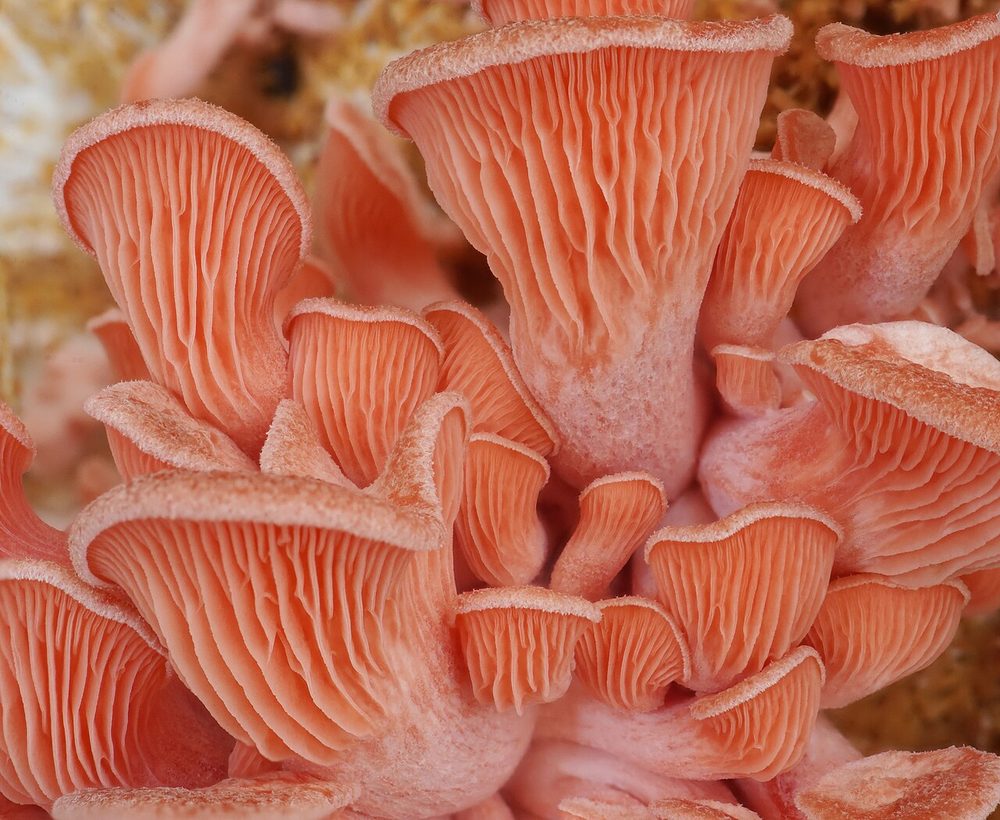
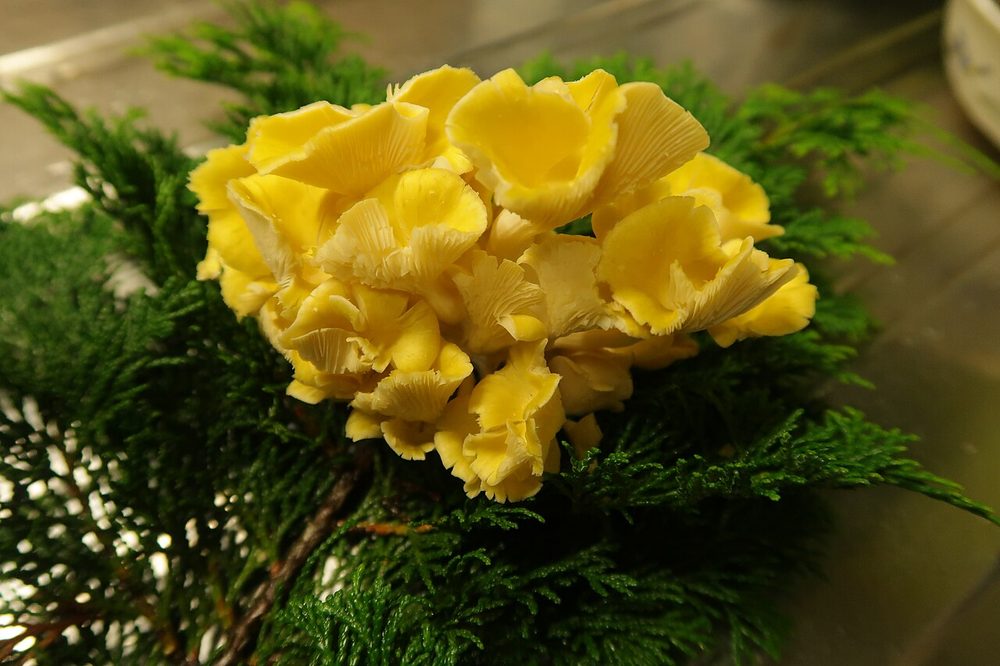
Several species are sold as oyster mushrooms, and the main practical difference between them is the temperature they fruit at. Cornell Small Farms suggests choosing by season rather than heating or cooling the room: pearl or blue oyster (P. ostreatus) in fall, winter and spring, and phoenix oyster (P. pulmonarius) in summer. The Cornell and Fungi Ally farm book names yellow, pink and phoenix oysters as good for high temperatures. ATTRA groups them the same way: blue for cool weather, pink for warm, golden for in between.
| Oyster | ATTRA | Agromisa | ICAR-DMR |
|---|---|---|---|
| Pearl or blue oyster, P. ostreatus | 55 to 65°F (blue oyster) | 5 to 25°C (41 to 77°F) | 14 to 20°C (57 to 68°F) |
| Phoenix oyster, P. pulmonarius | Not given | 13 to 20°C (55 to 68°F) | Not given |
| Pink oyster, P. djamor | 70 to 85°F | 20 to 30°C (68 to 86°F) | Not given; incubates at 22 to 25°C |
| Golden oyster, P. citrinopileatus | Not given in its table; “intermediate” | 15 to 25°C (59 to 77°F), listed under P. cornucopiae | 18 to 22°C (64 to 72°F) |
Agromisa's table groups golden oyster under P. cornucopiae and lists probable synonyms for pink oyster; the names here are as each source gives them. ICAR-DMR also gives methods for P. florida (fruiting at 15 to 22°C) and P. sajor-caju (18 to 26°C), which it grows in India's winter and spring.
Strain matters as much as species. Cornell names fruiting temperature, growth speed, colour, shelf life and yield among the things the strain decides, and says spawn and block suppliers provide strains selected for performance; growers making their own spawn trial 4 to 5 strains side by side. King oyster (P. eryngii) is a Pleurotus too, but it is grown differently: Cornell fruits it from the top of the bag for a long stem, and ICAR-DMR grows it on sterilized, bran-supplemented substrate at 10 to 15°C. It is not covered by this guide.
Harvest, yield and keeping
When. UC picks oyster mushrooms just before the curled-under edge of the cap rises to flat. Agromisa gives five days to harvest at 15 to 20°C (59 to 68°F), or two to three days at higher temperatures, and another five to nine days for the next flush.
How many flushes. UF/IFAS expects 2 to 4 more flushes after the first, depending on the strain and the room; Agromisa counts three or four in all, and takes the bags out of the room when the substrate turns soft and colourless.
How much. Yield is measured against the dry weight of the substrate. UC defines biological efficiency as fresh mushrooms as a percentage of the dry substrate, so 100% means one pound of mushrooms for each pound of dry straw. It gives an average commercial yield of 1 kg of fresh mushrooms per kg of dry substrate, and a range of 100 to 200%. Plain straw gives less than that. A Fungi Ally trial for Northeast SARE grew six strains on straw in 10 lb bags and averaged 29% on heat-pasteurized straw and 41% on lime-treated straw, with a best of 65%; a Southern SARE trial measured 107% on a supplemented pellet mix, inside UC's range. As a worked example (our arithmetic), a 10 lb bag of wet straw at 60% moisture holds 4 lb of dry straw: at the trial's 29% it gives about 1.2 lb of mushrooms over its flushes, and at UC's average about 4 lb. Agromisa's figure of about 20% of the wet substrate weight works out to about 50% on such a bag (our arithmetic). The biological efficiency page sets the two bases side by side, and the yield estimator works it out for your bags.
Keeping. UC puts oyster mushrooms at 91% water. Cornell Small Farms stores harvested mushrooms at 34 to 37°F for about 7 days, and says oyster keeps less well than shiitake. Agromisa's experiments in the tropics kept oyster mushrooms 4 days at 8 to 10°C (46 to 50°F) in perforated film. The shelf life page has the rest.
What goes wrong with this one
Each sign below has its own page with the causes in the order to check them.
| What you see | The usual cause for oyster | Where to look |
|---|---|---|
| Long stems and small caps | Too much carbon dioxide or too little light (Cornell; Agromisa). Oyster is more sensitive to carbon dioxide than shiitake or lion's mane (Cornell and Fungi Ally farm book) | Long stems and small caps |
| Stalks with no caps, branching like coral | No light at all (Agromisa) | Fruiting: light |
| A white bag that does not pin | Not yet fully grown, stale air, dry air or a warm room (UC; Cornell) | Won't pin |
| Cracked caps, pins that wither | Air too dry; UC mists to stop caps cracking | Dry or cracked caps |
| Green patches in the bag | Trichoderma green mold, which UF/IFAS names as a common contaminant; Penn State limes oyster substrate against it | Green mold |
| A bag that stops turning white | Too cold, or too hot inside: UC gives oyster mycelium dying above 104°F held for 48 hours | Stalled colonization |
Related pages
Sources
- Asheville Fungi. Final Report for FS13-268 (waste-stream substrates for oyster mushroom production). Southern SARE producer grant. The standard mix of 80% oak fuel pellets, 18% wheat bran and 2% gypsum in 5 lb bags: 2.15 lb harvested per bag, 43% biological efficiency on wet weight and 107% on dry weight.
- Fungi Ally. Final Report for FNE15-825, Northeast SARE, and its oyster mushroom booklet (pp. 24 and 25). Straw in 10 lb bags at about 70% moisture, six strains, three runs: average biological efficiency 18% (fermented), 20% (wood ash), 29% (heat-pasteurized) and 41% (lime); best 65% (lime, Elm A strain).
- University of California Cooperative Extension. 2011. Cultivating Mushrooms on Small Farms (slides). Why oyster suits small growers (p. 20), the stage figures (pp. 27, 29, 34), water content and average yield (p. 39), biological efficiency (p. 58).
- Liao, H.-L., C.-M. Hsu, K. Hameed and V. T. Cotter. 2018, revised 2025. D.I.Y. FunGuide: Grow Your Own Oyster Mushrooms at Home (SL448). UF/IFAS Extension. The home straw method, substrates, incubation and fruiting chamber, flushes, contamination.
- Penn State Department of Plant Pathology and Environmental Microbiology. Specialty Mushrooms: Production Technology. The hulls-and-straw mix, moisture, limestone and pH, commercial incubation.
- Cornell Small Farms Program. Methods of Commercial Mushroom Cultivation in the Northeastern United States: 2. Seven Stages of Cultivation. Strains, incubation times and temperature, carbon dioxide for oyster, seasonal species, storage.
- Crosby, W. (Fungi Ally) and S. Gabriel (Cornell Small Farms Program). 2021. Specialty Mushroom Farm Book. Northeast SARE. Oyster's carbon dioxide tolerance, warm-season oysters.
- Soto-Velez, G. 2026. Mushroom Cultivation (IP677). ATTRA, National Center for Appropriate Technology. Oyster as a first mushroom, varieties by temperature and spores (p. 7), fruiting temperatures (p. 13).
- Oei, P., with B. van Nieuwenhuijzen. 2005. Small-scale mushroom cultivation (Agrodok 40). Agromisa Foundation and CTA. The cold shock (p. 12), fruiting temperatures by species (Table 1, p. 13), light (p. 49), harvest timing, flushes and yield (pp. 50 to 51), keeping (p. 71).
- ICAR-Directorate of Mushroom Research, Solan. 2020. Technologies Developed by ICAR-DMR for Commercial Use. Methods for pink oyster (p. 19), P. sajor-caju (p. 19), P. florida (p. 22), P. ostreatus and golden oyster (p. 25), king oyster (p. 27).
Frequently asked questions.
How long does it take to grow oyster mushrooms?
Often three to four weeks from spawning to the first harvest, and longer in a cool room. In UF/IFAS Extension's home straw method the bags are white through in two to three weeks and carry grown clusters about 25 days after they go in to incubate. Penn State says commercial oyster bags are harvested about 3 to 4 weeks after spawning, depending on the strain, supplement and spawn-run temperature. Cornell Small Farms gives up to 28 days on straw just to colonize. Later flushes follow about 10 days apart (UC Cooperative Extension).
How do I grow oyster mushrooms on straw at home?
UF/IFAS Extension cuts wheat straw into 4 to 5 inch pieces, soaks it overnight, pasteurizes it in a 165 F water bath for 1 to 2 hours, drains and cools it, mixes in 5 to 10% oyster spawn, and packs it firmly into bags with small cross cuts. The bags sit in a clean, dark place at 75 to 77 F until white, then move to a humid, lit spot with fresh air at about 68 F to fruit.
What temperature do oyster mushrooms grow best at?
It depends on the stage. UC Cooperative Extension gives the fastest colonizing at a substrate temperature of 78 to 84 F, then 55 to 60 F while pins form and 60 to 64 F while the mushrooms grow. Species differ: ATTRA gives blue oyster 55 to 65 F and pink oyster 70 to 85 F for fruiting.
Which oyster mushroom should I grow in summer?
A warm-weather species. Cornell Small Farms suggests phoenix oyster (Pleurotus pulmonarius) for summer and pearl or blue oyster (P. ostreatus) for fall, winter and spring. The Cornell and Fungi Ally farm book names yellow, pink and phoenix oysters as good for high temperatures, and ATTRA gives pink oyster a fruiting range of 70 to 85 F.
How much do oyster mushrooms yield per bag?
It depends most on the substrate. UC Cooperative Extension gives an average commercial yield of 1 kg of fresh mushrooms per kg of dry substrate, with a range of 100 to 200%, and a Southern SARE trial measured 107% on a supplemented pellet mix. On plain pasteurized straw, a Fungi Ally trial for Northeast SARE averaged 29%, and 41% on lime-treated straw. A bag holding 4 lb of dry straw would give about 1.2 lb at 29% and about 4 lb at 100%, over all its flushes.
How many times will an oyster mushroom bag fruit?
Several times. UF/IFAS Extension expects 2 to 4 more flushes after the first, depending on the strain and the room, and Agromisa counts three or four in all. UC Cooperative Extension gives about 10 days between flushes. Agromisa takes a bag out when the substrate turns soft and colourless.
When should I pick oyster mushrooms?
Just before the curled-under edge of the caps flattens out, which is the harvest stage UC Cooperative Extension gives. Agromisa gives five days to harvest at 59 to 68 F, sooner when it is warmer. Twist the cluster off gently or cut it flush with the substrate (UF/IFAS), and cool the mushrooms at once.
Do oyster mushroom spores cause problems indoors?
They can. ATTRA notes that oyster mushrooms can release high volumes of spores while fruiting, which may cause respiratory irritation in enclosed or poorly ventilated indoor spaces, and recommends proper ventilation or a respirator for indoor growers producing at scale.