

A fully colonized mushroom block starts to fruit when four things change at once: it gets fresh air, very humid air, light, and for most mushrooms a cooler room. For oyster mushrooms, UC Cooperative Extension gives 95% humidity at 55 to 60°F while the first pins form, then 85 to 92% at 60 to 64°F while they grow, with carbon dioxide held under 600 ppm. The hard part is holding that humidity while bringing in fresh air, which dries the room; Cornell's guide says the fresh air is what makes fruiting “a dance.”
Is the block ready?
Change nothing until the mushroom has grown all the way through its food. Agromisa explains why: most of the changes that make a mushroom fruit slow down the growth of the mycelium, the white threads that colonize the block, so they should only come once the substrate is fully grown through. On straw in a bag, UF/IFAS Extension says this takes two to three weeks of spawn run, until the whole bag is white.
Shiitake blocks take longer and look different. Cornell Small Farms says to leave them on the incubation shelf for 6 to 7 weeks, and not to move them on until about 75% of the block has turned brown and bumpy (“popcorned”). The incubation page covers the weeks before this one.
Starting it, step by step
These steps are for oyster mushrooms in a bag or block, the usual first grow. The figures are UC Cooperative Extension's for pin initiation unless another source is named.
- Move it to where it will fruit. UF/IFAS describes a fruiting chamber at about 68°F and 90% humidity, with light and good air exchange. At home that can be a box or tub over the bags; its example is a laundry hamper. Cornell's guide notes that a fruiting space can be anything from a single shelf to a tractor trailer.
- Open the bag where the mushrooms should come out. For oyster, Cornell cuts the bag corner to corner on its broad side, and the next flush comes from the same cut. Straw bags made the UF/IFAS way already have 10 to 15 small cross cuts, about 4 to 6 inches apart. Do not cut into the block: Agromisa warns that a deep cut damages the mycelium, and that a larger opening gives smaller mushrooms and dries the substrate faster.
- Drop the temperature. UC gives 55 to 60°F for oyster pins. Agromisa says some Pleurotus ostreatus strains fruit reliably after a cold shock, a drop of 5 to 10°C (9 to 18°F).
- Raise the humidity to 95%. Cornell's guide calls the first four days after initiation the most critical for humidity, and keeps it above 85% through them.
- Bring in fresh air. Hold CO2 under 600 ppm, with 4 air changes an hour. Agromisa makes the same point: the CO2 has to come down for the mushroom to fruit.
- Turn on the light. UC: oyster responds best to about 2,000 lux for 12 hours a day, though diffuse daylight is enough. Agromisa: light is essential for fruiting.
- Mist and wait. UC mists once or twice a day until the mushrooms reach 30 to 40% of harvest size. Pins take 7 to 14 days to form (UC); Agromisa sees them three to four days after the bag is opened.
Shiitake starts differently. It is woken with water or cold rather than by opening the bag alone. Cornell soaks blocks for 5 to 12 hours and logs for 24, or chills blocks for 12 to 24 hours and then strips off the plastic. UC gives a cold-water soak of 24 to 72 hours for logs and blocks. The two sources differ on soak time. Our suggestion, not theirs: ask the supplier of your strain which soak it needs.
Other mushrooms open differently. Cornell cuts small V or X slits for lion's mane, two on the broad side and one on the narrow side, and fruits it from the side, because a top-fruited block can collect water and invite disease. King oyster is fruited from the top, with the bag cut to leave 3 inches of plastic above the substrate to hold humidity.
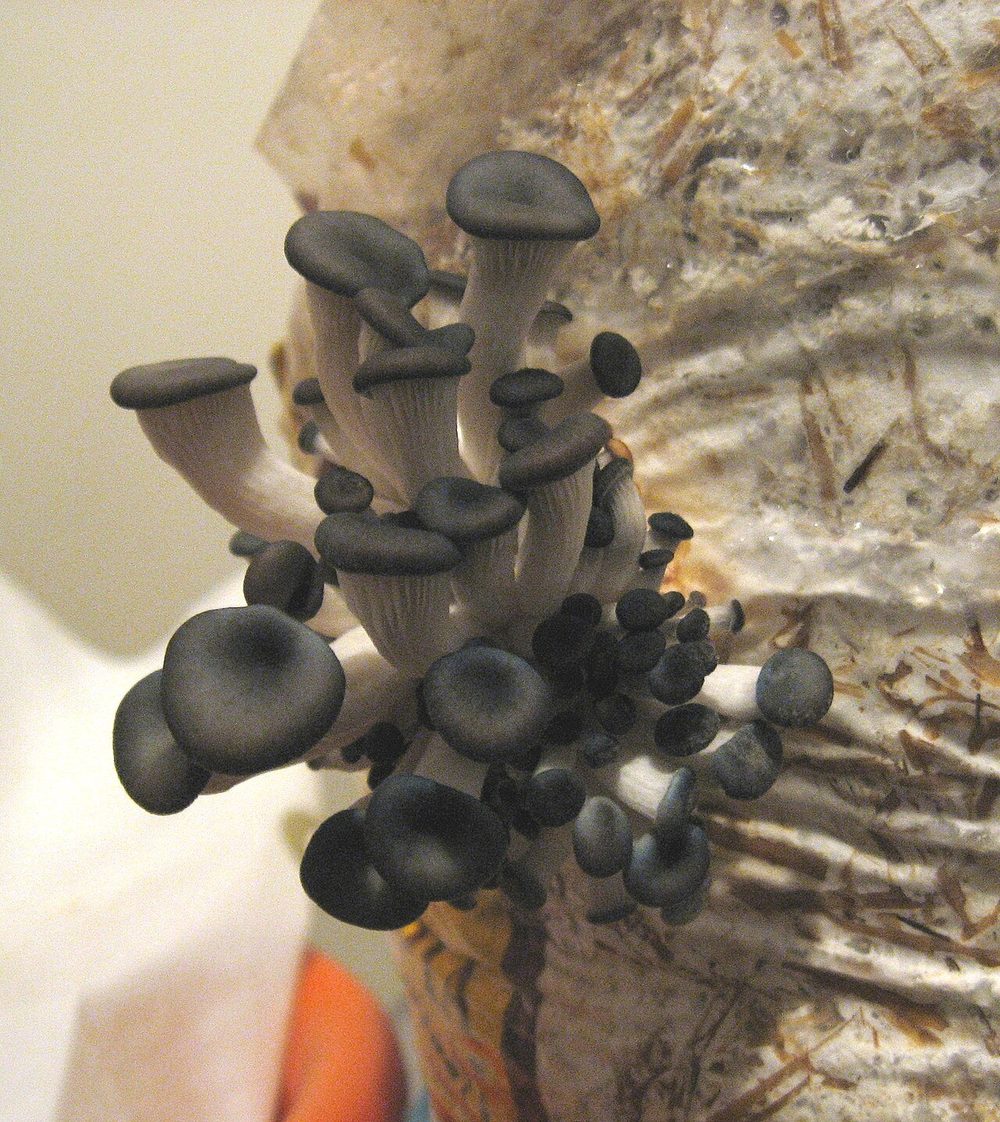
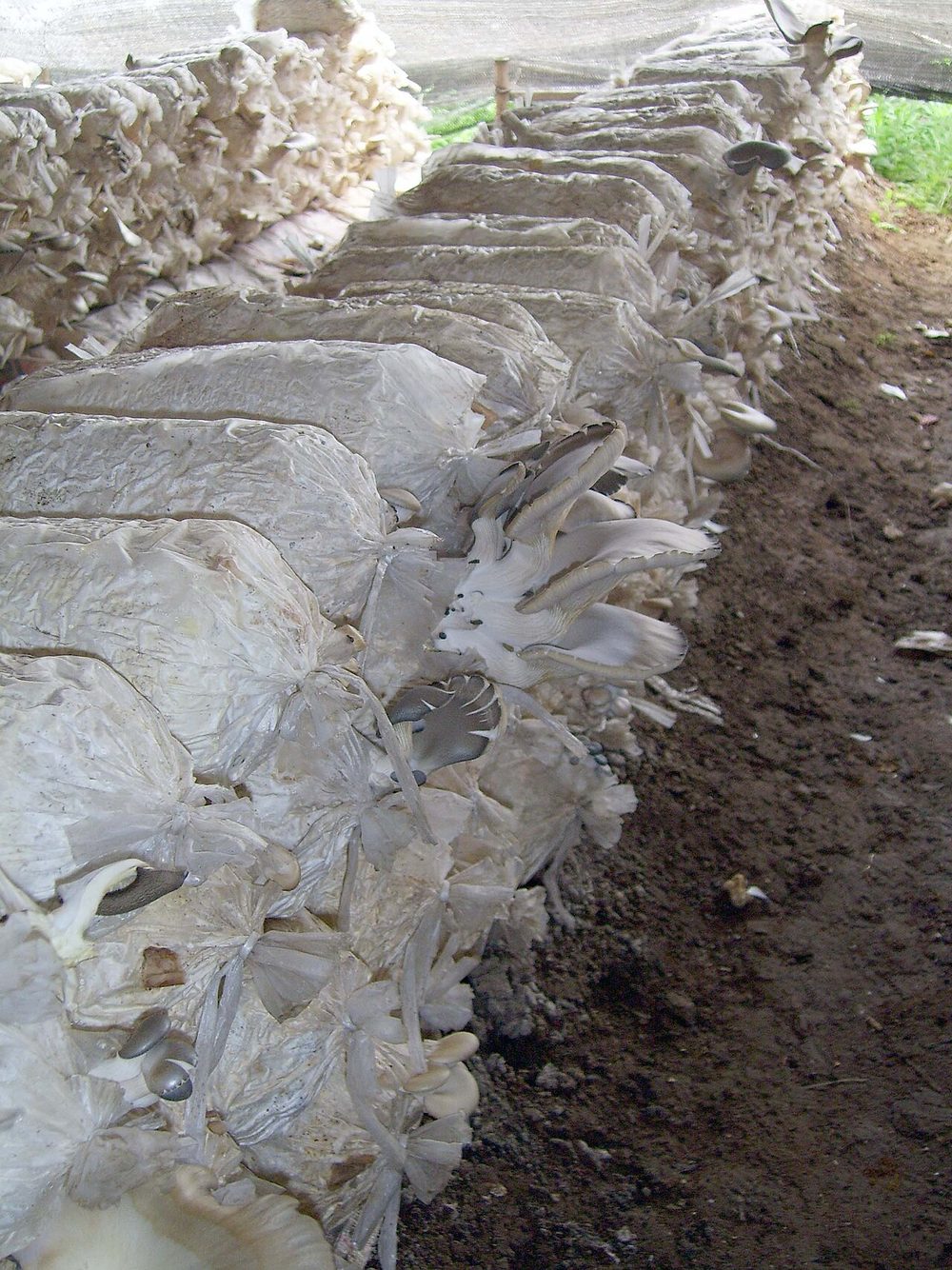
Humidity
Pins and young mushrooms dry out easily, so humidity is highest at the start and can ease a little as they grow. UC Cooperative Extension gives oyster 95% for pinning and 85 to 92% for cropping. Cornell's guide keeps it above 85% for the first four days, then says it may fall as low as 60% once pins have formed, though the 80s are ideal. ATTRA's 2026 guide aims for 85 to 95% through fruiting for most species.
Misting is not the same as humidity. UC's oyster schedule mists once or twice a day, to stop caps cracking and to keep resting pins alive. Mist settles on the block and the mushrooms; between mistings, the room's humidity is whatever the air holds. For a room, the sources turn to equipment: Cornell's guide says humidity is usually held with a humidifier switched by a humidistat or timer. The Cornell and Fungi Ally farm book lists home humidifiers, ultrasonic misters, atomizing nozzles, and wetting the floor and walls several times a day. ATTRA suggests light, frequent misting for small setups and humidifiers or foggers for rooms, always with air moving so surfaces do not stay wet.
Do not soak the mushrooms. Agromisa explains why: the mushroom is fed by a steady flow of moisture that only continues while water evaporates from its surface, so spraying maturing mushrooms, or air that is too humid, can spoil the crop. Mushrooms about to be picked should not be sprayed at all, because wet mushrooms keep far less well. The farm book adds that mushrooms soak up water like sponges and, kept wet, get diseases such as blotch, while lion's mane becomes waterlogged. Shiitake is the exception it names: it does well sprayed directly for its first four days.
| What you see | What it points to | Source |
|---|---|---|
| Caps cracking or splitting; pins that stall or wither | Air too dry | ATTRA; UC |
| Lion's mane in small dense lumps instead of long spines | Air too dry | ATTRA |
| Yellow patches or slimy spots on the mushrooms | Too humid, often with bacterial blotch | ATTRA |
| Water dripping from the ceiling or walls | Too humid, or too little air moving; fix both | ATTRA |
Fresh air and CO2
A mushroom breathes like we do: it takes in oxygen and gives off carbon dioxide (Cornell). In a closed room full of fruiting blocks, the farm book says it takes only about 10 minutes for CO2 to rise too high for proper fruiting. Fresh air brings it back down.
How low. UC holds oyster under 600 ppm while it pins and crops, and shiitake under 1,000 ppm while it crops. Cornell's guide keeps most species under 1,000 ppm and oyster under 800. The farm book gives the range by mushroom: oyster deforms above 800 ppm and fruiting can stop above 1,200, while shiitake, lion's mane and king oyster tolerate 1,000 to 1,300 ppm, and maitake and enoki can fruit well in high CO2.
How much air. The sources measure it two ways and do not agree exactly:
- UC: 4 to 6 air changes an hour for cropping oyster, 2 to 4 for shiitake.
- Cornell's guide: change all the air in the room every 5 to 10 minutes, which is 6 to 12 changes an hour. The farm book says at least every 10 minutes, and that for oyster, the more fresh air the better.
Our suggestion for a first grow: start at UC's rate, and add air if the stems run long or a CO2 reading climbs past the figure for your mushroom.
Cornell's guide prefers short, strong bursts: replace all the air in a minute or two rather than leave a small fan running. Its example is a 10 by 10 by 7 foot room, 700 cubic feet, with a 720 CFM fan run for 60 seconds about every 7 minutes. Most growers fit an intake fan and an exhaust fan and time them together. ATTRA adds that fresh air should come in low and stale air leave high. Kurtzman's review of mushroom ventilation argues the other way where fans only blow air in or the air is still: carbon dioxide is heavier than air, so it should leave below the lowest shelf (his observations are from button mushroom rooms). The CO2 and fresh air page sets out both. For a tent or a few bags, ATTRA cracks the bags open, cuts small slits in the blocks, or opens the tent flaps during the day, with a small oscillating fan for gentle movement and never a direct blast. To size a fan for your own room, use the air exchange calculator.
What too little air looks like. Oyster mushrooms grow long stems and small caps (Cornell; ATTRA; Agromisa). ATTRA adds fuzzy, misshapen lion's mane, a musty smell that lingers, and condensation building on surfaces.
Light
Mushrooms do not make food from light, but they use it as a signal, and too little gives the same long stems and small caps as too little air (Cornell; farm book). The amount needed is modest and the sources put it in different ways:
- Enough to read by. Cornell's guide: if a book can be read comfortably in the room, the light is enough. Agromisa gives growers' rule of thumb of enough to read a newspaper anywhere in the room.
- In lux. ATTRA: about 500 to 1,000 lux for most species, on a 12-hour cycle. UC: oyster responds best to about 2,000 lux for 12 hours a day.
- Hours. The farm book runs 18 hours on and 6 off, longer than the 12 hours ATTRA and UC give.
No particular colour of light is needed; ordinary shop lights or LED strips do the job (Cornell). Keep hot, direct sun off the blocks, because it dries the surface (ATTRA). With no light at all, Agromisa says oyster mushrooms grow stalks with no caps, in a branching shape like coral.
Temperature
Oyster pins form cooler than they grow: UC gives 55 to 60°F for pinning and 60 to 64°F for cropping. Cornell's guide puts the best room for most species at 62 to 65°F, and notes that a basement holds 50 to 65°F with little heating or cooling. Below 50 to 55°F many species slow sharply; above 75°F many give fewer and poorer mushrooms. Cooler rooms fruit more slowly but give a meatier mushroom; warmer rooms give thinner ones that pass their best quickly.
Match the mushroom to the season. Rather than heat or cool the room, Cornell suggests switching what you grow: pearl or blue oyster (Pleurotus ostreatus) in fall, winter and spring, and phoenix oyster (P. pulmonarius) in summer. Agromisa gives the same advice for the same reason: a mushroom that fruits near the outdoor temperature needs less climate control and less energy. ATTRA's fruiting ranges for other mushrooms: pink oyster 70 to 85°F, chestnut 60 to 70°F, enoki 45 to 60°F, reishi 75 to 85°F.
| Mushroom | Temperature and humidity | Fresh air and light | Source |
|---|---|---|---|
| Shiitake, blocks and logs | 59 to 68°F; 95% humidity to start pins, 85 to 90% while cropping | 2 to 4 air changes an hour, CO2 under 1,000 ppm while cropping; natural daylight, or about 10 lux of 370 to 420 nm light | UC, pp. 48 and 53 |
| King oyster | 10 to 15°C (50 to 59°F); 80 to 85% humidity | Air not given; 800 to 1,000 lux for 5 hours a day | ICAR-DMR, king oyster method |
| Lion's mane | 60 to 68°F; high humidity, and especially sensitive to dry air | Too little air gives fuzzy, misshapen fruit; benefits from steady light | ATTRA, pp. 12 and 13 |
The figures for lion's mane are thinner than for oyster and shiitake in the sources we read; ATTRA gives its needs in words rather than numbers apart from temperature.
Why humidity and fresh air fight
Every air change swaps the room's damp air for outside air, at the outside air's temperature and moisture. Cornell's guide tells growers to allow for what fresh air does to humidity and temperature, and ATTRA's advice runs the same way: if mushrooms dry after you increase the airflow, increase the misting or humidification.
Warming air makes the problem bigger. Air holds more water when it is warm, so cold outside air that is damp outdoors becomes dry once it warms to room temperature. As a worked example (our arithmetic, from the standard relation between temperature and water vapour): air at 40°F and 80% humidity, warmed to 62°F, falls to about 35% humidity. A fruiting room wants 85% or more, so in winter each air change brings in air that has to have water added before the mushrooms see it. The humidity and VPD page explains the drying power of air in more detail.
Summer turns it around. Air at 85°F and 60% humidity has a dew point near 70°F (again our arithmetic), so cooling it to 62°F wrings water out of it: on the cooling coil, which dries the room, or on cold walls and ceilings, which drip. Cornell's example of 100°F outside air in a room held at 65 to 70°F makes the same point about the cooling load.
What the sources do about it:
- Exchange air in short, strong bursts on a timer, with intake and exhaust fans running together (Cornell).
- Run the humidifier on a humidistat, so it answers what the air is doing (Cornell).
- Shade the air intakes and keep direct sun off the space (ATTRA).
- Condition the smallest space you can and seal drafts, so that temperature, humidity and airflow work together (ATTRA).
- Grow for the season, so the outside air is closer to what the room needs (Cornell; Agromisa).
The numbers behind sizing a humidifier against the fresh air a room needs are thinly covered in the sources we have found; a separate page will set out what is known, with our own reasoning marked as ours.
From pins to harvest
For oyster, UC gives 7 to 14 days for pins to form, and Agromisa three to four days after the bag is opened. Agromisa gives five days to harvest at 15 to 20°C (59 to 68°F), or two to three days at higher temperatures. Agromisa adds that strains, substrates and rooms vary so much that these are guides, not schedules.
UC picks oyster just before the curled-under edge of the cap flattens out. After the first flush the block rests and fruits again: UC gives about 10 days between flushes over a 5 to 7 week cropping period, and UF/IFAS expects 2 to 4 more flushes after the first, depending on the strain and the room. Keep misting through the rest, because UC's misting also keeps resting pins alive. Picking, cooling and storing are on the harvest and storage page.
Measuring it
The signs in the tables above appear on the mushrooms after the air has already gone wrong. A humidity sensor and a CO2 sensor show it while it is happening, and they are the two readings this page turns on. Two cautions from the makers' own datasheets:
- Humidity sensors and wet air. Sensirion rates its SHT31 from 0 to 100% but says it performs best between 20 and 80%, and that long exposure above 80% can offset its reading for a while (its example: 3% after 60 hours). A fruiting room is above 80% all the time. The temperature and humidity sensors page gives each part's rating and how to check a sensor against a reference.
- CO2 sensors and wet air. Sensirion rates its SCD4x CO2 sensors for 0 to 95% humidity, non-condensing. The CO2 and air sensors page has the rest.
None of these ratings covers a sensor that gets wet. Our advice, not a maker's: mount the sensors at the height of the blocks, out of the path of the mist and away from the humidifier's outlet, so they read the air the mushrooms are in. A CO2 controller can run the exhaust fan from the CO2 reading instead of a timer.
Before and after this step
Sources
- University of California Cooperative Extension. 2011. Cultivating Mushrooms on Small Farms (slides). Conditions by stage for oyster (pp. 27, 29, 34) and shiitake (pp. 45, 48, 53): humidity, temperature, CO2, air changes, light, misting, harvest stage, flush interval.
- Cornell Small Farms Program. Methods of Commercial Mushroom Cultivation in the Northeastern United States: 2. Seven Stages of Cultivation. Initiation by species, shiitake soaking and chilling, the four fruiting conditions, the fan example, seasonal strains.
- Crosby, W. (Fungi Ally) and S. Gabriel (Cornell Small Farms Program). 2021. Specialty Mushroom Farm Book. Northeast SARE. Creating a fruiting room: humidity, misting equipment, CO2 by mushroom, light hours, temperature.
- Soto-Velez, G. 2026. Mushroom Cultivation (IP677). ATTRA, National Center for Appropriate Technology. Humidity range and signs (p. 12), light, fresh air and small setups, temperatures by species (p. 13), spores (p. 7).
- Liao, H.-L., C.-M. Hsu, K. Hameed and V. T. Cotter. 2018, revised 2025. D.I.Y. FunGuide: Grow Your Own Oyster Mushrooms at Home (SL448). UF/IFAS Extension. When a straw bag is ready, the fruiting chamber, flushes.
- Oei, P., with B. van Nieuwenhuijzen. 2005. Small-scale mushroom cultivation (Agrodok 40). Agromisa Foundation and CTA. What triggers fruiting and the cold shock (p. 12), choosing a mushroom for your temperatures (p. 12), opening bags, light, humidity and harvest timing (pp. 48 to 50).
- ICAR-Directorate of Mushroom Research, Solan. 2020. Technologies Developed by ICAR-DMR for Commercial Use. King oyster cropping conditions (p. 27).
- Kurtzman, R. H. Jr. 2010. Ventilation for mushroom cultivation: the importance of the needs of mushrooms and of the gas laws. Micologia Aplicada International 22(2): 63 to 78. Where stale air should leave (pp. 75 to 76).
- Sensirion. SHT3x-DIS datasheet, version 7, December 2022. Humidity range and the offset above 80%. The SCD4x rating is cited on the CO2 and air sensors page.
Frequently asked questions.
How much humidity do mushrooms need to fruit?
High, and highest at the start. UC Cooperative Extension gives oyster mushrooms 95% relative humidity while pins form and 85 to 92% while they grow; for shiitake, 95% to start and 85 to 90% while cropping. Cornell Small Farms keeps it above 85% for the first four days after initiation. ATTRA aims for 85 to 95% through fruiting for most species.
How often should I mist my mushroom grow bag?
UC Cooperative Extension mists oyster mushrooms once or twice a day until they reach 30 to 40% of harvest size, and keeps misting to stop caps cracking. ATTRA suggests light, frequent misting rather than soaking. Do not spray mushrooms that are nearly ready to pick: Agromisa says wet mushrooms keep far less well. Misting wets surfaces; to hold the room itself at fruiting humidity, the sources use a humidifier on a humidistat or timer.
Why are my oyster mushrooms long and skinny with small caps?
Usually too much carbon dioxide, too little light, or both. Cornell Small Farms says that when CO2 is high, oyster mushrooms form long stems and little caps, and that low light gives the same shape. Its guide keeps oyster below 800 ppm; UC Cooperative Extension gives under 600 ppm. Increase the fresh air, and make sure the room is bright enough to read in.
Do mushrooms need light to grow?
Yes, for most cultivated mushrooms while they fruit, though not much. Cornell Small Farms says light enough to read a book by is sufficient. ATTRA gives about 500 to 1,000 lux on a 12-hour cycle; UC Cooperative Extension gives about 2,000 lux for 12 hours a day for oyster. Agromisa says oyster mushrooms grown in complete darkness form stalks with no caps.
How much fresh air do mushrooms need?
Enough to keep carbon dioxide down: under 600 ppm for oyster in UC Cooperative Extension's figures, and under 1,000 ppm for most species in Cornell Small Farms' guide. UC gives 4 to 6 air changes an hour for cropping oyster; Cornell changes all the air every 5 to 10 minutes, and finds a short strong burst better than a small fan left running.
What temperature do oyster mushrooms fruit at?
UC Cooperative Extension gives 55 to 60 F for pins to form and 60 to 64 F while they grow. Cornell Small Farms puts the best fruiting room for most species at 62 to 65 F. Strains differ: ATTRA gives blue oyster 55 to 65 F and pink oyster 70 to 85 F, and Cornell suggests phoenix oyster for summer.
Why are my mushroom pins not growing?
Dry air is the first thing to check. ATTRA says pins stall or wither when the air is too dry, and Cornell Small Farms calls the first four days after initiation the most critical for humidity, keeping it above 85%. UC Cooperative Extension keeps misting partly to keep resting pins alive. Too little fresh air and the wrong temperature for the strain are the next things to rule out.
Why do my mushroom caps crack?
Cracked or split caps point to air that is too dry (ATTRA). UC Cooperative Extension mists oyster mushrooms regularly while they crop to prevent caps cracking. If the caps dry after you increase the airflow, ATTRA advises increasing the misting or humidification to match.