

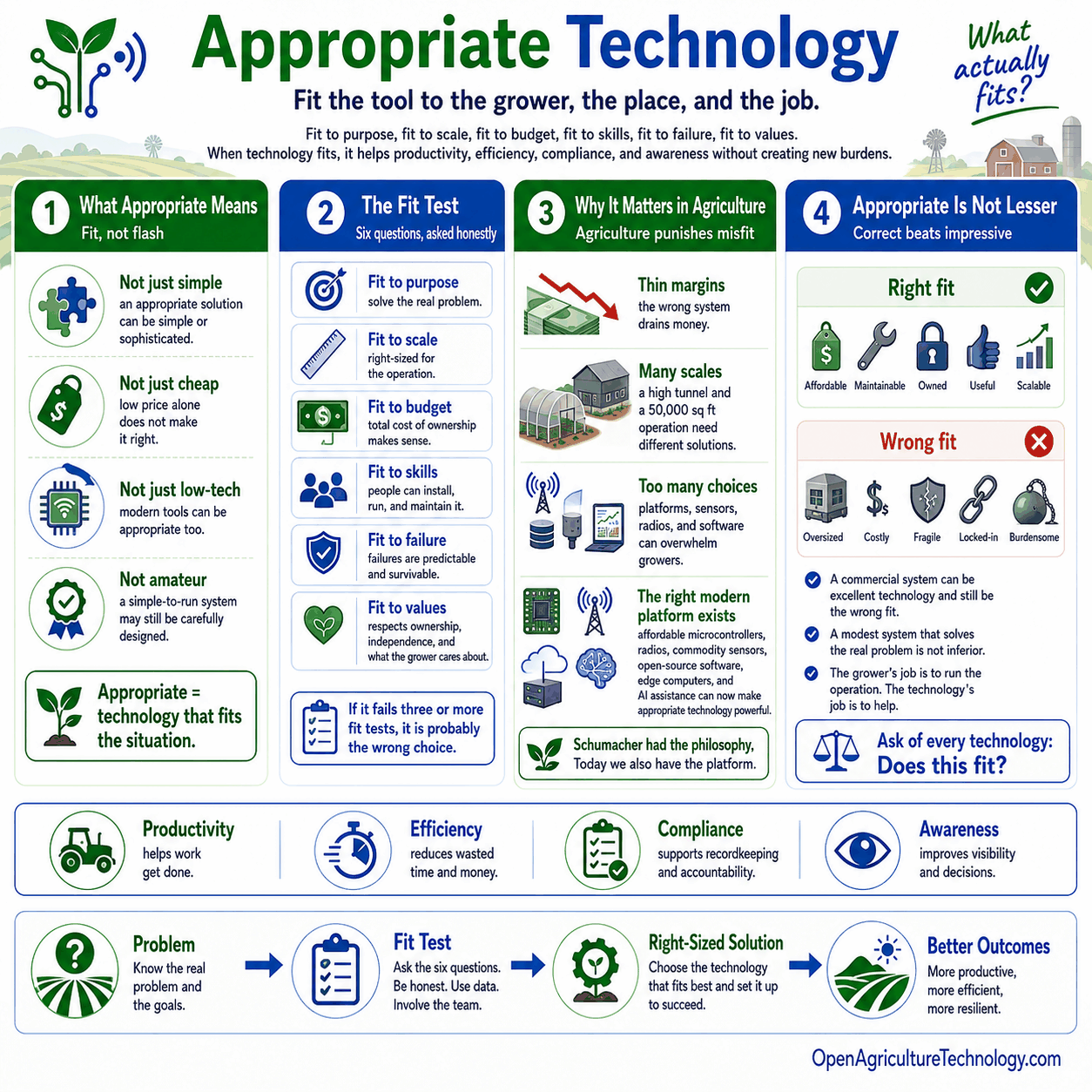
Appropriate use of technology in the appropriate place. Fit to purpose, fit to scale, fit to budget, fit to skills, fit to failure, fit to values. When technology fits, it serves productivity, efficiency, compliance, and awareness without creating new burdens. When technology does not fit, it takes more than it gives.
01What the word appropriate actually means.
The word appropriate is used here in a specific sense. It is worth stating clearly what that sense includes, and what it does not.
Appropriate does not mean simple. An appropriate solution can be a twenty-dollar sensor or a hundred-thousand-dollar climate system. The cost and complexity are not the criteria. The criterion is fit to the situation.
Appropriate does not mean cheap. Cheap is sometimes appropriate and sometimes not. A cheap sensor that gives unreliable readings in a humid environment is not appropriate, even though it is inexpensive. An expensive sensor in a situation that does not need that precision is not appropriate, even though it would work well technically. Price is one variable. Fit is the evaluation.
Appropriate does not mean low-tech. Appropriate technology uses whatever technology actually fits. Some of the tools in a collective-built monitoring system (an ESP32 microcontroller, a digital humidity sensor, a software platform running on a small computer) represent decades of accumulated engineering. They are not primitive. They are appropriate, which is a different thing.
Appropriate does not mean amateur. A system that is simple to operate is not necessarily simple to design. Designing a minimal system can be harder than designing a maximal one: you have to understand the constraints well enough to know what to leave out, not just what to add.
What appropriate does mean: the technology fits the situation. It does the job at a cost the operation can afford. It can be installed by people the operation actually has. It can be maintained by people the operation will actually keep. It fails in ways the operation can survive. It does not require capabilities the operation does not possess. It serves productivity, efficiency, compliance, and awareness (the reasons technology exists in agriculture in the first place) without creating new burdens that cancel those benefits.
That is the standard: the conditions in the paragraph above. A technology that meets them is appropriate to the situation. One that misses them is not.
02Where the idea came from.
The concept of appropriate technology has a history. It did not start with agriculture and it did not start in the twenty-first century. Knowing where it came from helps understand why it matters.
In 1973 an economist named E.F. Schumacher published a book called Small Is Beautiful: A Study of Economics as if People Mattered. Schumacher had spent decades working on development economics: the question of how wealthy nations should help poorer ones improve their conditions. He had watched the standard answer being implemented around the world and had become convinced it was failing.
The standard answer was to export advanced industrial technology from wealthy countries to poorer ones. Build large factories. Install modern equipment. Electrify. Mechanize. The assumption was that the poorer country would become like the wealthier one, just on a delay.
Schumacher observed that this rarely worked. The advanced technology was expensive. It required infrastructure the receiving country did not have: reliable electricity, trained technicians, supply chains for spare parts, financial systems that could handle the capital requirements. It often required workers with education levels and skills that were not widely available. When any of these prerequisites failed, the technology sat idle.
Meanwhile, advanced technology displaced the traditional economy. A factory employed a hundred people while putting a thousand local craftspeople out of work. A mechanized operation made food cheaper for urban populations while making rural subsistence impossible. The result, Schumacher argued, was not development. It was the creation of what he called dual economies, where a small modern sector served by advanced technology coexisted with a much larger population that had been made poorer by the disruption.
His alternative was what he called intermediate technology. Technology that was more productive than what the poorer country had before, but affordable, repairable, and suitable to the conditions on the ground. Tools that local people could build, use, and maintain. A factory making egg cartons by hand-pressed paper pulp, employing thirty local workers, made more sense for a rural region than an imported machine that employed three and put thousands of small egg producers out of business.
Schumacher was not nostalgic for poverty. He was arguing that technology should serve the people using it, fit the place where it was being used, and respect the economic and social fabric it entered. He called this appropriate technology. The idea spread. Organizations formed around it. The US Congress funded a National Center for Appropriate Technology in 1976. For a while, it looked like a movement.
Then the idea lost steam in the 1980s and 1990s, partly because appropriate technology was widely misunderstood as inferior technology. Critics said the appropriate technology movement wanted to keep poor regions poor by denying them advanced tools. That was not what Schumacher had argued, but the misreading stuck. The movement faded from prominence.
What did not fade was the underlying observation. The standard pattern (advanced technology exported without regard for fit) kept producing the results Schumacher had predicted. Dual economies. Disruption without development. Tools that sat idle because they did not match the context. And the people on the ground (growers, small manufacturers, rural communities, the majority of the world's population) kept being priced out of the technology that was supposed to help them.
Schumacher wrote one sentence that captures the whole idea as well as anything since:
Any intelligent fool can make things bigger, more complex, and more violent. It takes a touch of genius, and a lot of courage, to move in the opposite direction.
That sentence sits over this site's whole purpose. Moving in the opposite direction does not mean moving backward. It means resisting the assumption that bigger and more complex is automatically better, and asking the harder question: what actually fits?
03What Schumacher did not have.
Schumacher had the philosophy. He did not have the platform. The appropriate technology movement of the 1970s was limited by the tools available in the 1970s. Hand-pressed paper pulp. Treadle pumps. Solar cookers. Bicycle-driven generators. All of them real, all of them valuable in context, but all of them constrained by the era's hardware.
What he did not have, because it did not yet exist:
Microcontrollers that cost a few dollars, made by the billion, that can run for years on a pair of batteries.
Radio chips that can reach miles with almost no power draw, making wireless sensor networks possible in places where no wired infrastructure exists.
Open-source software platforms used in millions of deployments worldwide, maintained by communities of thousands of contributors, free for anyone to use and modify.
A global internet capable of sharing designs, documentation, and working configurations at essentially zero cost to anyone who needs them.
Commodity sensor modules (temperature, humidity, light, carbon dioxide, soil moisture, water flow) that cost a few dollars each and match or exceed the precision of laboratory instruments from twenty years ago.
Small computers the size of a paperback book that can coordinate hundreds of sensors, run rich automations, store years of historical data, and operate on the power budget of a desk lamp. The old computer you retired from your desk a few years ago can do this. It is already paid for.
Artificial intelligence systems capable of helping a grower translate their question into technical guidance without needing a consultant to sit beside them.
Each of those tools, on its own, is remarkable. The combination (affordable microcontrollers plus long-range radios plus open-source software plus a global knowledge network plus commodity sensors plus capable edge computers plus AI assistance) makes appropriate agricultural technology more powerful than anything the 1970s movement could have imagined. The philosophy Schumacher articulated fifty years ago has finally met the platform it needed.
This is not going backward. This is going forward, with the grower at the center, using tools that finally fit what the grower actually needs.
04The fit test.
A concrete way to evaluate whether a piece of technology is appropriate for a specific situation: run it through the fit test. Six questions, asked honestly.
Fit to purpose.
Does this technology solve the problem the grower actually has? A grower losing crops to overnight temperature swings needs temperature alarms, not an analytics dashboard. A grower trying to document spray compliance needs logging, not real-time control. Matching the technology to the specific problem (not to the general category of the problem) is the first fit question.
Fit to scale.
Does the cost and complexity match the size of the operation? A system designed for fifty thousand square feet of production will cost too much, take too long to install, and require too much ongoing attention when applied to five hundred square feet. A system designed for five hundred square feet will not have the reliability or redundancy a fifty-thousand-square-foot operation needs. Scale matters, and technology has to be right-sized to it.
Fit to budget.
Not just the purchase cost. The total cost of ownership over the life of the system, including subscriptions, service contracts, replacement parts, and the grower's time. A system that costs nothing upfront and two hundred dollars a month is ten thousand dollars over four years. A system that costs three hundred dollars upfront and nothing ongoing is three hundred dollars over four years. Both are real costs. The grower needs to see both honestly before deciding.
Fit to skills.
Can the people who will operate and maintain this system actually do so? A commercial system that requires certified technicians does not fit an operation that does not have a service contract with one. A DIY system that requires embedded-software debugging does not fit an operation whose people do not have those skills. The collective approach tries to sit between those extremes (production-grade reliability that a motivated grower can learn to maintain with shared knowledge) but it still requires some engagement. The fit-to-skills question is about matching technology to the people who will actually use it.
Fit to failure.
What happens when the system breaks, and can the operation survive it? Every system will eventually fail. Sensors drift. Batteries die. Internet connections drop. Companies change pricing. Hardware ages out. The grower who installs technology without thinking about failure modes discovers, at the worst possible moment, that their monitoring depended on something they could not control. Appropriate technology has predictable, survivable failure modes. Inappropriate technology fails in ways that take the operation down with it.
Fit to values.
Some growers care about owning their data. Some care about supporting open-source communities. Some care about being able to hand their system to their kids. Some care about minimizing vendor dependencies. Some do not care about any of this and just want the thing to work. Values are legitimate criteria. A grower who deeply values ownership of their operation should not be persuaded into a technology that removes that ownership, even if the technology works technically. Appropriate fits values as well as function.
A technology that passes all six fit tests is appropriate for that grower, that operation, that situation. A technology that fails one or two of them might still be the right choice in specific circumstances. Fit is not always perfect. A technology that fails three or more of them is almost certainly inappropriate, and the grower who installs it anyway is setting up a future problem.
05Why this matters specifically in agriculture.
Agriculture has always been a domain where technology has to fit. A tractor that cannot navigate a specific field is useless. A greenhouse design that does not suit a local climate fails. A cold-chain system that relies on constant grid power is fragile in regions where grid power is not constant. Growers have always known, in their bones, that tools have to fit the job.
What has changed is that the pace of new agricultural technology has accelerated to the point where evaluating fit is harder than it has ever been. A grower today faces dozens of IoT platforms, hundreds of sensor products, multiple communication standards, competing software ecosystems, and marketing claims that often overstate capabilities. The decision about what to install is no longer a once-a-decade capital choice. It is a continuous evaluation problem, and most growers do not have time to become technology evaluators in addition to growing food.
Meanwhile the economics of agriculture have tightened. Margins on most crops are thin. The gap between large operations that can afford enterprise-grade systems and small operations that cannot has widened. Many of the most interesting agricultural innovations (precise irrigation, accurate climate control, data-driven nutrient management, traceability systems for regulatory compliance) are locked behind price points that exclude most of the growers who would benefit most.
Appropriate technology addresses this directly. It is not an ideology or a movement label. It is a practical discipline for matching the tools to the job, at a cost the job can absorb, with an ownership model that respects the grower. When applied to agricultural monitoring and control, it takes the form of open-source software running on commodity hardware, configured using knowledge shared through a collective of growers, educators, and makers. That is the OpenAgTech approach. It is not new in principle. It is the latest expression of a fifty-year-old philosophy, finally equipped with the tools it needed all along.
06Appropriate is not a lesser word.
The most common misunderstanding of appropriate technology is that appropriate means lesser. The critic says: you are offering small growers a cheap alternative to real technology. You are telling them to make do with less because you assume they cannot have more.
This is the opposite of what appropriate technology argues.
A system that fits the grower's operation, that the grower can afford, that the grower can maintain, that gives the grower real-time visibility into their crop, that alerts them when something is wrong, that logs their data for compliance and analysis, that survives a vendor closing or a subscription price increase, and that the grower owns end to end, that system is not inferior to a fifty-thousand-dollar commercial installation. It is different. It is appropriate to the grower's situation in a way the commercial installation would not be.
The inferior choice would be the commercial system in that grower's operation: a system that cost too much, took too long to install, required a service contract the grower could not afford, locked in a vendor relationship the grower did not want, and produced data the grower did not own. The commercial system is excellent technology. Installed in the wrong context, it becomes the inferior choice.
Appropriate is not lesser. It is correct. And in the grower's own operation, correct beats impressive.
07How the collective applies appropriate technology.
Every piece of knowledge on this site, every configuration shared through the collective, every conversation between members, all of it is filtered through the appropriate technology lens.
When a member of the collective documents a monitoring configuration, the documentation names what the configuration fits. Not just the hardware and the software: the kind of operation, the scale, the climate, the failure modes the configuration tolerates. A grower reading the documentation can see whether their situation matches before committing.
When the collective evaluates a new sensor or a new piece of hardware, the question is not whether the technology is impressive. The question is what situations it fits. A sensor that is cheap and reliable in dry indoor environments but fails in high humidity gets documented with that context clearly stated. A grower in a dry climate can use the sensor confidently. A grower in a greenhouse ignores it.
When a member contributes a guide or a crop profile, the collective asks the same question: for whom is this appropriate? A guide to managing a ten-thousand-square-foot lettuce operation is useful to growers at that scale and educational for others. A guide to managing a single high tunnel is useful to growers at that scale and educational for others. The collective does not pretend every solution fits every grower. It helps each grower find solutions that fit them.
The result is a knowledge base organized around fit. A reader who understands the appropriate technology lens can navigate the site productively from the first visit. A reader who does not understand the lens can still use the site, but the lens is what makes the knowledge transferable. Once a grower internalizes the idea that technology has to fit, every specific solution becomes easier to evaluate, not just the ones on this site, but anything the grower encounters anywhere.
That transfer is the real goal. If a grower learns one thing from this site, let it be the habit of asking, about every technology: does this fit?
08The shortest version.
Appropriate use of technology in the appropriate place. Fit to purpose, fit to scale, fit to budget, fit to skills, fit to failure, fit to values. When technology fits, it serves productivity, efficiency, compliance, and awareness without creating new burdens. When technology does not fit, it takes more than it gives.
The grower's job is to run their operation. The technology's job is to help. Technology that does not help is not appropriate, regardless of how advanced or impressive it appears. Technology that does help is appropriate, regardless of how simple or familiar it is.
That is the whole lesson. Everything else on this site is an application of it.
Frequently asked questions.
What is appropriate technology?
Appropriate technology is technology that fits its context: the place, the purpose, the people using it, the budget, the scale, and the failure modes the situation can tolerate. A technology is not good or bad on its own; it is appropriate or inappropriate to a specific situation. The concept was articulated by economist E.F. Schumacher in 1973 and applies to any tool or system, agricultural or otherwise.
Does appropriate technology mean low-tech?
No. Appropriate technology is whatever actually fits the situation. Some appropriate solutions use advanced microcontrollers, long-range radios, and sophisticated software. Others use simple mechanical devices. The criterion is fit, not sophistication. Modern open-source hardware and software make appropriate technology more powerful than the 1970s movement could have imagined.
Who coined the term appropriate technology?
E.F. Schumacher popularized the concept in his 1973 book Small Is Beautiful. He originally called it intermediate technology. The idea grew from his work in development economics, where he observed that advanced industrial technology exported to poorer regions often failed to produce development and sometimes made conditions worse. The National Center for Appropriate Technology was founded in the United States in 1976 to advance the idea.
What are the criteria for evaluating whether a technology is appropriate?
Six fit tests: fit to purpose (does it solve the actual problem), fit to scale (does cost and complexity match operation size), fit to budget (total cost of ownership over the life of the system), fit to skills (can the available people operate and maintain it), fit to failure (are failure modes survivable), and fit to values (does it respect ownership, data rights, and other things the grower cares about). A technology that passes all six is appropriate for that situation.
Is appropriate technology inferior to commercial technology?
No. A system that fits an operation, solves its real problems, can be maintained by the people who run it, and costs what the operation can afford is not inferior. It is correct for that context. A commercial system installed in an operation that cannot sustain it is the inferior choice in that context, despite being excellent technology. Appropriateness is about fit, not about quality.
Why did the appropriate technology movement lose momentum in the 1980s?
Partly because appropriate technology was widely misunderstood as inferior technology. Critics argued that focusing on simple tools kept poor regions poor. That was a misreading of Schumacher, but it stuck. The movement also lacked the hardware and software platforms that make the idea practical today: open-source ecosystems, commodity microcontrollers, and global knowledge networks did not yet exist.
Why does appropriate technology matter in agriculture specifically?
Agricultural margins are thin, operations vary enormously in scale and context, and the pace of new agricultural technology has accelerated past most growers' ability to evaluate fit. The gap between large operations that can afford enterprise systems and small operations that cannot has widened. Appropriate technology provides a practical discipline for matching tools to situations at a cost each situation can absorb.
How do you apply appropriate technology when choosing farm tools?
Match each tool to the situation before adopting it. Document what a given solution assumes: the operation type, scale, climate, and how much failure it can tolerate, then confirm it fits all of them rather than assuming one solution fits every grower. The skill is transferable, because a grower who learns to evaluate fit can apply that habit to any technology later, not only to a single source's recommendations.
Put it to work
The cheapest way to understand appropriate technology is to build a small piece of it: one sensor, one reading, landing somewhere you own.