
01Why this page exists.
A grower looking for monitoring and control technology meets a wide range of options that can look alike at a glance. A sixty-thousand-dollar commercial control system and a twenty-dollar Bluetooth (BLE) temperature sensor can both be described as "monitoring your greenhouse," yet they are different kinds of thing, built for different operations, at different costs.
The categories can look alike at a glance, and any product's own materials naturally lead with what it does best, so the work of telling the categories apart falls to the buyer. A grower who can name the four shapes can place any product in context and judge whether it fits; a grower who can't may end up with something that doesn't match the operation, or pay for more than they need.
So this page maps the landscape. It lays out four broad shapes of technology, what each does well, what each costs, and the kind of operation each fits, so you can weigh any product by how well it solves your problem, at a cost you can afford, with a level of ownership and upkeep you can sustain. Sometimes the answer is a commercial system; sometimes a subscription product; sometimes a handful of sensors and a small computer. Knowing which is which is what this page shares.
We'll also be upfront about where we stand. Across these four shapes, Open Agriculture Technology favors the ones that keep your data and your control in your own hands, that conviction runs through this site, and we think the case is strong. It isn't the right call for everyone, and we'll say plainly where each of the other shapes fits better. There's nothing here to sell you; the point is to lay out the whole landscape, our view included, so you can decide for your own operation.
02The four shapes of agricultural technology.
Most of what a grower will encounter falls into four broad shapes. The lines aren't perfectly clean, a few products straddle them, but each shape has its own economic logic and its own best fit.
1. Legacy commercial control systems.
The established brands that have run commercial horticulture for decades: industrial hardware often rated to last fifteen to twenty years, climate algorithms refined over many years of commercial use, and a technician who drives out when something breaks. It is proprietary end to end, the hardware, the software, and usually the data stay with the vendor, on annual service contracts.
Fits: large, standardized operations where downtime costs thousands an hour and having the vendor carry the liability is worth it. Trade-off: you don't own the system or the data, and you can't change how it behaves without the vendor.
2. IoT (internet-of-things) subscription products.
The newer wave: sensors paired with a phone app, usually set up within an hour. The hardware is typically inexpensive upfront, with the ongoing cost carried by a monthly or annual subscription that funds the app, cloud storage, and support. Many work well for what they promise.
Fits: growers who want a vendor to carry the load, turnkey setup, support to call, nothing to maintain or learn, and don't mind a recurring bill or vendor-held data. For a time-strapped grower, that convenience is often well worth the cost, and many of these products run for years without trouble. Trade-off: you rent rather than own, the hardware usually stops working if the subscription lapses, the data lives on the vendor's cloud, ten years of fees can total several times an owned system, and if the company folds the cloud service can go with it.
3. Do-it-yourself.
Not a product category, a practice. With some time, curiosity, and patience, a grower can build a monitoring system from open components for a few hundred dollars and learn a great deal doing it.
Fits: makers, students, and technically-inclined growers who enjoy the building. Trade-off: your time, up front and ongoing, and no one to call when something breaks at midnight.
4. The open, community approach.
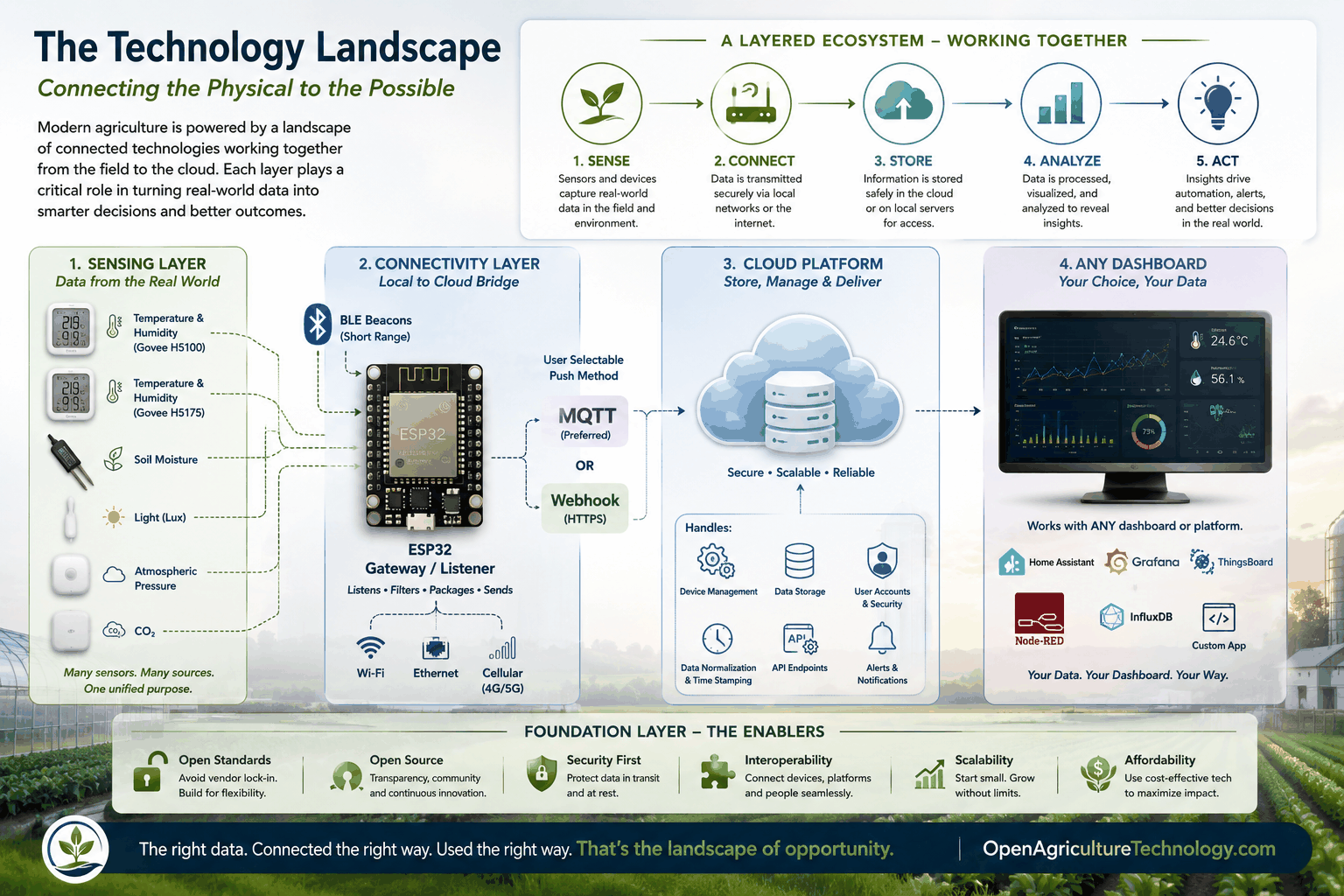
Off-the-shelf hardware paired with open-source software, software whose code is free to use, run, and modify, rather than a single vendor's product. One common example, Home Assistant, is a free open-source platform used widely in homes and small businesses; it runs on a small computer the grower owns. Configurations are shared in open grower communities, so common setups don't have to be rebuilt from scratch. The data stays on the grower's own equipment in open, documented file formats, and the only ongoing cost is the electricity for the small computer plus the occasional replacement sensor; there is no subscription.
Fits: small and mid-scale growers who want to own their system at low cost and don't mind some hands-on involvement (community members and independent consultants can help). Trade-off: it takes technical engagement to set up and maintain; a grower who needs a vendor on call, or who runs a very large, critical operation, is better served by shape 1.
03Comparing the shapes.
| Legacy commercial | IoT subscription | DIY | Open / community | |
|---|---|---|---|---|
| Who owns the hardware | vendor-specific; you own it but can't service it alone | you own it, but it's useless without the subscription | you own it, source parts directly | you own it, source parts directly |
| Who owns the data | usually the vendor | the vendor's cloud | you, readable and exportable | you, exportable in open formats |
| If the company folds | service ends; parts may dry up | often stops working | nothing changes | nothing changes |
| Upfront (small op) | $10k–100k | $50–500 hardware | $100–500 parts | $100–500 + a small computer |
| Ongoing per year | $2k–10k service | $100–600 | ~$0 (parts) | ~$0 (parts + power) |
| Time to running | weeks–months | hours | days–weeks | hours–days (shared configs) |
| Customization | vendor only | little to none | unlimited | unlimited, from shared starting points |
| Reliability | very high, when serviced | good; depends on the company | depends on you | high (mature open software) |
The cost figures on this page are rough estimates as of 2026, drawn from typical retail component prices and published service-contract ranges; your region, scale, and suppliers will move them. Treat them as ballparks for comparison, not quotes.
04Which shape fits you.
No shape is best for everyone; the fit depends on the operation, so here's an honest guide, our own lean included. A commercial system suits large, standardized sites where downtime is costly. A subscription suits growers who want turnkey simplicity and don't mind a recurring bill. DIY suits those who enjoy building. The open, community approach, the one Open Agriculture Technology favors and builds around, suits growers who want to own their system at low cost and don't mind some hands-on involvement. A few questions usually point to the fit:
- How critical is the monitoring? A six-figure crop on the line leans commercial; a meaningful but recoverable loss fits a subscription or the community approach; pure convenience fits DIY.
- What's the ten-year cost? Capital plus ten years of fees. As a rough comparison: a $200 + $30/month subscription is about $3,800 over ten years; an open, community build runs roughly $300–$1,500 in parts depending on sensor count, plus a little electricity; a commercial system runs into the tens of thousands. Each makes sense for a different operation.
- How much does ownership matter? If vendor-held data is fine as long as the app works, two shapes stay open. If you want to own every byte, two shapes drop out.
- What happens when it breaks? If you can troubleshoot it yourself, DIY or the community approach works; if you need someone to call, commercial or subscription works.
- How custom is the operation? A standardized single-crop greenhouse fits commercial and subscription assumptions; a mix of crops, structures, and workflows leans DIY or the community approach.
Real operations often mix shapes, a commercial system on the main production houses, a community-built rig on the propagation room, the curing room, and the well pump. The four are tools, not teams; use the right one for each job.
05A note on the vendors we haven't named.
This page describes shapes, not brands, on purpose. Every category includes companies that serve growers well in the right context, and the goal is to give you a framework you can apply to any product, not to praise or criticize particular ones. When you read a review, it is judging a specific vendor; the open, community approach isn't a product at all but a pattern you can build with different parts, at different scales. Either way the question is the same: how does a given product fit my operation, my budget, my need to own it, and my capacity to maintain it?
Frequently asked questions.
Short answers.
What are the types of agricultural monitoring?
Agricultural monitoring and control technology divides into four broad categories: legacy commercial control systems that serve large operations with proprietary hardware and service contracts, subscription-based IoT products that offer turnkey solutions for ongoing fees, do-it-yourself systems built by makers using open components, and the open, community approach that combines commodity hardware, mature open-source software, and shared knowledge so the grower owns everything.
Which type of agricultural monitoring system is best?
No single type is universally best; each fits a different kind of operation. A large commercial greenhouse often needs a legacy commercial system. A small grower who wants a turnkey solution may prefer a subscription product. A technical grower who enjoys building may prefer do-it-yourself. A grower who wants ownership at low cost and can do some hands-on setup may prefer an open-source community system. Budget, operation size, need for ownership, and technical capacity determine which one fits.
How much does the open, community approach cost?
Upfront hardware cost for a small-to-mid-scale community-built system typically runs three hundred to fifteen hundred US dollars. It depends on your needs and the size of your operation. Software is free. Ongoing costs are electricity for a small computer (less than five dollars a month in most regions) plus occasional replacement parts. There are no subscriptions or service contracts.
How much do subscription IoT products cost over time?
Subscription IoT products have low upfront costs, typically fifty to five hundred US dollars in hardware, but ongoing subscription fees typically run one hundred to six hundred dollars per year. Over ten years, a typical subscription's fees can add up to several times the one-time cost of a comparable owned system, depending on the subscription price and how long you keep it. The trade-off is simplicity and vendor support.
What happens to subscription IoT products if the company closes?
It depends on the product. Some subscription IoT products are partially usable without the cloud service, but most lose significant functionality and some stop working entirely. The grower's monitoring can disappear overnight if the company changes pricing, gets acquired, or shuts down. Growers relying on subscription products should understand this risk before committing to one for critical operations.
How can I compare agricultural monitoring products objectively?
Use a framework you can apply to any product rather than relying on brand reputation. Sort products into broad categories (legacy commercial systems, subscription IoT products, do-it-yourself builds, and open-source community systems), then judge a specific product on how well it fits your operation's scale, budget, ownership needs, and failure tolerance. A grower who understands the categories can evaluate any product on its merits without vendor bias.
Is the open, community approach hard to set up?
Setting up a basic open, community approach system (a small computer running Home Assistant, a handful of sensors, a simple dashboard) typically takes a few hours to a day using configurations the community shares. More sophisticated systems take longer but benefit from the same shared starting points. A grower who can follow a recipe can build a working system. Deeper customization requires more engagement, but is not required to get started. There are additional methods some don’t require a computer on site and push data to Google spreadsheets or to a cloud platform - all choices to fit the need appropriately.
Can I combine different types of agricultural monitoring systems?
Yes. Many operations use combinations. A commercial system might handle climate control in the main production houses while an open-source community system monitors the propagation room, the well pump, or the cold storage. The categories are tools, and using the right tool for each job is the point.
Put it to work
You have seen the map. The fastest way to learn the terrain is to stand on one piece of it and build.