

01Why this lesson matters.
Most growers who set out to build or buy a monitoring system start by thinking about sensors. What do I want to measure? That is a natural first question, but it is the wrong first question. The first question is: where does the device need to live, and what power source is available there?
A sensor that needs to report temperature from the middle of a field four hundred meters from the nearest outlet faces an entirely different power problem than a sensor reporting temperature from inside a greenhouse with outlets on every pole. The sensors themselves may be identical. The power architecture will be completely different. One might run on two AA batteries for three years. The other plugs into a USB adapter and runs forever. Same job, different system, because the power context is different.
Getting power wrong is the most common way an agricultural monitoring project fails. The grower buys sensors, installs them where the crop actually needs monitoring, and discovers that the sensors die in a month because the batteries were never going to last at the reporting interval required, or discovers that the solar panel was undersized for the location, or discovers that the wall-powered device was installed in a place where the power gets cut every time maintenance runs the irrigation pump. Power is the foundation. Getting it right the first time saves enormous amounts of frustration later.
This lesson walks through the power options available for agricultural technology, what each one actually does, where each one fits, how to size each one correctly, and the common ways each one fails. A grower who finishes this page will know how to evaluate any specific device's power requirements against the reality of where it needs to be installed.
02Power basics for people who have avoided thinking about electricity.
Before getting into specific power sources, a quick tour of the concepts that matter. A grower who already understands voltage, current, and watts can skip to the next section. For everyone else, these are the numbers that will show up in every conversation about powering a device.
Voltage.
Voltage is the pressure that pushes electricity through a wire. Measured in volts, abbreviated V. Wall outlets in North America deliver 120 volts alternating current (120 VAC). In Europe and most of the world, wall outlets deliver 230 or 240 volts alternating current. A typical battery delivers somewhere between 1.5 volts (a standard AA) and 12 volts (a car battery). Electronics almost always run on lower voltages: 3.3 volts or 5 volts is typical for a microcontroller. A power supply converts wall voltage to whatever voltage the device needs.
Current.
Current is how much electricity is flowing at any given moment. Measured in amps (A) or, for small devices, milliamps (mA). A thousand milliamps equals one amp. A small sensor might draw ten milliamps when active and less than one milliamp when sleeping. A wall outlet can typically deliver fifteen to twenty amps of current, far more than any sensor will ever need.
Watts.
Watts are voltage multiplied by current. This is the unit that matters most for thinking about power consumption over time. A device that runs at 5 volts and draws 200 milliamps uses one watt. Watts are what your electric bill charges for, what solar panels are rated in, and what power supplies are rated to deliver. If a device uses one watt continuously, it consumes 24 watt-hours per day or about 8,760 watt-hours (8.76 kilowatt-hours) per year.
Alternating current (AC) and direct current (DC).
Wall power is alternating current: the voltage reverses direction many times per second. Batteries, solar panels, and most electronics use direct current: the voltage flows in one direction. Nearly every device converts AC to DC somewhere in its power supply. When you plug a USB adapter into a wall, the adapter is doing this conversion. When you run a device off a battery, you skip the conversion because batteries are already DC.
Duty cycle.
The percentage of time a device is active versus sleeping. A sensor that wakes up once every ten minutes, takes a reading in two seconds, and goes back to sleep has a duty cycle of 2/600 or about 0.3 percent. A sensor reporting constantly has a duty cycle of 100 percent. Duty cycle matters enormously for battery life. The same sensor that runs for three years on batteries at a 0.3 percent duty cycle might last two weeks at 100 percent.
Amp-hours (Ah) and watt-hours (Wh).
These are the standard ways to express battery capacity. An amp-hour is how much current a battery can deliver for one hour: a 10 Ah battery can deliver 10 amps for 1 hour, or 1 amp for 10 hours, or 0.01 amps (10 mA) for 1,000 hours. Watt-hours are amp-hours multiplied by voltage. A 12 volt, 10 Ah battery has 120 watt-hours of energy. Knowing watt-hours for both your battery and your device's consumption lets you calculate how long the battery will last.
With those concepts in hand, the power options make more sense.
03Wall power.
When wall power is available, use it. A device plugged into a wall outlet through a good power supply runs indefinitely, wakes up instantly when it needs to, reports data as frequently as desired, and costs almost nothing to operate. A typical sensor or microcontroller running continuously consumes between half a watt and two watts. At US electricity rates of about twelve cents per kilowatt-hour, that is one to three dollars per year. At European rates of about thirty cents per kilowatt-hour, three to eight dollars per year. Operational cost is effectively zero.
Wall power is appropriate anywhere outlets exist and the device will stay in one place. Greenhouses, indoor grows, barns, pump houses, container farms, packing rooms, equipment sheds, and anywhere with building electrical infrastructure. The practical limit is the reach of an extension cord or the cost of running new wire. If a grower would be comfortable plugging in a clock radio at the sensor location, wall power is the right answer.
Power supplies: getting it right.
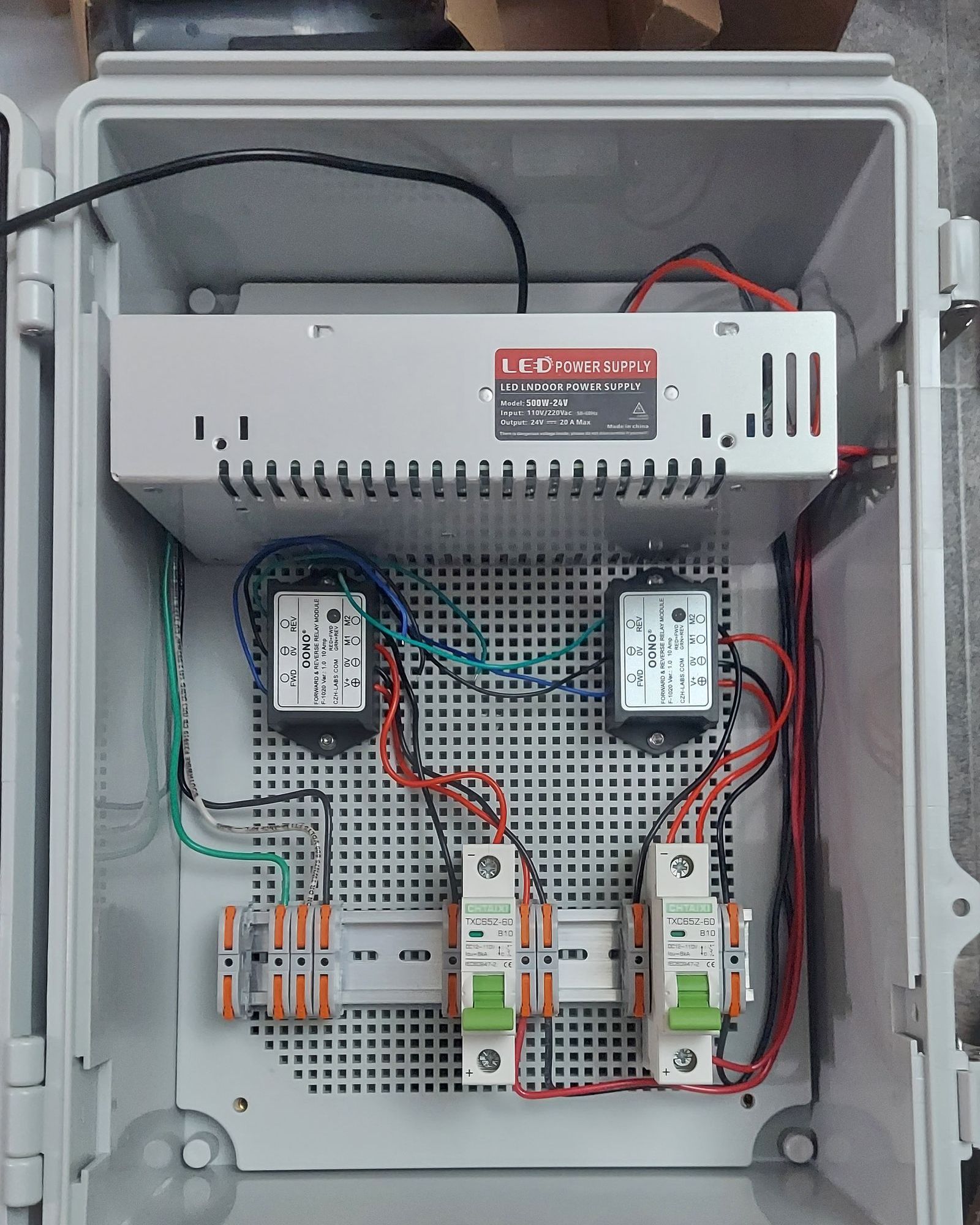
Wall-powered devices need a power supply to convert the wall voltage to whatever the device needs. This sounds simple, and for good devices it is: they come with a power supply, you plug it in, you are done. But for devices that do not come with a specific power supply, or for custom-built systems, choosing the right supply matters.
Three things define a power supply: output voltage, maximum output current, and whether the voltage is regulated. A device that needs 5 volts at up to 500 milliamps will work fine with a regulated 5-volt supply rated at 1 amp or more. It will not work correctly with an unregulated supply whose voltage sags under load, even if the label says 5 volts. It will probably fail immediately if connected to a 12-volt supply by mistake. Reading the device's actual power requirements (not guessing from the connector shape) matters.
USB as a power standard.
Most low-power agricultural electronics now use USB for power. USB-A, USB-B, USB-C, and micro-USB connectors all deliver 5 volts at varying current levels. Standard USB delivers up to 500 milliamps (older standard) or 900 milliamps (USB 3), USB-C power delivery can deliver much more. A standard USB wall adapter is a fine power supply for most ESP32-based sensors, small Raspberry Pi computers (with the right adapter), and many low-power devices. A phone charger often works for small agricultural sensors, though higher-amperage chargers are safer for devices that need the current.
Power-line noise and interference.
Agricultural environments often have electrical noise from pumps, motors, variable-speed drives, and fluorescent lighting. This noise can affect sensitive electronics, causing false readings, resets, or outright failures. A sensor plugged into the same circuit as a large irrigation pump may work fine for months and then start showing strange behavior whenever the pump runs. Symptoms include random reboots, data dropouts, and readings that shift during pump cycles. Solutions range from using a different circuit to adding filter capacitors to using a small uninterruptible power supply to isolate the device. For critical monitoring, isolating the sensor's power from the heavy equipment is often worth doing.
What wall power does not solve.
Wall power does not help when the wall power goes out. A grower who monitors a greenhouse with a wall-powered system and loses power to the greenhouse loses the monitoring at the same moment they most need it, during an outage that might be damaging the crop. For critical alerts, a small battery backup on the monitoring device or gateway keeps the alerts flowing when the grid fails. This is covered below under the uninterruptible power supply section.
04Battery power.
When wall power is not available, batteries are the next option. A battery-powered sensor can go anywhere: the middle of a field, a remote greenhouse, a mobile platform, the top of a pole, inside a storage container. The device is self-contained, installation is fast, and as long as the battery lasts, the device reports data. Battery life depends entirely on how much power the device uses, how often it wakes up, and how cold it gets.
Battery chemistry matters.
Not all batteries are equal. The chemistry determines how long the battery lasts, how it behaves in cold and heat, how much energy it stores per unit of weight, and how much it costs.
Alkaline batteries (the standard AA, AAA, C, D, 9V cells in the kitchen drawer) are cheap, widely available, and fine for devices that do not need to run long. They lose significant capacity below freezing, self-discharge over years in storage, and cannot be recharged. A single AA alkaline holds about 2.5 watt-hours of usable energy at room temperature, less when cold.
Lithium primary cells (non-rechargeable, often lithium thionyl chloride, often called LiSOCl2) are the workhorse of remote sensors. They hold more energy per unit weight than alkaline, keep most of their capacity in cold conditions, have very low self-discharge (under one percent per year), and can deliver energy for twenty or more years from a single cell. They are more expensive than alkaline but the cost is justified when the sensor needs to run for years without maintenance. Most commercial long-life outdoor sensors use lithium primaries.
Lithium-ion rechargeable cells (the kind in phones and laptops) hold a lot of energy per unit weight but do not love temperature extremes. In cold conditions (below freezing), they lose capacity quickly. In heat (above forty degrees Celsius or one hundred four degrees Fahrenheit), they age faster and can fail catastrophically in rare cases. They are ideal for solar-powered installations in moderate climates and become problematic in harsh outdoor environments.
Sealed lead-acid (SLA) batteries are heavy and bulky but very tolerant of harsh conditions. They work well for larger installations (a monitoring station with solar panels) and are nearly always what small off-grid systems use. SLA batteries last three to five years in outdoor applications, less in extreme heat. Their energy per unit weight is low, so they are impractical for small portable sensors.
Lithium iron phosphate (LiFePO4 or LFP) batteries are the newer option for larger installations. They handle temperature extremes better than lithium-ion, last ten to fifteen years with proper management, and have become affordable. They have largely replaced SLA in new solar installations where the extra cost can be absorbed.
Calculating how long a battery will last.
This is the question every battery-powered installation has to answer. The calculation is not complicated, but it requires honest data about the device's power consumption and the duty cycle it will actually run at.
Step one: find the device's current draw when active and when sleeping. The datasheet usually lists this. An ESP32-based sensor might draw 80 milliamps when transmitting, 10 milliamps when active but idle, and 10 microamps (0.01 milliamps) when in deep sleep. Those three numbers span four orders of magnitude.
Step two: find how long the device spends in each mode. If the sensor wakes up once every fifteen minutes, transmits for one second, then goes back to deep sleep, the duty cycle for transmission is 1/900 or about 0.11 percent. The rest of the time is deep sleep.
Step three: calculate average current. 80 mA × 0.11 percent + 0.01 mA × 99.89 percent = 0.088 mA + 0.01 mA = roughly 0.1 mA average. This is why deep sleep matters so much. The device is effectively off almost all the time.
Step four: divide battery capacity by average current. A 2.5 watt-hour AA alkaline at 1.5 volts is about 1.67 amp-hours. At 0.1 mA average draw, that battery lasts 1,670 hours, or about 70 days. Not great. Switch to a lithium primary AA with 3 watt-hours and the life doubles. Move the reporting interval from 15 minutes to 1 hour and the duty cycle drops by a factor of four, extending life to a year or more. The numbers reveal the tradeoffs before the sensor is deployed.
Real-world tip: batteries never deliver the full rated capacity in actual use. Cold reduces capacity. High peak currents reduce effective capacity. Self-discharge over time reduces usable capacity. A conservative design assumes sixty to seventy percent of rated capacity is actually usable. If the math says a battery lasts 70 days, assume 50 days and plan accordingly.
What drains batteries fastest.
In order of severity: running the radio at high power for long periods, waking up frequently, operating in cold temperatures, having a device that does not properly sleep between readings, high-current sensors that need to stay powered constantly, and LEDs left on as indicators. Battery-powered sensor design is largely about minimizing each of these.
Signs a battery is failing.
Voltage drops over time: a fresh lithium primary reads close to its nominal voltage; as it depletes, the voltage gradually falls, then drops sharply near end of life. Most well-designed sensors report battery voltage as part of every data packet. A grower watching the voltage trend can see batteries coming due weeks before they fail. A sensor that suddenly goes offline after months of reliable reporting is usually a dead battery.
05Solar power.
Solar is how sensors live forever in the field. A small solar panel recharges a battery during daylight, the battery powers the device through the night, and the cycle repeats. A properly sized solar installation can run a sensor indefinitely without human intervention, the sensor lasts as long as its hardware does, which is typically five to ten years. For field sensors, remote greenhouses, off-grid monitoring stations, and any application where running wire is impractical, solar is usually the right answer.
What a solar power system includes.
A solar-powered device has four main components: the solar panel (converts sunlight to electricity), the battery (stores energy for nighttime and cloudy days), the charge controller (manages the flow between panel and battery, prevents overcharging and deep discharge), and the device itself (uses the stored energy). Small commercial solar sensor kits combine all four into a single weatherproof enclosure. Custom builds assemble the components separately, which offers flexibility but requires correct sizing.
Sizing a solar installation.
This is where most solar projects go wrong. A panel sized for a sunny summer day will fail in a cloudy November week. Correct sizing assumes the worst-case scenario the system needs to survive: typically the shortest day of the year with several consecutive cloudy days.
The sizing process: first, determine the device's average daily energy consumption in watt-hours. A sensor that averages 0.1 mA at 3.3 volts uses 0.33 milliwatts continuously, or about 0.008 watt-hours per day. A small computer running Home Assistant might use 5 watts continuously, or 120 watt-hours per day. These two systems have wildly different solar requirements.
Second, determine the worst-case solar hours available at the location. This is the number of hours per day of full-equivalent sunlight, averaged over the worst month. In Tennessee in December, it is about 2.5 hours. In Arizona in December, it is about 4.5 hours. In northern Europe in December, it is about 1 hour. The panel must generate the daily energy requirement in those worst-case hours.
Third, size the panel. A 10-watt panel in 2.5 solar hours generates 25 watt-hours per day. That is plenty for the 0.008 watt-hour sensor (three thousand times over), and far too little for the 120 watt-hour Home Assistant server. The server would need at least a 60-watt panel in the same conditions, and even that is marginal, designers typically multiply by 1.5 to 2 for safety, so a 100 to 120 watt panel is more realistic.
Fourth, size the battery. The battery must hold enough energy to run the device through the longest expected period without sun. For a sensor that uses 0.008 watt-hours per day, a 10 watt-hour battery runs it for over a thousand days. For the 120 watt-hour server, three cloudy days is 360 watt-hours of reserve, implying at least a 400 watt-hour battery, and typical design doubles that for battery longevity (LiFePO4 batteries last longer when not deeply discharged). So the server needs an 800 watt-hour battery, a real-sized battery, not a sensor-sized one.
Fifth, account for losses. Panels age (typically one to two percent per year). Charge controllers lose five to ten percent in conversion. Batteries do not discharge to zero without damage: lithium can go to twenty percent minimum; lead-acid should not go below fifty percent. Real-world installations deliver seventy to eighty percent of their nameplate capacity.
Seasonal and climate considerations.
Solar panels perform worst in winter when daylight is short, often cloudy, and the sun is low in the sky. They also perform worse in extreme heat. Panels lose about 0.4 percent of output per degree Celsius above twenty-five degrees. In desert climates, a panel can lose twenty percent of rated output simply because it is hot. Panel orientation matters: in the northern hemisphere, panels tilted toward the south at an angle roughly equal to the local latitude produce the most energy over a year. Panels that are flat, or oriented wrong, lose a significant fraction of their potential.
Shade is catastrophic.
A solar panel with even a small shadow on a corner can lose more than half its output. Shading one cell effectively limits the current through the whole panel. A tree branch that shades the panel for an hour in the morning can cost more energy than expected. Before installing a panel, walk the site at different times of day and different times of year. What is clear in July is often shaded in December as the sun angles lower.
Security and theft.
Solar panels are valuable and easy to steal. In remote locations, they are targets. Design accordingly: mount the panel where it is not visible from roads, secure it mechanically to the structure, and accept that in some locations, a solar installation will need replacement after theft every few years. Budget for the replacement.
06Power over Ethernet (POE).
Power over Ethernet delivers both data and electricity through a single Cat5 or Cat6 network cable. This is the answer for devices that need both network connectivity and power, which describes most small computers and IP cameras in agricultural installations. Run one cable, get both.
How POE works.
An Ethernet cable has four pairs of wires. Some pairs carry data; others can carry low-voltage DC power. A POE injector or a POE-capable network switch puts voltage on the power pairs; a POE-capable device at the far end uses the voltage. Standard POE delivers up to 15.4 watts at 48 volts. POE+ delivers up to 30 watts. POE++ delivers up to 90 watts, enough to run a small computer and peripherals.
Passive versus active POE.
Active POE follows the IEEE 802.3af, 802.3at, or 802.3bt standards. The injector or switch negotiates with the device, delivers the right voltage, and protects devices that do not support POE from getting voltage they cannot handle. Passive POE simply applies voltage to the cable at all times, regardless of what is connected. Passive POE is cheaper and simpler but dangerous: plugging a non-POE device into a passive POE line can damage the device. When in doubt, use active POE. It is safer and only marginally more expensive.
POE cable distance.
Standard Ethernet cable runs up to 100 meters (about 330 feet). POE voltage drop over long runs matters. At 48 volts and low currents, the drop is usually acceptable. For high-current devices at the full 100 meter distance, check the math: a Cat5 cable at 100 meters carrying 1 amp can drop 2 to 3 volts, which may push the device below its minimum operating voltage. Thicker cable (Cat6 or Cat6a) reduces the drop.
When POE makes sense.
POE is ideal for indoor installations where cable can be run: greenhouses, processing facilities, multi-building operations. A small computer running Home Assistant can live in an office or server closet, with POE-powered IP cameras, environmental sensors, and network gateways distributed throughout the facility. No separate power supplies, no wall adapters, one cable per device. Installation is clean and reliable.
When POE does not make sense.
Outdoor installations where running cable is difficult. Mobile or temporary setups. Single-device deployments where a USB adapter is simpler. Distances beyond 100 meters without a repeater.
07Combining power sources.
Real installations often combine multiple power sources. The hub that runs Home Assistant sits on wall power with a battery backup for outages. The greenhouse sensors run on USB adapters from wall outlets in the greenhouse. The field sensors run on lithium primary batteries. The remote gate sensor at the edge of the property runs on solar with a small battery. Each device uses what fits its location, and the whole system works together over the communication network (see Understanding Communications).
Uninterruptible Power Supply (UPS) for critical monitoring.
For the hub or gateway that coordinates everything, a small UPS is almost always worth the money. An affordable UPS with a 10-minute runtime at the device's load keeps the monitoring alive through brief outages and gives the device time to shut down cleanly if the outage extends. More importantly, the hub can keep receiving sensor data and sending alerts during a grid failure, exactly when the grower most needs to know what is happening. A greenhouse without power is losing climate control; the grower needs the alert to say so.
Battery backup for cellular gateways.
If the system uses cellular to send alerts outside the local network, the cellular modem needs to keep working during power outages. A small battery or solar arrangement on the modem ensures that even if the rest of the greenhouse is dark, the alerts still go out.
08Common power failure modes and how to prevent them.
Power failures are the most common cause of monitoring system failures. Recognizing the patterns before deployment prevents most of them.
Undersized solar panel.
System works fine in summer, fails in November. Prevention: size for the worst month, not the average.
Battery aging out.
System runs for years, then starts cutting out. Lithium primaries last long but eventually die; SLA batteries age out in three to five years. Prevention: track battery voltage as part of the monitoring data and replace proactively before failure.
Bad power supply.
Cheap no-name USB adapters fail or put out dirty power. Devices reset randomly or exhibit strange behavior. Prevention: use quality power supplies from reputable sources. The extra five dollars pays back fifty times in reliability.
Loose connections.
Screw terminals loosen over time with vibration and temperature cycling. Soldered joints crack. Prevention: check connections during commissioning, use locking connectors where available, and include connection inspection in annual maintenance.
Corrosion.
Agricultural environments are hard on connectors: humidity, salt spray, ammonia from greenhouse fertilizer programs. Prevention: use weatherproof connectors rated for the environment, apply dielectric grease at connection points, and locate devices in areas with less corrosion when possible.
Shared circuits with noisy equipment.
Monitoring device shares a circuit with an irrigation pump, and every pump cycle disrupts the monitoring. Prevention: put sensitive electronics on their own circuit, or use a small UPS to isolate them from grid noise.
Cold weather killing batteries.
A system that runs fine in summer fails in January when the batteries lose capacity. Prevention: choose battery chemistry appropriate for the expected temperatures, insulate enclosures where practical, or size the battery for cold-weather capacity rather than rated capacity.
Phantom loads.
LEDs, idle microcontrollers, and poorly-designed sleep modes slowly drain batteries when the device should be inactive. Prevention: measure actual current draw in every device state, not just active; eliminate unnecessary indicators; use proper deep-sleep modes.
09Rules of thumb for power decisions.
A few simplifications that make the decisions faster:
If wall power is available within reason, use it. It is almost always the right answer. Reach of an extension cord or an inexpensive cable run beats any battery calculation.
For portable or remote devices that need to run more than three months between battery changes, plan for lithium chemistry. Alkaline is fine for short deployments; lithium pays off in longer ones.
For anything that needs to run for years unattended in the field, solar is almost always the answer. Batteries alone eventually die. Solar plus a good battery can last the life of the hardware.
Size solar installations for the worst month, then multiply by 1.5 for safety. The failure mode of undersized solar is the same as no solar.
Always include a UPS on the system hub. The cost is trivial; the benefit during a grid outage is significant.
Measure actual power consumption before committing to a battery design. Datasheets lie by omission; real-world measurements reveal the truth.
When building a custom system, use quality power supplies. Cheap supplies are the most common cause of hard-to-diagnose problems.
Include battery voltage in every sensor's reported data. Trending battery voltage lets the grower replace batteries before they fail, not after.
Power architecture is not glamorous. It is also the foundation that determines whether the rest of the system works. Getting it right the first time is the decision that pays off most in any deployment.
Frequently asked questions.
What is voltage?
Voltage is the pressure that pushes electricity through a wire, measured in volts (V). Wall outlets in North America deliver 120 volts, and in most of the world they deliver 230 or 240 volts. Most electronics inside agricultural sensors run on much lower voltages: typically 3.3 or 5 volts, supplied by a power supply that converts wall voltage down.
What is current?
Current is how much electricity flows at any given moment, measured in amps (A) or milliamps (mA). One amp equals 1,000 milliamps. A small sensor might draw 10 milliamps when active and less than 1 milliamp when sleeping. Current is what batteries supply, and how much the device uses determines how long a battery lasts.
What is a watt?
A watt is voltage multiplied by current. It is the standard unit for measuring how much power a device uses. A device running at 5 volts and drawing 200 milliamps (0.2 amps) consumes one watt. Watts are what electricity bills charge for and what solar panels are rated to produce.
What is the difference between AC and DC?
AC stands for alternating current: the voltage reverses direction many times per second. Wall power is AC. DC stands for direct current: the voltage flows in one direction. Batteries, solar panels, and most electronics are DC. A power supply converts wall AC to the DC voltage a device needs.
What is an amp-hour?
An amp-hour (Ah) is a measure of battery capacity. A 10 amp-hour battery can deliver 10 amps for 1 hour, or 1 amp for 10 hours, or a much smaller current for a much longer time. A 100 milliamp-hour (mAh) battery can deliver 100 milliamps for 1 hour, or 10 milliamps for 10 hours. Amp-hours multiplied by battery voltage equals watt-hours, the more useful measure of total stored energy.
What is a duty cycle?
Duty cycle is the percentage of time a device is active versus sleeping. A sensor that wakes up for two seconds every 15 minutes has a duty cycle of about 0.2 percent. A sensor running continuously has a duty cycle of 100 percent. Duty cycle is the single most important factor in battery life: the same device might run for three years at 0.2 percent duty cycle or two weeks at 100 percent.
What is the best power source for agricultural sensors?
The best power source depends on where the sensor needs to live. Wall power is the best option anywhere an outlet is available: it is reliable, cheap to operate, and allows unlimited reporting frequency. Batteries are best for portable or remote sensors where wall power is impractical. Solar is best for field installations that need to run for years unattended. Power over Ethernet works well for networked devices in buildings with cable runs.
How long will a battery-powered sensor last?
Battery life depends on the battery capacity, the sensor's power consumption in each mode, and how often the sensor wakes up. A typical lithium-primary-AA-powered outdoor sensor reporting every 15 minutes can run for three to five years. The same sensor reporting every minute might last six months. The same sensor running constantly might last two weeks. Designing for low duty cycle is essential for long battery life.
What is the best battery for outdoor sensors?
Lithium primary cells (often lithium thionyl chloride, or LiSOCl2) are the standard for long-life outdoor sensors. They tolerate temperature extremes, hold most of their capacity in cold weather, have very low self-discharge, and can run sensors for years. They cost more than alkaline but the cost is justified when the sensor needs to run unattended. For rechargeable solar applications, lithium iron phosphate (LiFePO4) is the current best choice.
Why do alkaline batteries fail in cold weather?
Alkaline batteries lose significant capacity below freezing. The chemical reactions that produce current slow down at low temperatures, reducing both voltage and available energy. An alkaline battery that reads full at 20°C (68°F) may deliver only half its capacity at -10°C (14°F). Lithium batteries handle cold much better and are the right choice for outdoor winter installations.
Can I use rechargeable AA batteries in a sensor instead of alkaline?
Rechargeable AA batteries (NiMH chemistry) can work in some sensors, but the voltage is lower than alkaline: about 1.2 volts instead of 1.5 volts. Some devices work fine with the lower voltage and some do not. NiMH batteries also have higher self-discharge than alkaline, meaning they lose charge sitting on the shelf. For most agricultural sensors, lithium primaries outlast NiMH by far, and the cost difference is small over the life of the deployment.
How do I size a solar panel for a sensor?
Size the panel by calculating the device's daily energy consumption in watt-hours, dividing by the worst-case solar hours available at the location (typically the shortest, cloudiest month), and multiplying by 1.5 to 2 for safety. A sensor using 0.01 watt-hours per day in a location with 2.5 worst-case solar hours needs a panel that produces at least 0.004 watts in those hours: a 1-watt panel is more than enough. A small Home Assistant computer using 120 watt-hours per day needs a 100+ watt panel in the same conditions.
How big a battery do I need for a solar system?
The battery must hold enough energy to run the device through the longest expected period without sunlight: typically three to five cloudy days in most climates. Multiply the daily energy consumption by the number of reserve days, then multiply again by 1.5 to 2 so the battery is not deeply discharged (which shortens its life). A 120 watt-hour per day system with five days of reserve needs at least a 900 to 1,200 watt-hour battery.
Why did my solar-powered sensor stop working in winter?
The most common reason is that the solar panel was sized for summer conditions and is undersized for winter. In winter, days are shorter, the sun angle is lower, cloud cover is often more persistent, and many locations see fewer solar hours per day. A panel sized for 6 hours of summer sun may only receive 1 to 2 hours of winter-equivalent sun, producing a fraction of the energy the system needs. Correct sizing assumes the worst month, not the average.
Does shade affect solar panels?
Yes, dramatically. Even a small shadow on a corner of a panel can cut output by more than half. This is because the cells in a panel are wired in series, and the shaded cell limits the current through the whole string. Partial shade from a tree branch, a building edge, or a pole can be devastating. Always check for shade at different times of day and different times of year before installing a panel.
How long do solar panels last in agricultural environments?
Quality solar panels typically last 20 to 25 years, losing about 0.5 to 1 percent of output per year. In agricultural environments with dust, ammonia from fertilizer, bird droppings, and occasional physical damage, the practical life is often shorter. Periodic cleaning restores most lost output. Panels also underperform in extreme heat, losing about 0.4 percent of output per degree Celsius above 25°C.
How much electricity does a small monitoring system use?
A typical small agricultural monitoring system (a Home Assistant computer, a network switch, a few wall-powered sensors, a wireless gateway) draws 10 to 20 watts continuously. That is 240 to 480 watt-hours per day, or 7 to 14 kilowatt-hours per month. At US electricity rates of about 12 cents per kilowatt-hour, that is less than $2 per month. At European rates of about 30 cents per kilowatt-hour, $2 to $4 per month.
Do I need a special power supply for agricultural sensors?
Most modern low-power agricultural electronics use standard USB power, so a quality USB wall adapter works for most devices. Choose a regulated supply rated for at least the device's maximum current draw. Avoid cheap no-name adapters: they are the most common cause of hard-to-diagnose problems. A phone charger from a reputable manufacturer is usually fine for small sensors; larger devices or custom builds may need specific voltage and current ratings that the device's documentation specifies.
Why does my sensor reset when the irrigation pump runs?
Electrical noise from large motors can propagate through shared circuits and disrupt sensitive electronics. The pump turning on creates a voltage dip and high-frequency noise that some power supplies cannot filter. Solutions: put the sensor on a different circuit, add a small uninterruptible power supply to isolate the sensor, or use a better power supply with more filtering. For critical monitoring, keeping sensitive electronics on their own electrical circuit is worth doing.
Do I need a UPS (Uninterruptible Power Supply) for my monitoring system?
For the central hub or gateway of a monitoring system, yes, a small UPS is almost always worth the money. An affordable UPS keeps the monitoring alive through brief outages and allows alerts to fire during a grid failure, which is exactly when a grower most needs to know what is happening. For individual sensors, a UPS is usually overkill; battery-backed sensors handle their own outage resilience.
What is Power over Ethernet?
Power over Ethernet (POE) delivers both data and electricity through a single Ethernet cable. A POE-capable network switch or injector puts voltage on unused wire pairs; a POE-capable device at the far end uses the voltage to run itself. Standard POE delivers up to 15.4 watts; POE+ delivers up to 30 watts; POE++ delivers up to 90 watts. POE is ideal for networked devices in buildings where cable can be run.
What is the difference between active and passive POE?
Active POE follows standards (IEEE 802.3af, 802.3at, 802.3bt) that include a negotiation between the switch and the device to ensure the right voltage is delivered and non-POE devices are not damaged. Passive POE simply puts voltage on the cable at all times, regardless of what is connected. Passive POE can damage devices that do not support it. Active POE is safer and only marginally more expensive; use it whenever possible.
How far can POE run over an Ethernet cable?
Standard Ethernet specifies a maximum cable length of 100 meters (about 330 feet). Within that distance, active POE works reliably for most devices. At longer distances, voltage drop becomes significant: a thin cable carrying high current over 100 meters can drop 2 to 3 volts, which may push the device below its operating minimum. For longer runs, use thicker cable (Cat6a or better) or add a POE extender in the middle.
How much does it cost to power an agricultural monitoring system?
Operating costs are minimal for most small-to-mid-scale systems. Wall power for a typical Home Assistant-based monitoring system is a small monthly cost in electricity. Battery replacement for field sensors is a small cost per sensor over a multi-year interval. Solar systems have almost no operating cost once installed but do require occasional battery replacement (every 5 to 15 years depending on chemistry). Total power operating cost for a small farm monitoring system is typically a few tens of dollars per year.
How much does a good solar power system for a sensor cost?
A small solar-powered sensor package (panel, battery, charge controller, enclosure) is moderately priced, with size and quality driving the cost. A larger solar installation capable of running a small computer with multiple days of battery reserve is a sizable investment. Prices have dropped significantly over the past decade; solar is now affordable for applications that would have been cost-prohibitive ten years ago.
What does a UPS cost?
A small consumer UPS suitable for protecting a monitoring hub and network equipment costs a modest amount at retail. Capacity is measured in volt-amps (VA) or watts; a 350 to 750 VA unit is plenty for a Home Assistant computer plus a small switch. Higher-capacity UPS units cost proportionally more. The battery inside a UPS typically lasts 3 to 5 years before needing replacement.
Why is my sensor's battery dying faster than expected?
The most common causes: the sensor is reporting more often than designed, the device is not entering proper deep sleep between readings, the environment is much colder than the original design assumptions, or the battery was already partially depleted when installed. Check the actual current draw in each operating state, verify that deep sleep is working correctly, and track battery voltage over time to see the real discharge curve.
Why do solar lights and sensors stop working after a year or two?
Most cheap consumer solar products fail for one of three reasons: the battery inside is cheap and degrades quickly (often after just 300 to 500 charge cycles), the panel is low quality and loses output rapidly, or the charge controller is inadequate and damages the battery through overcharging or deep discharge. Higher-quality components cost more but last ten times longer. Agricultural applications benefit from quality components, not consumer-grade packages.
How do I know if a battery is going bad?
Track the battery voltage as part of the regular sensor data. A healthy battery shows a gradual voltage decline over months or years, with a more rapid drop near end of life. A battery that consistently reads lower than expected, drops voltage quickly under load, or recovers slowly after waking the device from sleep is aging. Many sensors can be configured to alert when battery voltage crosses a threshold: set that threshold high enough to give replacement lead time.
What happens if I put the wrong power supply on a device?
It depends on how wrong. A supply with too low a voltage may run the device in a degraded state or not at all. A supply with too high a voltage may damage or destroy the device immediately. A supply with correct voltage but insufficient current may cause the device to reset under load. A regulated supply protects against voltage variations; an unregulated supply may cause problems under varying load. Always match the supply to the device's specified requirements.
How does cold weather affect agricultural sensors?
Cold reduces battery capacity, slows electronic response times, can cause LCD displays to respond slowly or go blank, and may affect the accuracy of certain sensor types. Alkaline batteries lose significant capacity below freezing; lithium batteries handle cold much better. Liquid-electrolyte batteries (like lead-acid) can freeze and be destroyed. Design sensors for the coldest temperature they will actually see, not the average.
How does heat affect solar panels and batteries?
Solar panels lose about 0.4 percent of rated output per degree Celsius above 25°C (77°F). In a desert climate where panel surface temperatures can reach 60°C (140°F) or more, panels can lose 15 to 20 percent of their output. Batteries age faster at high temperatures: lithium-ion batteries at 40°C degrade about twice as fast as at 25°C. Shade the battery enclosure from direct sun when possible, and choose battery chemistry (like LiFePO4) that tolerates heat better.
Can I use the same monitoring system in a humid greenhouse and a dry field?
The sensors themselves may be the same, but the power architecture often differs. A greenhouse usually has wall power available, so sensors can plug in. A dry field does not, so sensors need batteries or solar. Humidity also affects sensor accuracy and connector reliability, so enclosures, weatherproofing, and connector choices matter more in humid environments. The wireless layer can change too: Wi-Fi works in a greenhouse but not across long field distances, where a long-range radio is needed.
Is more power always better?
No. Oversized power systems cost more, weigh more, take up more space, and are often wasteful. The goal is to size power for the actual need with a reasonable safety margin. A field sensor drawing a fraction of a watt does not need a 50-watt solar panel. A monitoring hub drawing 5 watts does not need a 20-amp power supply. Matching the power source to the actual requirement is appropriate technology applied to electricity.
Can I run a monitoring system on a car battery?
Yes, car batteries are commonly used for off-grid monitoring. Deep-cycle marine or RV batteries are better than automotive starting batteries for this purpose, because they are designed for long slow discharges rather than short high-current bursts. Lead-acid batteries need a solar panel and charge controller sized for the load to stay charged. Lithium iron phosphate batteries have largely replaced lead-acid in new off-grid installations because they last longer and handle discharge better.
Is wireless power practical for agricultural sensors?
Not yet for most applications. Wireless power transfer (charging pads, resonant induction, radio-frequency harvesting) works over very short distances or at very low power levels. A sensor that needs a few milliwatts can sometimes harvest ambient RF energy or solar energy from indirect light, and these systems are beginning to appear in research. For practical field sensors, batteries and solar remain the dominant solutions.
Put it to work
Power is where a build gets real, and it is the one place this site asks you to read the safety page first. It is short.