
01Why this lesson matters.
Communications is the second foundational decision after power. A grower who gets power right but picks the wrong communication technology ends up with sensors that work but cannot reach anything, or sensors that drain their batteries in weeks because the radio is wrong for the job, or a system that works beautifully inside the greenhouse and fails the moment the operation extends into the surrounding field.
The variety of radio technologies available today is a gift and a source of confusion. Twenty years ago the choices were few and expensive. Today a grower can buy radios that reach miles on batteries that last years, for a few dollars per device. The question is no longer whether the technology exists. It is which specific technology fits the situation. That is what this lesson teaches.
The core insight that makes everything else easier: no single radio is best at everything. Each radio makes a specific tradeoff between range, bandwidth, power consumption, infrastructure requirements, and cost. A radio optimized for long range sacrifices bandwidth. A radio optimized for high bandwidth sacrifices range and battery life. A radio that works without infrastructure costs more to operate than one that uses existing networks. Understanding the tradeoffs (rather than chasing the radio with the most impressive specification) is how a grower picks correctly.
02How radio actually works, in plain language.
A grower does not need to be an electrical engineer to pick the right radio, but a few concepts make everything else click into place. These are not just definitions. They are the reasons the different radios behave differently.
Frequency.
Radio signals travel as electromagnetic waves at specific frequencies, measured in hertz (Hz). Low frequencies (kilohertz, megahertz) travel farther and penetrate obstacles better but carry less data. High frequencies (gigahertz) travel shorter distances and are blocked more easily by walls, trees, and rain, but carry much more data. This is the most important tradeoff in radio: lower frequency means more range, higher frequency means more speed. Wi-Fi is at 2.4 and 5 gigahertz. Bluetooth is at 2.4 gigahertz. Cellular spans from 600 megahertz to 6 gigahertz depending on the service. LoRa is typically at 868 megahertz (Europe) or 915 megahertz (North America). The frequency differences explain why Wi-Fi cannot reach across a farm but LoRa can.
Bandwidth.
Bandwidth is how much data a radio can send per second, measured in bits per second (bps), kilobits (kbps), or megabits (Mbps). A video stream needs tens of megabits per second. A weather report needs a few kilobits. A simple temperature reading needs fewer than 100 bits. Most agricultural sensors send tiny amounts of data, which means high-bandwidth radios are often overkill. A sensor reporting a temperature once a minute sends less data in a year than a web page loads in one second.
Range.
Range is how far the signal can reach. It depends on frequency, transmit power, antenna quality, obstacles in the path, and a thing called line of sight (whether the radios can see each other without trees, buildings, or terrain in between). Manufacturer range specifications are usually measured in open air with no obstacles. Real-world range is typically half to a tenth of the spec, depending on the environment. A radio rated for 10 kilometers in open air may only reach 2 kilometers through a wooded area.
Power consumption.
Radios use electricity when they transmit, which is why they matter for battery-powered devices. Some radios use very little power to send a message (LoRa, Bluetooth Low Energy). Others use a lot (Wi-Fi, cellular). The time the radio is active also matters: a radio that sends a one-second burst every fifteen minutes uses a tiny fraction of what a radio listening constantly uses. This is why duty cycle (covered in Understanding Power) matters so much for battery-powered sensors with radios.
Infrastructure.
Some radios need infrastructure to work. Wi-Fi needs a router. Cellular needs a carrier. Others work without any infrastructure at all: two LoRa radios can talk directly to each other with nothing else in between. The infrastructure question determines both monthly cost (cellular has fees, Wi-Fi usually does not) and where the radio can be used (cellular works almost anywhere humans live, Wi-Fi works inside buildings with routers).
Line of sight and obstacles.
Radio signals are weakened and bent by obstacles. Trees block signals more than empty air. Metal structures reflect signals. Water absorbs signals. A greenhouse full of plants is full of water, which is why radio that works fine in an empty greenhouse can struggle when the canopy is mature. Buildings block signals depending on their materials: a metal-sided barn is much harder to penetrate than a wood-framed house. Hills and terrain block low-frequency signals less than high-frequency signals. The grower who understands that radio behaves like light (blocked by solid objects, reduced by absorbing materials, bent around obstacles) will make better choices than one who treats radio as magic.
With these concepts established, the specific radios make more sense.
03The radios, one at a time.
Wi-Fi.
The most familiar wireless technology. Wi-Fi is what connects phones, laptops, and smart devices to the internet inside homes and businesses. It operates in the 2.4 and 5 gigahertz bands, with 6 gigahertz coming online in newer standards. Wi-Fi is high-bandwidth, moderate range, medium power consumption, and requires infrastructure (a router or access point).
What Wi-Fi does well.
High data rates: enough to stream video from cameras, push software updates, transfer large data files. Ubiquitous consumer-grade hardware: Wi-Fi chips cost a few dollars and are in everything. Mature security standards when properly configured. Fast setup when the infrastructure exists.
What Wi-Fi does not do well.
Long range: indoor Wi-Fi typically reaches 30 to 45 meters through walls; outdoor line-of-sight reach can extend further but drops off quickly past 100 meters without high-gain antennas. Battery life: Wi-Fi chips consume enough power that constantly-connected Wi-Fi sensors drain even large batteries in days to weeks. Sensor density: a typical home router handles 20 to 50 devices well, but hundreds of sensors on the same network cause congestion and reliability problems. Outdoor survivability: Wi-Fi hardware is typically consumer-grade and not designed for weather.
Where Wi-Fi fits in agriculture.
Indoor grows, greenhouses with wall power available for sensors, connecting a hub computer to the local network and from there to the internet, devices that send lots of data (cameras, dashboards), and applications where the sensor is plugged in and the power consumption of Wi-Fi does not matter. Less useful for battery-powered field sensors or installations spanning more than a building.
Bluetooth and Bluetooth Low Energy (BLE).
Bluetooth is the short-range wireless technology in phones, headphones, fitness trackers, and a growing array of consumer sensors. Most modern agricultural use cases use Bluetooth Low Energy (BLE), a variant designed specifically for low-power, small-data applications. BLE changed the economics of agricultural monitoring: it makes consumer-grade sensor hardware dirt cheap, with battery life measured in years.
What BLE does well.
Very low power consumption: a BLE sensor can run for one to five years on a single coin-cell battery. Very low cost: a complete BLE temperature and humidity sensor with an LCD display retails for around ten US dollars because they are mass-produced for home use. Simple pairing and installation. Good enough for most agricultural sensor data, which is low-volume and infrequent. Widespread support: every smartphone can read BLE.
What BLE does not do well.
Short range: typical BLE sensors reach 10 to 30 meters indoors, less through obstacles. Low data rates: not suitable for cameras or high-volume data streams. Limited number of concurrent connections per receiver. Not designed for long-distance or outdoor use across fields.
Where BLE fits in agriculture.
Greenhouse monitoring with a receiver inside or near the greenhouse. Indoor grow monitoring. Cold chain temperature logging in coolers, trucks, and storage rooms. Personal or small-area environmental monitoring. The massive consumer sensor market means that cheap, reliable BLE sensors exist for most variables a grower wants to measure: temperature, humidity, light, soil moisture, CO2. A common pattern: many BLE sensors scattered throughout a growing area, a single central hub that collects their readings and pushes the data upstream through Wi-Fi or another longer-range technology.
The consumer sensor revolution is an appropriate-technology gift. Products designed for home environmental monitoring (a small sensor that sits on a shelf and shows temperature and humidity on a display) turn out to be perfect for agricultural use at a tenth of the price of purpose-built agricultural sensors. A BLE temperature sensor in a greenhouse works exactly the same way it works in a living room. The sensor does not know or care what it is measuring.
Zigbee and Z-Wave.
Zigbee and Z-Wave are related but distinct wireless protocols designed for networks of many small, low-power devices. They operate in different frequency bands (Zigbee at 2.4 gigahertz, Z-Wave at around 900 megahertz in North America) and have different technical specifics, but their role in agricultural systems is similar: they create mesh networks of sensors and actuators that span a building or a small property.
What Zigbee and Z-Wave do well.
Mesh networking: devices relay signals for each other, extending range and adding redundancy. Each device added to the network potentially improves coverage for the rest. Low power consumption for battery-powered devices. Good for many devices on one network (hundreds to thousands of devices are theoretically possible, dozens to hundreds in practice). Standardized device profiles: a Zigbee temperature sensor from one manufacturer works with a Zigbee hub from another, in most cases. Good for building-scale environments with indoor dense sensor deployments.
What Zigbee and Z-Wave do not do well.
Very long range: individual device range is similar to BLE; mesh extends coverage but not dramatically for sparse deployments. Outdoor, long-distance applications. High data rates (these are low-bandwidth protocols). Applications where you need to receive signals from a specific distant point without intervening mesh nodes.
Where Zigbee and Z-Wave fit in agriculture.
Greenhouses with many sensors where the mesh topology adds useful redundancy. Multi-room indoor grows where sensors in one room relay for sensors in another. Building-scale operations: processing facilities, office buildings, cold storage with dozens of monitoring points. These protocols are less common in small agricultural deployments because BLE often solves the same problem for less money with simpler setup, but for larger indoor installations Zigbee and Z-Wave shine.
LoRa and LoRaWAN.
The radio that changes what is possible in agricultural monitoring. LoRa is a long-range, low-power, low-bandwidth radio technology that can send small amounts of data several kilometers on very little battery. LoRaWAN is a networking protocol built on LoRa that allows many devices to share a single gateway. Together they make practical the thing that used to be impossible: sensors in the middle of a field that report their data to a receiver kilometers away, running on batteries that last years.
What LoRa does well.
Very long range: 2 to 15 kilometers in typical conditions, depending on terrain, up to 40 kilometers or more in ideal line-of-sight. Extremely low power consumption: a LoRa sensor transmitting once per hour can run on a single AA battery for three to five years, or forever with a small solar panel. No infrastructure costs: LoRa operates in unlicensed spectrum, so anyone can set up a gateway without paying a carrier. Mesh and star topologies both work. Open standards: multiple hardware manufacturers make compatible chips. Many existing community LoRaWAN networks (The Things Network, Helium, private farm networks) mean a grower sometimes does not even need to install their own gateway.
What LoRa does not do well.
Very low data rates: a LoRa message is typically 50 to 250 bytes, and regulations limit how often devices can transmit. Not suitable for images, video, audio, frequent reporting, or any application that needs to move more than a few hundred bytes per message. The tradeoff of long range and low power is necessarily low throughput.
Where LoRa fits in agriculture.
Field monitoring: soil moisture, temperature, rainfall, water level, gate status. Remote greenhouse monitoring: sending readings from a high tunnel at the back of the property to a gateway at the house. Orchard and vineyard monitoring across many acres. Remote livestock monitoring: a gate sensor, a water trough level sensor, a fence breach alarm. Cold chain monitoring in transport. Anywhere the grower needs monitoring over distances that other radios cannot reach, with battery life measured in years rather than weeks. This is the technology that makes affordable, practical agricultural IoT possible at field scale.
A practical note about LoRa ranges.
Manufacturer claims of 10 to 15 kilometer range assume ideal line-of-sight conditions: a sensor on top of a pole talking to a gateway on top of a tall building or tower. Real-world range in flat agricultural land with crops and scattered trees is often 2 to 5 kilometers. Range through dense woods or over hills is much less. When planning a LoRa deployment, assume the lower end of the range and add a second gateway if the operation spans more than a few kilometers.
Cellular (LTE, LTE-M, NB-IoT).
Cellular networks are the same networks mobile phones use. They can deliver data from almost anywhere humans live, through infrastructure that already exists, for a monthly fee paid to a carrier. For agricultural monitoring, the important variants are LTE-M and NB-IoT (lower-power, lower-bandwidth variants designed specifically for IoT applications and available through most carriers at lower cost than full LTE).
What cellular does well.
Coverage anywhere carriers provide service: typically 95+ percent of populated areas in developed countries, much more than LoRa coverage for a grower who has not built out their own network. No local infrastructure required: a cellular sensor works out of the box without setting up a gateway. Standardized and widely supported. Good for mobile applications (sensors on trucks, trailers, equipment). Proven technology with strong security options.
What cellular does not do well.
Ongoing cost: carrier fees per device add up quickly across many sensors. Higher power consumption than LoRa or BLE: cellular sensors typically need solar or larger batteries. Dependency on carrier coverage, which can be spotty in remote agricultural areas. Vendor lock-in risk if the carrier changes plans. Regulatory risk as carriers phase out older cellular generations (3G shutdowns already happened; 4G shutdowns are on the horizon).
Where cellular fits in agriculture.
Remote sites where LoRa coverage does not exist and installing a gateway is impractical. Mobile applications: a sensor that travels with livestock or equipment. Critical alerting: a cellular backup on the monitoring hub that sends alarms when other networks fail. Single-sensor remote deployments where one device reports infrequently and the monthly fee is acceptable. Less useful at scale because the per-device recurring cost grows linearly with deployment size.
Ethernet (wired).
Wired Ethernet is the oldest and most reliable way to connect a device to a network. A Cat5 or Cat6 cable carries data at speeds from 100 megabits per second (typical) to 10 gigabits per second (higher-end equipment), with minimal interference, no battery concerns, and very high reliability. In a field of wireless options, Ethernet remains the right answer more often than growers expect.
What Ethernet does well.
Very high reliability: a wired connection does not suffer from interference, signal fading, or congestion. High bandwidth: more than enough for any agricultural sensor, including video streams. No battery: the cable typically carries power too (see Power over Ethernet in Understanding Power). Long distance: 100 meters per cable run, with repeaters extending further. No licensing, no carrier fees. Security: physical access to the cable is required to intercept data, which is a significant barrier compared to wireless.
What Ethernet does not do well.
Installation: running cable through a building or across a farm is labor-intensive and sometimes impossible. Mobile devices: a cable ties a device to a specific location. Outdoor cable runs need weatherproofing and protection from wildlife, lawnmowers, and UV degradation. Not practical for dense deployments where many sensors are scattered across an area.
Where Ethernet fits in agriculture.
Connecting the hub computer to the local network router, connecting fixed indoor equipment (cameras, packaged sensors, network switches, POE devices), and backbone runs between buildings in multi-building operations. Any situation where a device needs high reliability and is staying in one place. A surprising number of the most reliable agricultural monitoring installations use Ethernet for everything that can be wired, and wireless only for the things that cannot.
Serial communication (RS-485, Modbus).
Industrial equipment (irrigation controllers, commercial HVAC, greenhouse environmental control systems, soil probes, flow meters) often communicates through serial protocols like RS-485 and Modbus rather than IP networks. These are older technologies but still standard in agriculture, and a monitoring system that cannot read Modbus will miss data from much of the commercial equipment a grower may already own.
What serial does well.
Industrial reliability: designed for noisy electrical environments with high tolerance for interference. Low cost: RS-485 cable is cheap, and Modbus is a simple, widely-supported protocol. Long cable runs: RS-485 can reach 1,200 meters (4,000 feet) with proper termination. Standardization: thousands of commercial sensors and controllers speak Modbus. Deterministic timing: industrial applications that need precise polling schedules rely on serial.
What serial does not do well.
Single master architecture: one device asks questions, others respond; it is not well-suited to multiple simultaneous readers. Lower bandwidth than modern wireless options. Requires cable, limiting mobility. Protocol quirks: Modbus has multiple variants (ASCII, RTU, TCP) that are not interchangeable. A beginner can get confused quickly without documentation.
Where serial fits in agriculture.
Reading data from existing commercial sensors and controllers that already use Modbus: soil probes, water meters, pump controllers, commercial greenhouse environmental units. Connecting specialized agricultural sensors (Teros multi-depth soil probes, for example) that speak Modbus natively. Retrofitting a modern open-source monitoring layer onto older commercial equipment. A field hub that polls Modbus devices and republishes their data over a newer wireless protocol is a common bridging pattern.
04Combining radios: the layered system.
Real agricultural monitoring installations almost never use a single radio. They use two or three layers, each playing its role, each fit to the job it does.
A typical pattern for a small greenhouse operation:
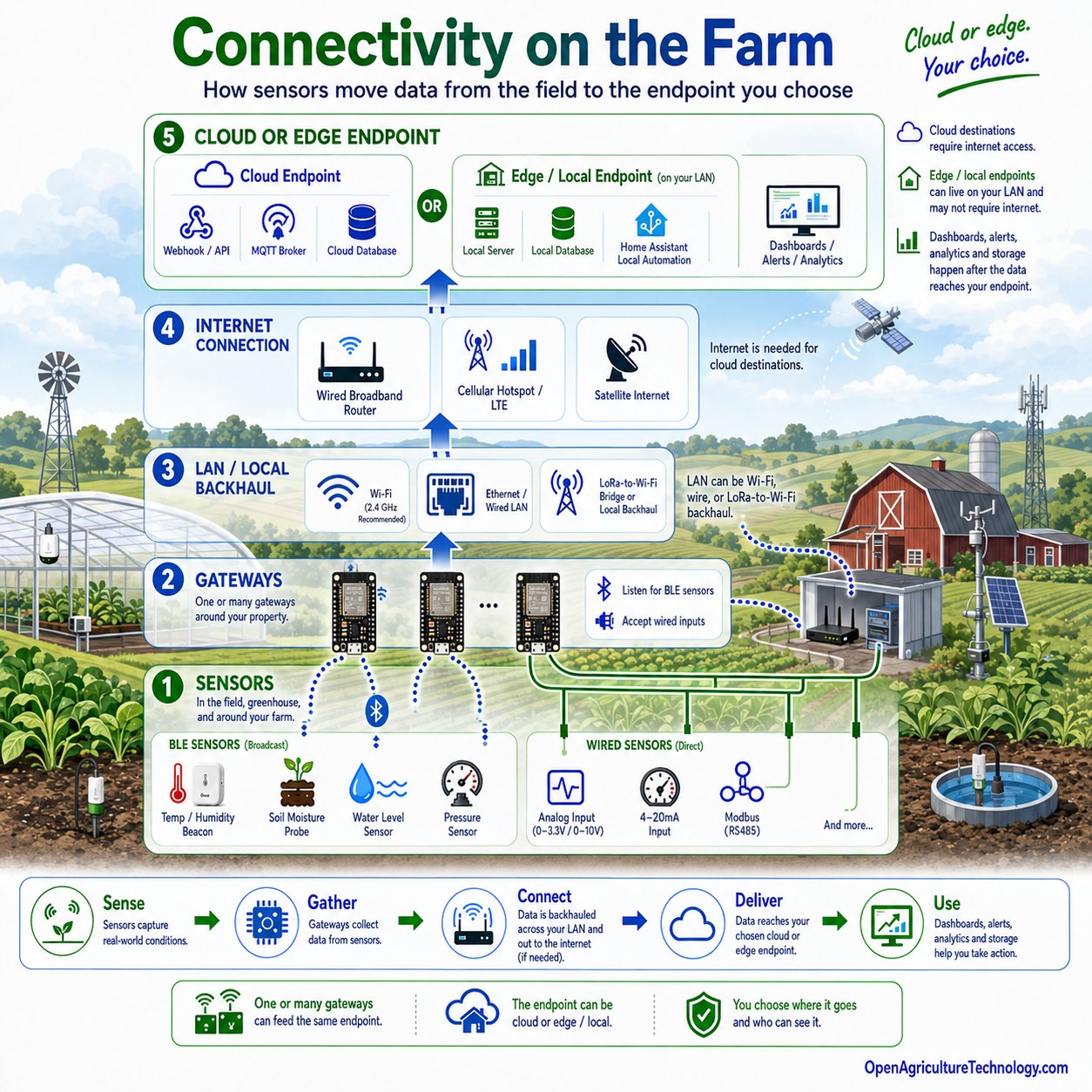
BLE sensors scattered throughout the greenhouse send their readings to a small computer (running Home Assistant or similar software) inside or near the greenhouse. The BLE sensors run on coin-cell batteries for years. The computer plugs into a wall outlet. Local dashboard, local automations, local data: everything works without the internet.
That same small computer connects to the grower's network through Wi-Fi or Ethernet. Data flows up to the home office, where the grower can see what is happening from their phone while they are in the field. The computer also pushes data to a cloud backup so the grower can check things while traveling.
For field sensors beyond Wi-Fi range, the grower adds a LoRa gateway. Soil moisture sensors, a water trough level sensor, a gate contact, a rain gauge. All of them run on lithium batteries or small solar panels, all of them report via LoRa to the gateway in the greenhouse or at the house. The gateway translates their LoRa messages into standard network data that the Home Assistant computer reads and integrates with the BLE sensors. Same dashboard, different radios, one system.
For the gate at the far end of the property where nothing else reaches, the grower might install a single cellular-enabled device. It costs more to operate, but it is the only option at that specific location. The rest of the system does not depend on cellular. Only this one sensor does.
A grower looking at this description sees the pattern. Pick the right radio for each place. Do not force a single radio to do every job. Layer the technologies the way a well-designed building layers different materials for different purposes: concrete in the foundation, steel in the structure, glass in the windows, wood in the finishes. Each material is appropriate where it is used.
05Network topology: how the pieces connect.
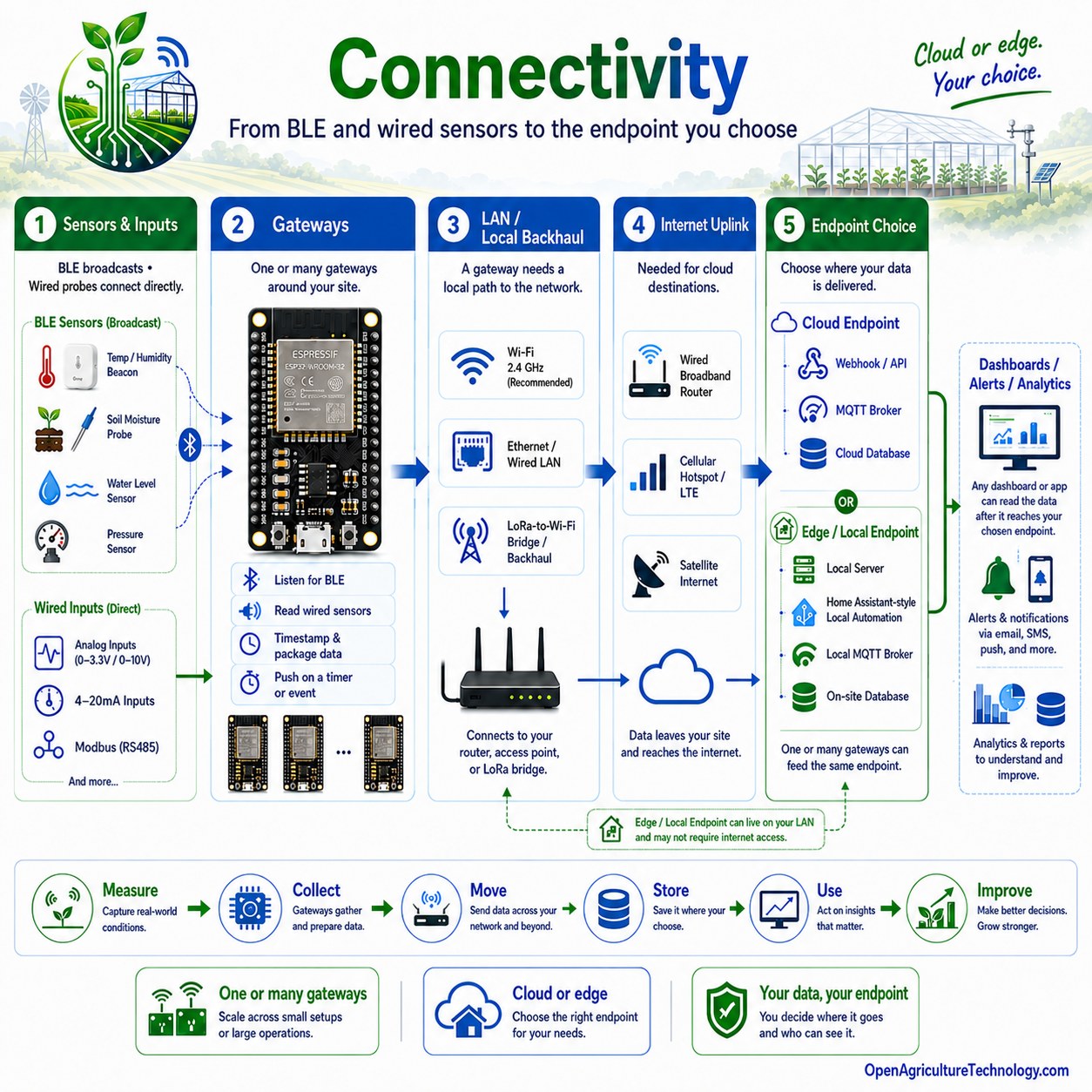
Beyond choosing radios, the way the network is arranged matters. Three topologies cover most agricultural systems.
Star topology.
All sensors talk to a single central hub. Wi-Fi, cellular, and LoRa typically work this way: every device reports to one access point or gateway. Simple to design and debug. The hub is a single point of failure: if it goes down, the whole network goes down. The hub is also the bottleneck for range: a sensor that cannot reach the hub is not part of the network.
Mesh topology.
Devices relay signals for each other. A sensor at the far edge of the property does not need to reach the hub directly: it just needs to reach a neighboring device, which forwards the signal along. Zigbee, Z-Wave, and some LoRa implementations use mesh topology. More resilient to single-point failures, better coverage in spread-out deployments, but more complex to configure and debug. Mesh networks can have subtle problems where specific combinations of device placement cause some devices to drop out intermittently.
Point-to-point.
Two devices talk directly to each other, without any hub or gateway. Point-to-point LoRa, Wi-Fi direct, or simple radio bridges fall into this category. Useful for specific purposes (connecting two buildings that need to share data, linking a remote sensor directly to a specific receiver) but not a general-purpose topology for many devices.
Most real agricultural systems are hybrid. A star topology of Wi-Fi sensors inside the greenhouse. A star topology of LoRa sensors in the field. The two stars connect to the same hub computer, which connects upstream to the internet through whatever infrastructure is available. Understanding topology helps a grower troubleshoot: if a single sensor is missing, look at the sensor and its path to the hub. If many sensors are missing, look at the hub and its upstream connections.
06Common communication failure modes.
Radio systems fail in specific, recognizable ways. The grower who knows the patterns diagnoses problems faster.
Wi-Fi range is shorter than expected.
Symptom: sensors at the edge of the network drop out intermittently. Cause: mature plant canopy absorbing signal, metal structures reflecting signal, or simple distance. Fix: move the router closer, add a Wi-Fi mesh point or access point, switch the distant sensors to a different technology (LoRa, cellular).
BLE sensor disappears from hub.
Symptom: a specific sensor's readings stop appearing. Cause: battery depleted, sensor moved out of range, interference from a new nearby device. Fix: check the sensor's battery indicator if available, verify physical location, look for nearby electrical noise sources.
LoRa coverage gaps.
Symptom: some field sensors report reliably, others miss readings. Cause: terrain or vegetation blocking line of sight between the missing sensors and the gateway. Fix: raise the gateway antenna higher, add a second gateway to cover the problem area, or reposition the problem sensors to locations with better line of sight.
Cellular sensor using more data than expected.
Symptom: carrier bill climbs unexpectedly. Cause: sensor is reconnecting more frequently than necessary, a firmware bug is sending duplicate messages, or the sensor is stuck in a reconnection loop. Fix: check sensor configuration, update firmware, configure the sensor for the correct reporting interval.
Zigbee network getting flaky.
Symptom: devices that worked fine start dropping out after a network change. Cause: mesh routing confused by a device that was moved, interference from a new 2.4 gigahertz source (a new Wi-Fi channel, a microwave oven, a baby monitor). Fix: rebuild the mesh by re-pairing problem devices, change Zigbee channel to avoid interference, check for physical obstructions.
Ethernet cable developed a problem.
Symptom: specific device suddenly disconnected or running at lower speed. Cause: cable damage (rodent chew, physical pinch, UV degradation on outdoor runs), connector corrosion, or switch port failure. Fix: swap the cable, test with a cable tester, try a different switch port, replace the connector.
Whole network down.
Symptom: nothing is reporting. Cause: the central hub is offline (power outage, hub crash, router failure, ISP outage). Fix: check the hub first, then the router, then the upstream connection. A UPS on the hub and router prevents most brief outages from becoming network-down events.
07Rules of thumb for communication decisions.
A practical summary of how to pick radios:
For anything inside a building with infrastructure, start with Wi-Fi, BLE, or Ethernet. Each has its place and often multiple live together on one network.
For field sensors beyond building-scale distances, LoRa is almost always the answer unless the grower has a specific reason to use cellular. LoRa is cheaper, lower-power, and gives the grower ownership of the infrastructure.
For cellular, budget the monthly fees honestly. One device per month is $60 per year, acceptable for many uses. Twenty devices per month is $1,200 per year, which quickly pays for a LoRa gateway and sensors.
Match power consumption to battery capacity. A Wi-Fi sensor on battery power will not last. A LoRa sensor on battery power can last years. BLE sensors on coin-cell batteries are a design sweet spot.
Consumer BLE sensors are often the most appropriate choice for small-scale environmental monitoring. The manufacturers designed them for living rooms, but plants and living rooms have similar environmental measurement needs.
Do not forget wired options. If a cable can be run, Ethernet or serial may be more reliable and cheaper than wireless over the long term.
Plan for the three-kilometer reality of LoRa, not the fifteen-kilometer datasheet. Build out with realistic assumptions and add capacity as needed.
Use multiple radios in one system. There is no single-radio answer that is right for every sensor. Fit the radio to the job, not the job to the radio.
Always have a plan for what happens when the primary communication path fails. A cellular backup on the hub, a second gateway for LoRa, a UPS on the router: small investments that prevent silent monitoring failures.
Frequently asked questions.
What is a radio frequency?
A radio frequency is how many times per second a radio wave oscillates, measured in hertz (Hz). Low frequencies (kilohertz, megahertz) travel farther and penetrate obstacles better but carry less data. High frequencies (gigahertz) travel shorter distances and are blocked more easily, but carry much more data. This is why Wi-Fi at 2.4 gigahertz works great inside a building but cannot reach across a field, while LoRa at 900 megahertz can reach kilometers.
What does bandwidth mean?
Bandwidth is how much data a radio can send per second, measured in bits per second (bps), kilobits (kbps), or megabits (Mbps). A Wi-Fi connection might have hundreds of megabits per second. A LoRa connection might have a few kilobits per second. Most agricultural sensors send tiny amounts of data (a temperature reading is less than 100 bits), so low-bandwidth radios are usually adequate.
What is the difference between Wi-Fi and Bluetooth?
Both are short-range wireless technologies, but they are designed for different purposes. Wi-Fi is higher bandwidth (good for internet access, video, file transfer) but uses more power and requires a router. Bluetooth, especially Bluetooth Low Energy (BLE), is lower bandwidth and lower power, designed for small-data applications like sensors, headphones, and fitness trackers. For most agricultural sensors, BLE is the better choice because of battery life.
What is LoRa?
LoRa (Long Range) is a radio technology designed for long-distance, low-power, low-bandwidth applications. It can send small amounts of data several kilometers on very little battery: typical ranges are 2 to 15 kilometers depending on terrain. LoRa is ideal for field sensors, remote monitoring, and any situation where a sensor needs to report infrequently from far away on battery or solar power.
What is LoRaWAN?
LoRaWAN is a networking protocol built on top of LoRa radio technology. Where LoRa defines how the radio signal works, LoRaWAN defines how many devices share a single gateway and how data moves between devices and the internet. Most commercial LoRa devices use LoRaWAN to handle the networking layer. Community LoRaWAN networks like The Things Network let devices send data through shared gateways at no cost.
What is BLE?
BLE stands for Bluetooth Low Energy. It is a variant of Bluetooth designed specifically for low-power applications: small sensors, fitness trackers, environmental monitors, and similar devices. A BLE sensor can run for years on a single coin-cell battery while sending periodic readings. BLE is the technology behind the inexpensive Bluetooth temperature and humidity sensors commonly used in greenhouse monitoring.
What is Zigbee?
Zigbee is a low-power wireless protocol designed for mesh networks of small devices. Devices in a Zigbee network relay signals for each other, extending coverage and adding redundancy. Zigbee is common in smart home products and fits well in building-scale agricultural deployments with many sensors. It operates at 2.4 gigahertz, the same band as Wi-Fi and Bluetooth.
What is Z-Wave?
Z-Wave is a low-power wireless protocol similar in purpose to Zigbee: it creates mesh networks of small devices for home and building automation. Z-Wave operates at around 900 megahertz in North America, which means less interference with Wi-Fi than Zigbee but shorter range than LoRa. Z-Wave devices work together if they follow the standard, but typically work within one manufacturer's ecosystem most reliably.
What is Modbus?
Modbus is a communication protocol widely used in industrial equipment, including commercial greenhouse controllers, soil probes, pump controllers, and environmental systems. It is an older protocol (originating in 1979) but remains the standard for many industrial sensors and controllers. A modern monitoring system that needs to integrate with existing commercial equipment almost always has to speak Modbus.
Which wireless technology is best for agricultural monitoring?
It depends on the situation. No single wireless technology is best for everything. Wi-Fi works well inside buildings with power. BLE works well for inexpensive, battery-powered short-range sensors. Zigbee and Z-Wave work well for mesh networks in buildings. LoRa works well for long-range field sensors on batteries. Cellular works for remote or mobile sensors where other technologies cannot reach. Most real systems use two or three technologies together.
How far does Wi-Fi reach in a greenhouse?
Wi-Fi typically reaches 30 to 45 meters through obstacles indoors. In a greenhouse, range depends heavily on the amount of plant canopy, which absorbs radio signals because plants contain water. An empty greenhouse may have excellent Wi-Fi coverage; the same greenhouse with a mature tomato canopy may have dead zones. For greenhouse operations larger than about 100 square meters, plan for multiple access points or use a different technology for distant sensors.
How far does BLE reach?
BLE range is typically 10 to 30 meters indoors. In an open outdoor environment with direct line of sight, some BLE devices can reach 100 meters or more. Through obstacles like walls and dense plant canopy, range drops significantly. For most practical agricultural deployments, expect 15 to 25 meters of reliable BLE coverage: beyond that, use a different technology or add relays.
How far does LoRa reach?
LoRa datasheets typically claim 10 to 15 kilometers of range, sometimes more in ideal conditions. Real-world range in typical agricultural terrain (flat land, scattered trees, some buildings) is usually 2 to 5 kilometers. Line of sight between the sensor and gateway is critical: a gateway on top of a building or tower reaches much farther than a gateway at ground level. Hills, dense woods, and metal structures all reduce LoRa range.
How much does cellular cost per sensor?
Typical IoT-class cellular service (LTE-M or NB-IoT) is a small monthly fee per device, depending on the carrier and data allowance. At typical fees of a few dollars a month, a single sensor runs about $60 a year, and twenty sensors about $1,200 a year: at which point building a LoRa network with a gateway often costs less over any reasonable time horizon. Budget cellular costs honestly before committing to large deployments.
What is the best radio for greenhouse monitoring?
For most greenhouse applications, BLE sensors are the best starting point. They are inexpensive, run for years on coin-cell batteries, and work well in the short distances typical of greenhouse environments. For larger greenhouses or operations that need real-time high-frequency data, Wi-Fi works well if the hardware is available. A typical configuration uses BLE sensors scattered throughout the greenhouse, reporting to a small central computer that pushes the data upstream through Wi-Fi or Ethernet.
Can I use Wi-Fi for battery-powered sensors?
Technically yes, but battery life will be short. Wi-Fi consumes significantly more power than BLE, Zigbee, or LoRa: a Wi-Fi sensor on battery power typically lasts days to weeks rather than years. Wi-Fi is fine for plugged-in devices (hub computers, always-on cameras, wall-powered sensors) but a poor choice for battery-only deployments. Use BLE or LoRa instead for battery-powered sensors.
Why does my Wi-Fi sensor stop working when the greenhouse has mature plants?
Plants are mostly water, and water absorbs 2.4 gigahertz Wi-Fi signals strongly. A greenhouse that had fine Wi-Fi coverage when empty can develop dead zones as the canopy matures. Solutions: move the access point to a better location, add a second access point, switch to 900-megahertz radios (like Z-Wave or some industrial Wi-Fi variants) that penetrate vegetation better, or use a low-frequency radio like LoRa for sensors in densely-planted areas.
What is the best radio for field monitoring?
LoRa is almost always the best choice for field sensors that need long range and battery life. Cellular (LTE-M or NB-IoT) works when LoRa coverage does not exist and only a few sensors are needed, but cellular per-device costs add up quickly at scale. For short-range field deployments near a building with infrastructure, Wi-Fi or point-to-point wireless can work. For fields beyond Wi-Fi range, LoRa is the standard answer.
How do I get LoRa coverage across a large farm?
Install one or more LoRa gateways at high points on the property. A single gateway on a tall building or pole can cover 2 to 5 kilometers in typical terrain. Large operations may need 2 to 4 gateways distributed across the property to ensure every sensor has coverage. Indoor gateway units are the budget end, and outdoor units with high-gain antennas cost more. Once installed, gateway operation is essentially free.
Can I use public LoRaWAN networks like The Things Network?
Yes, where coverage exists. The Things Network is a community-operated LoRaWAN network with gateways in many populated areas, free for use. Coverage varies widely: excellent in some cities, nonexistent in rural areas. Commercial LoRaWAN operators also offer paid coverage. For agricultural deployments in rural areas, installing private gateways is usually more reliable than depending on public networks.
Why does my LoRa sensor's battery last for years but my Wi-Fi sensor's battery lasts for weeks?
LoRa is designed specifically for low power: the radio uses very little energy per message and can sleep deeply between reports. Wi-Fi consumes far more power per message and typically maintains a connection to the router, which keeps the radio active more of the time. For battery-powered sensors, radio choice is the biggest factor in battery life, often more important than sensor choice or reporting frequency.
How often can a LoRa sensor report?
LoRa regulations limit how long each device can transmit per hour: typically a total of a few seconds to tens of seconds, depending on the regulatory region and the specific data rate. For a typical sensor sending small data packets, this translates to reporting intervals of a few minutes to once per hour. Sensors reporting more frequently than that may technically violate regulations and will certainly burn through batteries faster than necessary.
Can I mix different wireless technologies in one system?
Yes, and most real systems do. A common configuration: BLE sensors in the greenhouse, Wi-Fi or Ethernet connecting the hub to the network, LoRa for field sensors, cellular backup on the hub for alert delivery during power or internet outages. The hub computer (running Home Assistant or similar software) can integrate data from all radios into one dashboard. Each radio handles the part of the system where it fits best.
How do I connect a LoRa sensor to a Home Assistant system?
A LoRa gateway receives the sensor's messages and translates them into standard network protocol (usually MQTT). Home Assistant subscribes to the MQTT messages and displays the data. The full chain: sensor transmits via LoRa → gateway receives → gateway publishes to MQTT → Home Assistant subscribes and displays. Several gateway products and software packages (The Things Network or ChirpStack) handle these middle steps. Meshtastic is a different thing, a gateway-free LoRa mesh, not a LoRaWAN gateway.
How much does a BLE sensor cost?
Consumer-grade BLE temperature and humidity sensors are inexpensive retail, and cheaper in bulk. Higher-precision or weatherproof versions cost a modest amount. Specialized BLE sensors for specific agricultural uses (soil moisture probes, CO2 sensors) are mid-priced. The low cost of consumer BLE sensors is what makes dense environmental monitoring practical for small growers.
How much does a LoRa sensor cost?
LoRa sensors range widely in price. DIY LoRa sensors built on commodity hardware (ESP32 plus LoRa module) cost a modest amount in parts. Commercial LoRa sensors with proper enclosures, batteries, and solar panels are typically mid-priced. Specialized agricultural LoRa sensors (soil probes, weather stations, water level) are expensive depending on precision and features.
How much does a LoRa gateway cost?
Indoor LoRa gateways are the affordable entry point. Outdoor gateways with weatherproof enclosures, higher-gain antennas, and typically cellular backhaul are expensive. Professional-grade gateways for service providers are the most expensive. For a typical small farm, a single mid-priced outdoor gateway is plenty.
Why did a sensor suddenly stop reporting?
Most common causes: battery died, sensor was moved out of range, interference from a newly-installed device, firmware error requiring reboot, hub software crashed, or the physical sensor failed. Troubleshooting order: check battery voltage if the sensor reports it, verify the sensor is physically where it should be, look at the hub logs for error messages, and try power-cycling the sensor.
What causes interference with wireless sensors?
Common interference sources: microwave ovens (2.4 GHz), Wi-Fi access points on the same channel, cordless phones, baby monitors, other ISM-band devices, fluorescent light ballasts, variable-speed motor drives, and radio transmitters from nearby equipment. New interference sources appearing can cause previously-reliable sensors to drop out. Moving the sensor or changing the radio's channel often fixes interference problems.
Why is my network slower after adding more sensors?
Every network has a limit on how many devices it can handle efficiently. A home Wi-Fi router handles 20 to 50 devices well; performance degrades as device count grows. Zigbee networks start having mesh-routing delays above a few dozen active devices. LoRa networks have regulatory limits on total airtime that constrain aggregate network capacity. If a growing deployment causes performance problems, the solution is usually to segment the network or move to a different technology for some of the devices.
Does weather affect wireless signals?
Yes. Rain reduces range and bandwidth for higher-frequency radios (5 gigahertz Wi-Fi, cellular). Lightning can cause direct equipment damage and also creates radio noise that disrupts nearby systems. Snow and ice on antennas or equipment can degrade performance. Temperature extremes affect the electronic components themselves. Most well-designed agricultural radios are engineered for the conditions, but edge cases happen: a thunderstorm can knock out communication for hours even without a direct hit.
Does the size of an antenna matter?
Yes, significantly. A larger antenna (higher gain) concentrates the radio signal in a specific direction, extending range at the cost of coverage in other directions. A small antenna (low gain) radiates in all directions but with less range. For a LoRa gateway intended to cover a large farm, a high-gain vertical antenna mounted high on a building or tower can dramatically improve coverage. For a sensor that needs omnidirectional coverage, a small antenna is fine.
Is wireless monitoring secure?
It depends on the technology and how it is configured. Modern Wi-Fi, BLE, Zigbee, and LoRa all support encryption. Consumer BLE sensors often do not encrypt: their data is broadcast in the clear. For most agricultural monitoring, this is acceptable because the data is not sensitive. For applications where data confidentiality matters (competitive growing intelligence, compliance records, security cameras), configure encryption where available and isolate the monitoring network from the internet-facing network.
Can someone eavesdrop on my wireless sensors?
Technically yes, for unencrypted data, though in practice it rarely happens. Someone nearby with the right equipment can capture unencrypted BLE or LoRa messages. For most growers, the risk is low: nobody is driving past with a radio scanner hoping to learn the temperature in a greenhouse. For applications with real confidentiality needs (security monitoring, regulated substances), enable encryption and consider private networks.
Do I need 5G for agricultural monitoring?
Almost never. 5G is high-bandwidth and expensive, designed for applications like video streaming and mobile computing. Agricultural sensors send tiny amounts of data and do not benefit from 5G's bandwidth. LTE-M and NB-IoT (older cellular variants optimized for IoT) cost much less per device and work in more areas than 5G. Save 5G for applications that actually need high bandwidth.
Is mesh networking always better than star networking?
No. Mesh networking adds resilience through redundancy but also adds complexity, debugging difficulty, and sometimes subtle reliability problems. For many agricultural deployments, a simple star topology with one or two gateways is more reliable than a complex mesh. Use mesh when the physical layout genuinely benefits from it: dense deployments with many devices needing coverage across a large area, not as a default.
Is wireless always better than wired?
No. A wired Ethernet or serial connection is more reliable, faster, and often cheaper over the long term than wireless, if the cable can be installed. Default to wired when the location is permanent and accessible. Use wireless when wires are impractical: battery-powered devices, mobile sensors, spread-out deployments, or locations where cable installation is cost-prohibitive.
Put it to work
One reading moving over one link teaches more than any protocol chart. Start with the link you already have.