
Roots in a nutrient solution instead of soil. You hold the root-zone dials directly, and the feedback is fast.
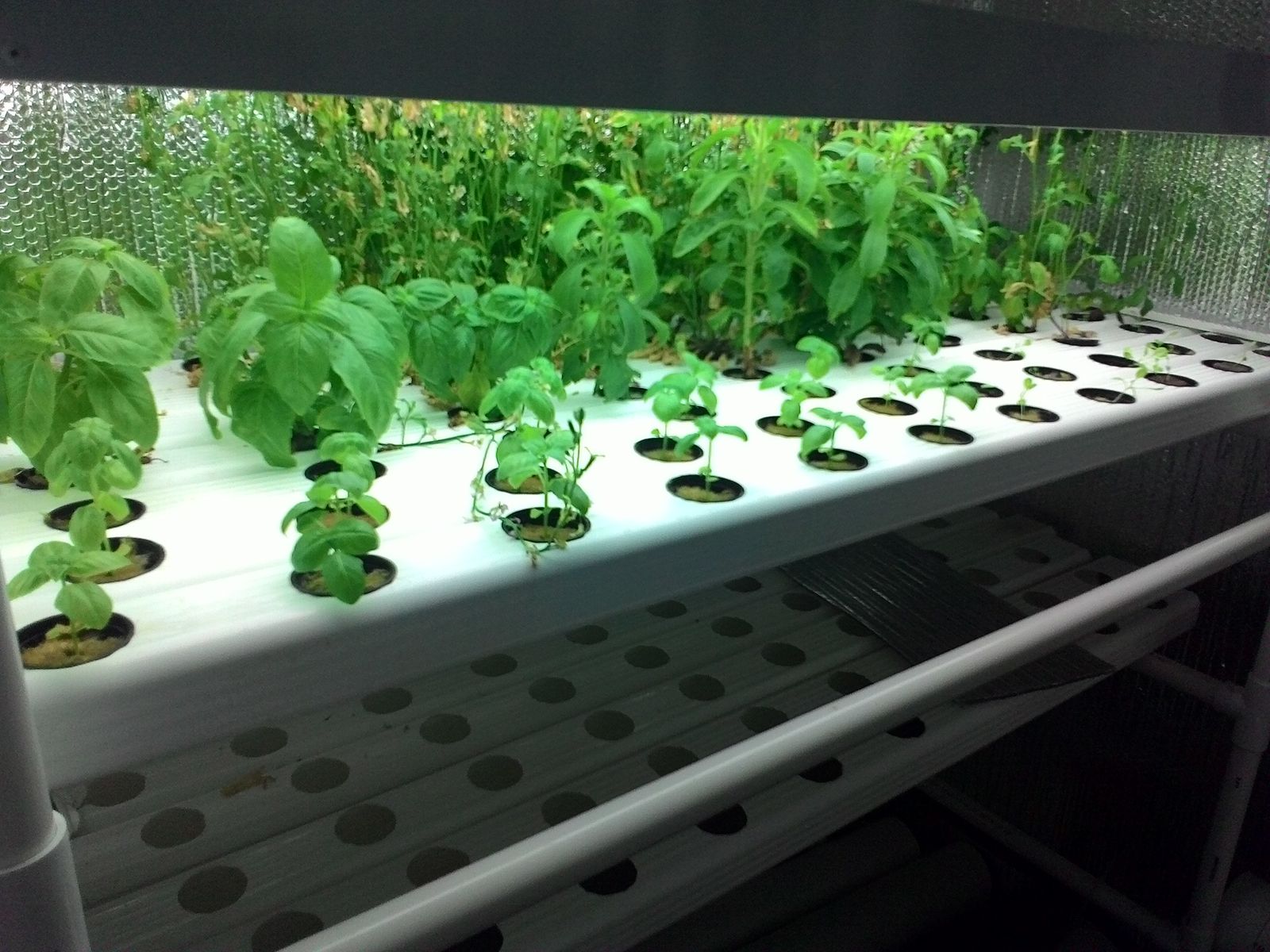
Hydroponics grows plants with their roots in a nutrient solution rather than soil. The grower mixes the feed, so the root zone stops being something you read and becomes something you set. Lettuce in floating rafts, tomatoes in rockwool slabs on drip, herbs in a recirculating film. They share one idea: the water carries everything the root needs, and you control its makeup.
Where it sits
On the spectrum of control, hydroponics takes the whole root zone into your hands. That is power and exposure at once: there is no soil buffer to forgive a mistake, so the dials move fast and so do the consequences. The aerial side (light, temperature, VPD, CO₂) may be open air in a greenhouse or fully controlled indoors. Hydroponics is a root-zone method that pairs with any point on the aerial spectrum.
The four common systems
- Deep water culture (DWC): roots hang in aerated, nutrient-rich water. Simple, fast-growing, and only as good as its dissolved oxygen.
- Nutrient film technique (NFT): a thin film of solution runs past the roots in a channel. Efficient, but unforgiving of a pump that stops.
- Drip: solution is metered onto an inert medium (rockwool, coco, perlite). The workhorse of commercial greenhouses.
- Ebb and flow: a tray floods and drains on a schedule, pulling fresh air to the roots between cycles.
The dials you now hold
Because the solution is the soil, the root-zone inputs become your daily work. pH drifts quickly in a small volume of water and decides whether the nutrients you added are even available. Nutrition is now a recipe you mix, tracked by electrical conductivity. Dissolved oxygen is life or death: roots in water suffocate without it. Root-zone temperature governs both oxygen and disease pressure. This is exactly where clean intervention earns its keep: the common pH-down is phosphoric acid, which quietly doses phosphorus you never meant to add.
Watching it
The dials you now hold are also the dials that move fastest. In a small volume of water, pH can drift out of range between the evening check and the morning one, and dissolved oxygen can crash in an hour when a pump quits. Water does not forgive the way soil does: there is no buffer, so a failure is not a slow slide, it is a cliff. That makes hydroponics the method where monitoring pays for itself first.
The watch itself is modest: a pH and EC probe in the reservoir, a temperature sensor beside them, a reading every few minutes landing somewhere you own, and an alert the moment a number leaves its lane. Reservoir temperature earns its spot twice, because warm water holds less oxygen right when roots want more of it, so a rising temperature line is your dissolved-oxygen early warning. All of it together costs less than a bag of nutrients, and it stands watch every night you sleep. When you are ready for the next rung, control adds auto top-off and dosing; the alarms come first.
Tools for hydroponics
Frequently asked questions.
What is the easiest hydroponic system to start with?
Deep water culture is the simplest: roots hang in aerated nutrient water. Its one non-negotiable is dissolved oxygen. Keep the water aerated and cool, and leafy greens grow quickly.
Why does my hydroponic pH keep moving?
A small volume of water has little buffering, so pH drifts as plants take up nutrients and as your source water's alkalinity pushes back. Track it daily, correct gently, and prefer a pH adjuster that adds no extra nutrient.
Do I need to test my water before mixing nutrients?
Yes. Source water carries its own minerals and alkalinity that count toward your recipe and fight your pH corrections. Decode the source first, then build the feed on top of what is already there.