
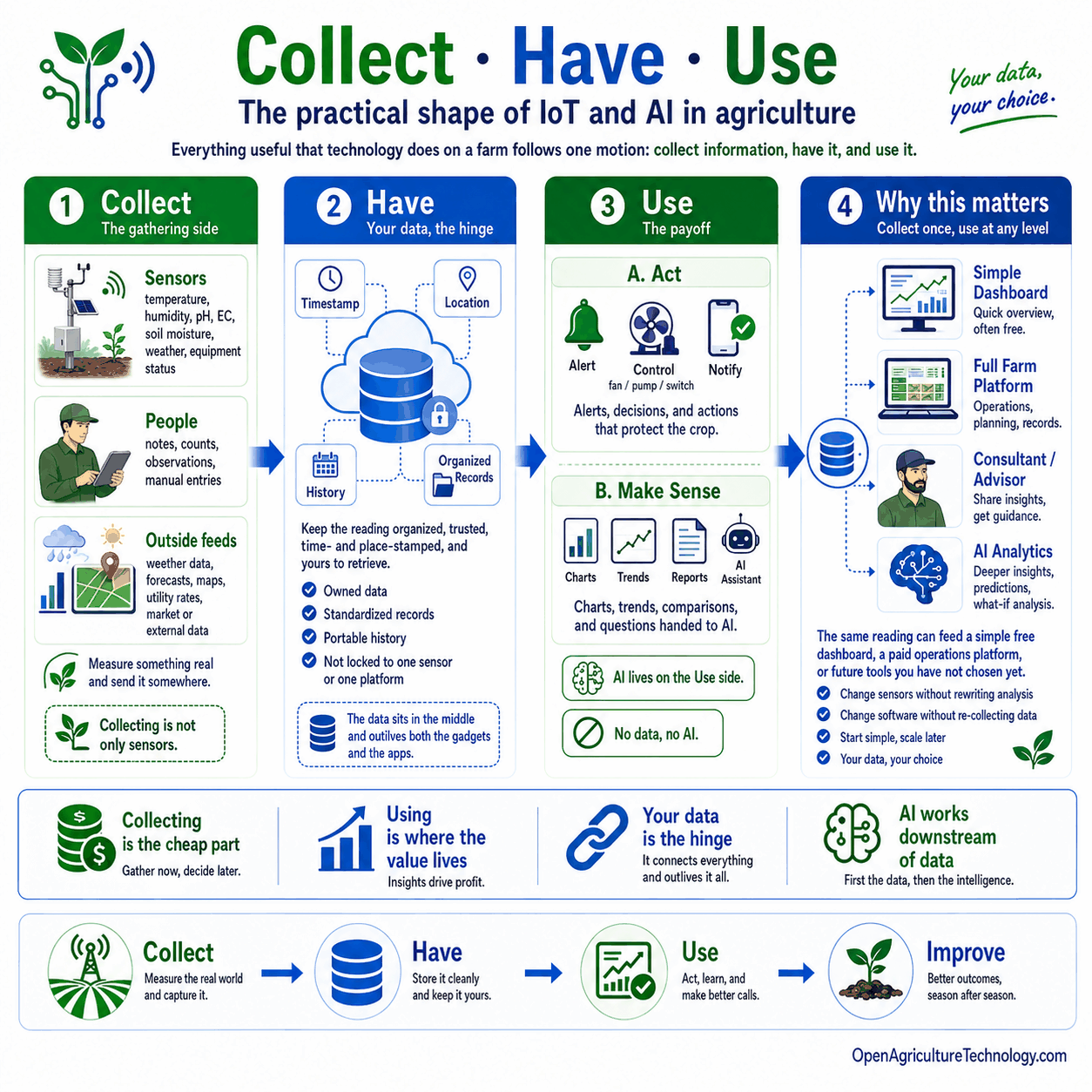
Everything useful that technology does on a farm is one motion: collect information, have it (own it) and use it. Collecting is the gathering. Using is the payoff. Your data sits in the middle, the one piece that makes both worth doing.
01The one motion.
Strip away the brand names and the wiring, and every monitoring or control system on a farm is the same three steps. Name them before any gadget:
Measure something real and send it somewhere: a sensor, a number you type in, a feed from the outside world.
Keep the reading: organized, trusted, stamped with when and where, and yours to get back out. This is the hinge.
Act on it (an alert, a decision, a switch) and make sense of it (a chart, a trend, a question to an AI). Now and for years.
Gathering on one side, the payoff on the other, your data the durable thing in the middle. Get this shape in your head and every product, wiring diagram, and how-to on this site becomes an example of one of the three, not a new thing to learn from scratch.
02Collect, the gathering side.
Collecting is getting information in. It is not only sensors. It is a $12 humidity sensor on a small board, yes, but it is also a number a grower types in after walking the rows, and a weather feed or a soil survey pulled from the outside world. All three are collection. The sensor's whole job is to measure reality and send it somewhere.
This is the commodity side, and that is good news, not bad. Cheap, capable sensing is the democratizer: the reason a small grower can play at all today. A $12 sensor that reliably shows a cooler trending the wrong way is doing real work; a moderately priced instrument might do it better, or might not. The appropriate-technology test lives here too: fit the measurement to the need, and do not gold-plate it. Seven decimal places a greenhouse will never use is not precision; it is waste.
03Have, the hinge.
Between collecting and using sits the thing that makes both worth doing: the data itself, kept and owned. This is where data is king: the reading organized, trusted, stamped with when and where, and yours to retrieve and take with you.
The reason to put "Have" in the middle and not skip past it is that the data is the handoff between the two sides. The sensor does not care what reads its data. The software does not care which sensor produced it. They agree on the reading, and nothing else. That is what lets you swap a sensor without touching your analysis, and bring next decade's tools to this decade's measurements.
04Use, the payoff.
Using is where the value is. It comes in two shapes:
- Act: a text at 2 a.m. when the heater quits, a decision made in time, a switch thrown. This is the use that saves a crop.
- Make sense of it: a chart, a trend across the season, a comparison across years, a question handed to an AI. This is the use that makes next year smarter.
This is where the value shows up. Collecting is cheap and getting cheaper; the intelligence, the "this is what it means and here is what to do," lives on the using side. A farm that collects and never uses has spent money to make a number nobody read. The whole point of the gathering side is the payoff side.
05The two sides stand apart.
Because the data is the handoff, the gathering and the using are independent. You can change the sensor without rewriting the software. You can change the software (or bring in a tool that did not exist when you started) without re-collecting a thing.
That independence is why data in an open, documented format can outlast both the sensor that produced it and the software that first read it, as long as the format stays readable and you keep access to the files. It is also why a tool built years from now can still use the readings you collect this afternoon: a standard format, and the data in your hands. Keep the reading clean and within reach, and it stays useful long after the gadget and the app that first touched it are gone.
06Collect once, use at any level.
The same reading can feed very different things. A temperature coming off a $12 sensor can drive a near-free alert dashboard you set up yourself (or, unchanged, feed a full operations-and-records platform that costs hundreds a month). The data does not change. What changes is what you do with it, and what that costs.
The value and the price live on the using side, not the gathering side. That is the practical payoff of owning your data: you can start at the free end and climb to the paid end (or hand it to a consultant) later, without re-collecting or starting over. You are not locked to the level you started at, and you do not have to pay to collect the same thing twice.
07AI lives on the use side.
Artificial intelligence is a tool for one job here: making sense of the data. That puts it on the using side, and that is the only place it belongs. It is worth reaching for when a question genuinely needs it, and overkill when a simple check would do. A scheduled task that just watches a number and texts you when it crosses a line needs no AI at all.
But wherever AI sits, it sits downstream of data. No data, no AI. Saying that plainly keeps two things honest at once: it deflates the hype (you are not buying magic, you are keeping owned data that future tools can make use of), and it makes data is king concrete: the data is the precondition for every smart thing, today's and tomorrow's.
The shortest version
One motion: collect it, have it, use it. Collecting is the cheap part; using is where the value lives; your owned data is the hinge that holds the two apart and outlives both. Collect once, use at any level. AI sits on the using side, and only with data to work from.
Frequently asked questions.
How do farm sensors send their readings?
A sensor measures something and sends the reading to a place that stores it, over Wi-Fi, a long-range radio, or a cellular connection. That is the collect step. Whatever reads the data later does not need to know which sensor sent it; they only have to agree on the reading itself. The choice of Wi-Fi, radio, or cellular depends on the distance to cover, the power available, and cost.
What can I actually do with greenhouse or farm sensor data?
Two things. Act on it: get an alert when the heater quits at 2 a.m., or trigger a fan or a pump. And make sense of it: watch trends across the season, compare years, or hand it to an AI to find patterns. Acting saves a crop; analyzing makes next year smarter. The acting and the analyzing are where the value is, not the collecting.
Can I switch monitoring systems without losing my history?
Yes, if you own your data and can get it back out. Because the sensor and the software only agree on the readings (not on each other), your data is portable. You can change the software, or bring in a new tool, without re-collecting anything, as long as you kept the data and can retrieve it.
Do I need AI to make use of farm data?
No. A lot of the value is simple: a scheduled task that watches a number and texts you when it crosses a line needs no AI at all. AI is worth reaching for when a question genuinely needs it: finding patterns across several seasons, say. And it only works on data you already have: no data, no AI.
Is collecting the data the expensive part?
Usually not. Sensors and the work of collecting are commodity and getting cheaper every year. The value (and sometimes the cost) lives on the using side: the alerts, the charts, the analysis. The same readings can feed a free dashboard you built yourself or a paid platform that costs hundreds a month. What you pay tracks what you do with the data, not the collecting.
What are the basic steps of a farm monitoring system?
Any monitoring system has three steps. Collect a reading, from a sensor, a person, or an outside source. Store it, so you keep it, own it, and can reach it. Then use it, by acting on it and making sense of it. Collecting is the gathering and using is the payoff, and the data you own is the hinge that connects and outlives both.
Put it to work
Collect once, use at any level. The collecting can start this weekend with one sensor and a free program.