
Data is the one thing on a farm that outlives everything else: the sensor, the software, the vendor, even the season. And now that a machine can read it, the data you kept and own is the most valuable thing on the place. Data is king. The king belongs to the farmer.
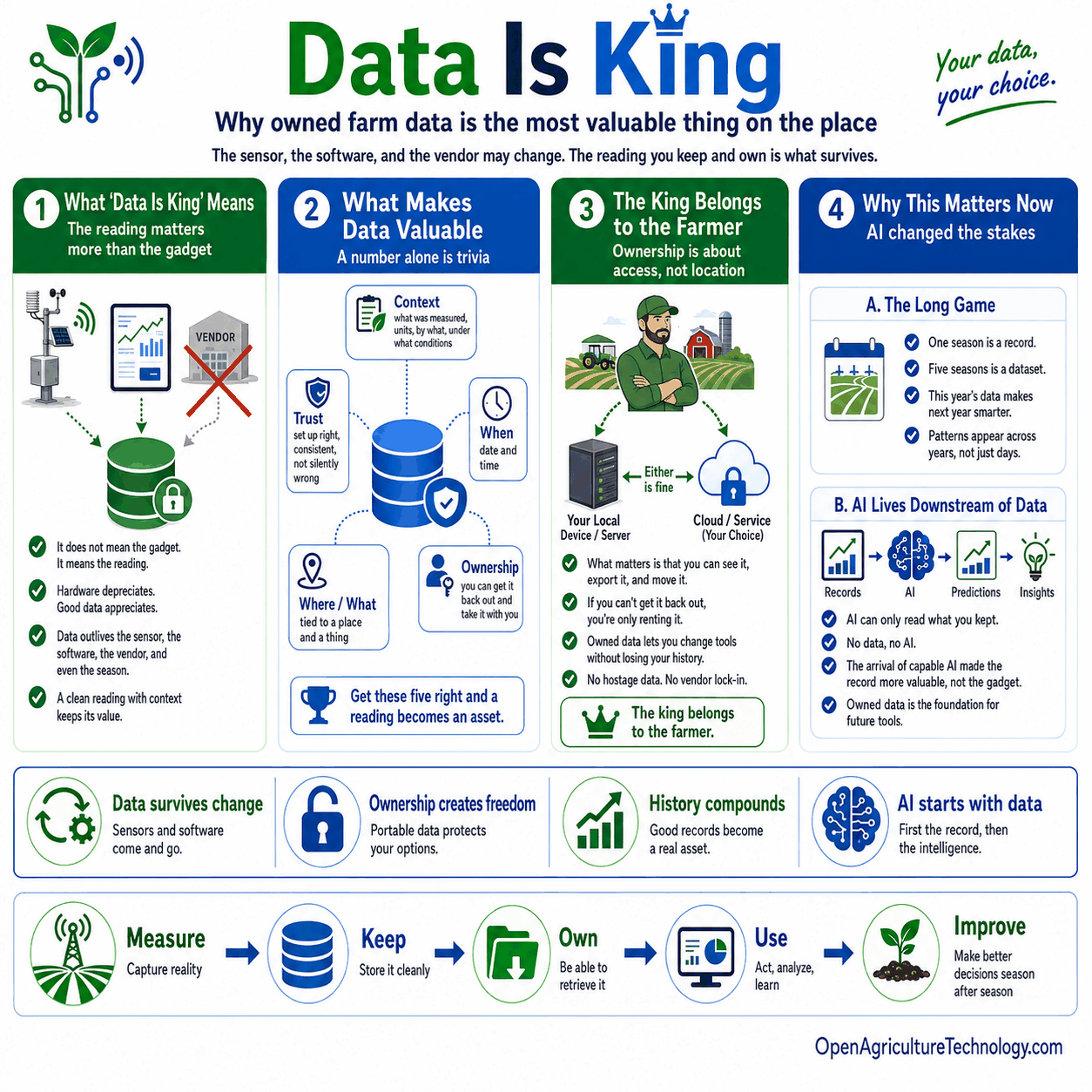
01What "data is king" means.
It does not mean the gadget. It means the reading.
A temperature you wrote down last January is worth more this January than the sensor that took it. The sensor will die. The app will change. The company behind it may fold. But a clean number, with its context intact, keeps its value and quietly compounds. Hardware depreciates the day you buy it. Good data appreciates.
That is the whole reason this site treats data as the center of everything. Everything else is a means. The sensor is a means. The software is a means. The data is the thing that survives all of them and stays yours.
02Why now, AI changed the stakes.
The idea that records matter is not new. What is new is that, for the first time, there is an engine that can read five seasons of numbers and hand back something no single season could show you: which beds dry fastest, which corner is trending toward trouble, what last year's data says about this year's plan.
But that engine can only read what you kept. Point an AI at a crop you never measured and it has nothing to say. The intelligence everyone is excited about runs on data, and the data has to exist, and it has to be yours to point a tool at. The arrival of capable AI did not make the gadget more valuable. It made the record more valuable.
03What makes data worth anything.
A number on its own is trivia. To be worth keeping, a reading needs five things:
- Context: what was measured, in what units, by what, under what conditions.
- Trust: the instrument was set up right and reads consistently, not silently wrong. A confident bad number is worse than no number.
- When: stamped with the date and time.
- Where / what (tied to a place and a thing: this greenhouse, this cooler, this plant).
- Ownership: you can get it back out and take it with you. A reading you cannot retrieve is not really yours.
Get those five right and a reading is an asset. Miss them and you have a pile of numbers nobody (human or machine) can do anything with.
04The king belongs to the farmer.
Owning your data is not about where it sits. It is about whether you can get it.
Your readings might live on a small box at your place, or on a service somewhere else (yours or a provider's). That is a practical choice, and either can be fine. What matters is that the data is yours: you can see it, get a copy in a form you can actually use, take it with you if you change providers, and nobody can hold it hostage.
That distinction is not academic. Operations have watched years of hard-won data evaporate, not because it was kept in the wrong place, but because they could not get it back out. A company changes its pricing, gets bought, or shuts the doors, and the records die with the access. Data you cannot retrieve is a shrinking dependency, no matter whose server it lives on.
Owned data is the opposite. Because you can pull it out whenever you want, in a form you can use, you can bring any tool to bear on it (today's, or one that does not exist yet) and combine it with weather, soil tests, or market prices freely. Owning your data is what makes both the software and the AI worth anything. It is the same instinct growers already have about fixing their own equipment, applied to the most valuable thing they produce that is not a crop.
05One season is a record; five seasons is a dataset.
A single season of readings is a logbook. Useful, but small. Five seasons is something else: a record that shows patterns no single year could, that survives a change in staff, that hands the next person (or the next generation) the memory of the place.
This is what makes data a long game and not a gadget purchase. The monitoring system is not the point. The accumulating record is the point. This year's data makes next year smarter, and the year after that smarter still, but only if you started keeping it, and only if it stayed yours.
06Data is appropriate technology too.
None of this means hoard everything. The appropriate-technology test applies to the data as squarely as it applies to the hardware.
Collect what answers a real question, at an accuracy the question actually needs. A $12 sensor that reliably catches a dangerous trend earns its place in your records exactly as much as a moderately priced instrument would, for the job of "tell me before the cooler kills the crop," the cheap, trustworthy reading is just as valid. Saving piles of numbers you will never look at is not wealth; it is clutter that makes the signal harder to find. Keep what you will use. Own all of it.
The shortest version
Data is the thing that survives every change, and AI just made it the most valuable thing you own. Give each reading context, trust, a when, and a where, then make sure you can always get it back out. One season is a record; five is a dataset. The king belongs to the farmer.
Frequently asked questions.
Why is data important in farming?
Because it is the part of an operation that outlasts the equipment, and modern AI can finally turn several seasons of readings into real answers. A clean record you own keeps its value and compounds. This year's data makes next year's decisions better. The gadget that took the reading will be obsolete long before the reading stops being useful.
Who owns the data from my farm sensors?
You should. Ownership is not about where the data is stored (it can sit on a device at your place or on a provider's service), it is about whether you can see it, get a copy in a usable form, and take it with you. If you can get your data out and move it, it is yours. If you cannot, you are only renting it.
What happens to my farm data if the software company shuts down?
If you can get your data out and hold a copy you can use, nothing. You keep your records and move on. If you cannot retrieve it, it usually disappears with the company. This is the single biggest reason to insist on owning your data (being able to export it) rather than only being able to look at it through one vendor's screen.
Is it worth tracking greenhouse temperature and humidity?
Yes. Even one season of readings is a useful logbook, and several seasons become a record that reveals patterns no single year could, and that an AI can analyze. The cost of collecting is low; the value is the history you build and the problems it helps you prevent or diagnose later.
How much data should a small farm collect?
Enough to answer real questions, at the accuracy those questions need: no more. A cheap, reliable sensor that catches a dangerous trend is as valuable as an expensive instrument for that job. Saving numbers you will never look at is clutter that hides the signal. Keep what you will use, and make sure you own it.
Can AI analyze my farm data?
Yes. But only data you actually collected and can get to. AI runs on data; point it at a crop you never measured and it has nothing to say. The more complete and the more truly yours your records are, the more a current or future AI tool can do with them. Keeping good data is the precondition for every smart thing that comes later.
Put it to work
A reading that lands organized, stamped, and yours is what makes every later use possible. The standard shows how.