

Carbon dioxide is plant food and, in a sealed room, a hazard. Measuring it well lets you enrich a greenhouse, ventilate a grow room, and keep a mushroom house safe to walk into. The catch is that a lot of cheap “CO₂” sensors do not measure CO₂ at all. Knowing the difference is the whole game.
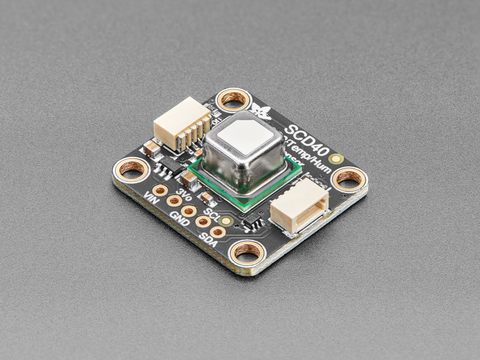
Why CO₂ matters.
Plants pull carbon from the air, so CO₂ is a direct input to photosynthesis. Outdoor air sits around 420 parts per million; in a sealed greenhouse or grow tent, raising it toward 800 to 1500 ppm can lift growth, which is why enrichment is common in serious indoor setups. The flip side is safety and ventilation: a closed room full of plants and people, or a mushroom house where fungi exhale CO₂, can climb to levels that stunt the crop or harm a person. Either way, you cannot manage what you cannot measure, and you cannot measure it with the wrong sensor.
The eCO₂ trap.
This is the one to get right. A class of cheap sensors (the CCS811, SGP30, and similar) is marketed around “eCO₂” or “equivalent CO₂.” They do not have a CO₂ sensor in them. They measure volatile organic compounds and guess a CO₂-equivalent number from that, on the assumption that the only thing changing the air is human breath. In a room full of plants, soil, and nutrients that assumption is false, so the number is meaningless for growing. For real CO₂ you need a sensor that measures it directly by infrared, called NDIR: the Sensirion SCD40/SCD41 or the Winsen MH-Z19 are the common ones. If a listing says “eCO₂” or “equivalent,” it is the guessing kind. Walk past it for any CO₂ decision.
Compare the sensors.
Two real CO₂ sensors and, for contrast, the estimating kind. The tinted column is the modern pick.
| Spec | SCD4xAccuracy pick | MH-Z19 | eCO₂ (CCS811) |
|---|---|---|---|
| Measures | True CO₂, temp, RH | True CO₂ | Estimated eCO₂ + VOC |
| Method | Photoacoustic (NDIR-class) | NDIR infrared | Guessed from VOCs |
| Real CO₂? | Yes | Yes | No, an estimate |
| Calibration | Auto (ABC) or manual | Auto (ABC) or manual | Baseline drift only |
| Interface | I²C | UART / PWM | I²C |
| Cost | About $25–50 | About $15–25 | About $5–15 |
| Best for | Real CO₂, the modern pick | Cheap real CO₂ | Air-quality trend only |
NDIR sensors self-calibrate with an automatic baseline (ABC) that assumes the room hits fresh-air levels regularly; in a room kept enriched, turn ABC off and calibrate manually. The SCD4x is handy because it also reports temperature and humidity from the same part. For the deep dive on the real-CO₂ pick, see the SCD40 and MH-Z19 pages.
Other air sensors.
CO₂ is the headline, but the same corner of the catalog holds a few more. Particulate sensors (the PMS5003 and kin) count dust and smoke (PM2.5), useful near drying, milling, or wildfire season. VOC sensors (the SGP40, or the gas channel of the BME680) track total volatile compounds as an air-freshness trend, not a specific gas. And a plain temperature-and-humidity part rounds out the air picture; for that, see the temperature and humidity page.
Where they fit, and where they don’t.
Where they fit
- CO₂ enrichment in a sealed greenhouse or tent (NDIR).
- Ventilation and fresh-air exchange in a grow or mushroom room.
- Safety monitoring where CO₂ can build up.
- Dust and smoke awareness near drying or milling (PM sensor).
Where they don’t
- Any CO₂ decision from an “eCO₂” sensor. It is a guess.
- Life-safety alarms; use a certified CO₂ or CO monitor for that.
- Enrichment control without turning off auto-calibration.
- Confusing CO₂ (carbon dioxide) with CO (carbon monoxide); different sensors.
Resources.
These open in a new tab:
Sensirion SCD4x (true CO₂) Adafruit SCD4x guide Temp & humidity sensors
Frequently asked questions.
Do cheap CO2 sensors really measure CO2?
Often not. Sensors marketed as eCO2 or equivalent CO2, like the CCS811 and SGP30, measure volatile organic compounds and estimate a CO2-equivalent. They do not contain a CO2 sensor. For a real reading you need an NDIR sensor such as the SCD40 or MH-Z19.
What is the difference between NDIR and eCO2?
NDIR measures carbon dioxide directly by how it absorbs infrared light, giving a true reading in parts per million. An eCO2 sensor measures VOCs and guesses a CO2-equivalent from them, which is meaningless in a room full of plants and soil. NDIR is the kind to buy for growing.
What CO2 sensor should I buy for a greenhouse?
An NDIR sensor. The Sensirion SCD40 or SCD41 is the modern compact pick and also reports temperature and humidity; the Winsen MH-Z19 is a cheaper true-CO2 option. Avoid anything labeled eCO2 for enrichment or safety.
What CO2 level do plants want?
Outdoor air is about 420 ppm. In a sealed space, enriching toward 800 to 1500 ppm can boost photosynthesis for many crops. The exact target depends on the crop and the light. Without enrichment, the goal is usually good ventilation so CO2 does not fall too low or, in dense rooms, climb too high.
Is a CO2 sensor the same as a carbon monoxide detector?
No. CO2 is carbon dioxide, what plants use; CO is carbon monoxide, a toxic gas from combustion. They need different sensors. For life-safety against carbon monoxide, use a certified CO alarm, not a hobby CO2 sensor.