

Incubation is the closed, dark half of a grow: the sealed bag, block or log sits at room warmth while the mushroom's white threads grow through all of its food. It needs no fresh air and little or no light, and humidity matters little while the bag is closed. Temperature is the thing to watch, because a growing block makes its own heat and runs warmer inside than the room: Cornell Small Farms keeps the room near 70°F and never above 80°F. Oyster mushrooms on straw take 14 to 28 days in Cornell's figures; shiitake blocks take weeks longer.
What the mycelium is doing
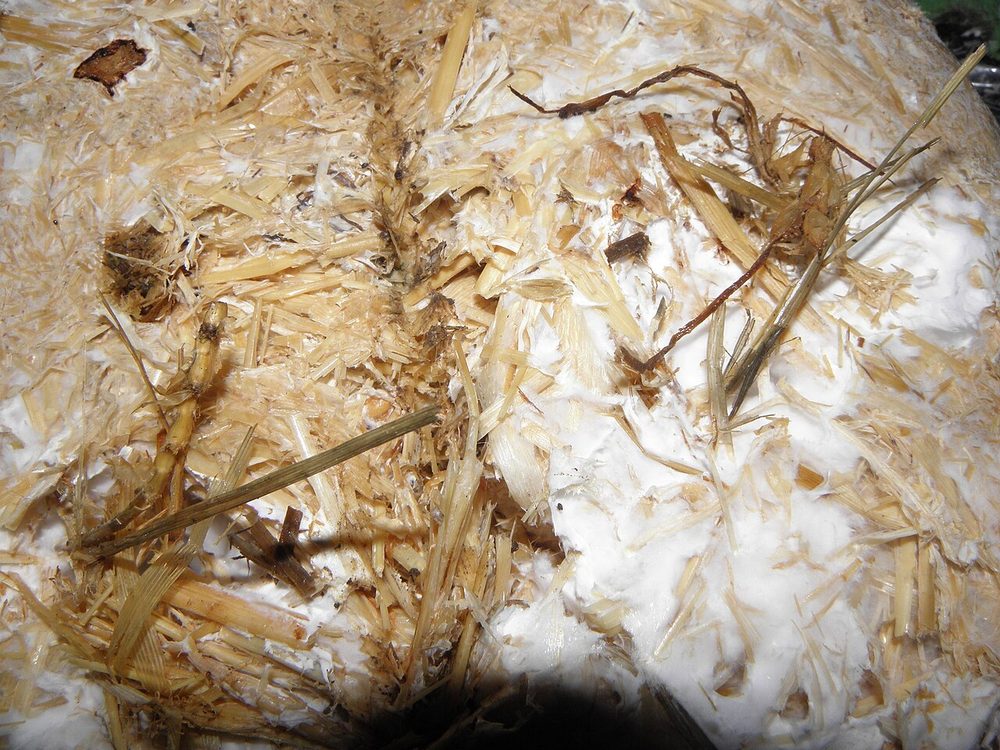
The mushroom you will eat is the last part of the fungus to appear. For weeks before it, the fungus grows as mycelium, the fine white threads that spread through the substrate and feed on it. Cornell Small Farms describes the sequence. About four days after inoculation the mycelium “leaps off” each piece of spawn onto the new substrate. From each point it grows outward in a three-dimensional sphere, and where two spheres meet they fuse, until the whole bag is one organism. When it has grown through all the food it can reach, the block is fully colonized and ready to be started into fruiting.
How fast that happens depends on the mushroom and on what it grows in. Cornell notes that oyster grows faster than shiitake and that sawdust colonizes far faster than logs. Agromisa adds the size of the bag, the amount of spawn, the strain and the temperature.
Setting it up, step by step
These steps are for bags and blocks indoors. Logs and outdoor beds are further down.
- Label each bag and move it at once. ATTRA's 2026 guide labels each unit with the date, batch and species and moves it to incubation right after inoculation.
- Space the bags on open shelves. Cornell's rule is a hand's width between bags, so air can pass between them; bags that touch can overheat where they meet. The Cornell and Fungi Ally farm book says the same, and wants shelving that lets air reach the bottoms of the bags, warning against materials like plywood that can splinter and puncture a bag.
- Hold the room near 70°F. Cornell keeps incubation at about 70°F and never above 80°F; the farm book gives 65 to 75°F.
- Keep it dark or dim. The farm book says no light is needed during incubation, only enough to work by and to watch the growth; ATTRA says dark or low light. For shiitake blocks the sources differ on light; see below.
- Leave the bags closed. UC Cooperative Extension gives no fresh air at all during the spawn run for oyster or shiitake. The farm book runs oscillating fans in the room so the air does not go stagnant around the bags, which it says can shorten incubation.
- Look, but do not handle. ATTRA checks bags regularly for off colors and odors and removes problem units promptly. Shiitake in particular should be left where it is, for reasons below.
Temperature, and why the bag runs warmer
The block makes heat. Mycelium generates heat as it grows (Cornell; farm book), so in a sealed bag the middle runs warmer than the room around it. The sources put the gap at different sizes:
- Cornell Small Farms: in 5- or 10-pound bags of supplemented sawdust, the inside can be 10 to 15°F warmer than outside. At 80°F outside, the core could reach 95°F, warm enough for the mycelium to “cook itself” and let contamination in.
- The farm book: internal bag temperatures tend to run 7 or 8 degrees above the room (it gives no unit; its other temperatures are Fahrenheit); with the room in the 80s, the bags approach the 90s, which can suffocate the mycelium and let contamination grow.
- Agromisa, writing about shiitake bags: the temperature inside is usually “a few or even ten degrees” above the room, and a room packed with bags may need a lot of cooling.
None of the sources we read gives the heat a block puts out in a form you could size a cooler from, so this page stops at what they say. Cornell's conclusion is practical: in a well-insulated room, cooling matters more than heating. The farm book expects an insulated incubation room to need no extra heat in winter and to need air conditioning, and notes that because the room does not have to exchange air with outdoors, an ordinary air conditioner is enough.
Room temperature or substrate temperature? Read which one a source gives. Cornell, the farm book and ATTRA give the room: ATTRA's targets are 70 to 75°F for oyster and 65 to 70°F for shiitake. UC gives the substrate: oyster grows fastest at 78 to 84°F in the substrate and shiitake at 77°F. Penn State incubates oyster at 23 to 25°C (73 to 77°F) substrate temperature. With the bag running warmer than the room, a room figure and a substrate figure for the same mushroom are not the same number.
If you want one number for the room, Cornell’s 70°F sits inside both the farm book’s range and ATTRA’s for oyster and shiitake; that reading is ours.
Cooler is slower, not fatal. Cornell says the room can drop as low as 50°F, but incubation will take longer. For shiitake there is a catch: Cornell warns that if the temperature falls below 55°F after week 4 or 5, blocks tend to fruit early instead of finishing, which greatly reduces yield.
Air, humidity and light
All three matter far less now than they will in fruiting. Cornell says temperature and humidity are the two things to control during incubation, and that CO2 and light are not important; they can be set for the comfort of the people working in the room. For bags indoors, even humidity drops back, because water does not readily escape a plastic bag: the substrate should already hold all the water the spawn run needs (Cornell).
- Air. UC gives no fresh air for the oyster spawn run and puts its CO2 at about 20,000 ppm, with growth stimulated up to 28,000 ppm. ATTRA limits air exchange to keep that CO2 in and keeps drafts away.
- Humidity. UC gives 90 to 100% for oyster and 90% for shiitake blocks; UF/IFAS Extension and ATTRA keep 80 to 90%. For a sealed bag these are the room around it.
- Light. UC incubates oyster in total darkness and says shiitake needs no light. Two other sources disagree for shiitake blocks: Agromisa says some light should be given at least at the end of the spawn run, and that a little light at every stage avoids problems. ICAR-DMR's shiitake strain sheets give 8 to 10 hours of light a day during spawn run for DMR Shiitake-38, and its short-duration method runs 4 hours of light and 20 of dark. Our suggestion: follow what your spawn supplier gives for your strain.
How long, by mushroom
Cornell Small Farms gives these incubation times in general: oyster on straw 14 to 28 days; oyster on sawdust 10 to 20 days; shiitake on sawdust 42 to 84 days; most specialty mushrooms on sawdust 21 days. ATTRA puts bags at one to three weeks and logs at much longer. The sources below each give one method, so their figures differ with the method as well as the mushroom.
| Mushroom and method | Temperature | Time | Source |
|---|---|---|---|
| Oyster, bags | Fastest at 78 to 84°F in the substrate; dark, no fresh air | 10 to 14 days | UC, p. 27 |
| Oyster on cottonseed hulls and straw | 23 to 25°C (73 to 77°F) substrate | 12 to 14 days | Penn State |
| Oyster on straw, at home | 24 to 25°C (75 to 77°F), dark | 2 to 3 weeks, until the bag is white | UF/IFAS |
| Pink oyster | 22 to 25°C (72 to 77°F), dark | 8 to 10 days | ICAR-DMR, p. 19 |
| King oyster | 22 to 25°C (72 to 77°F) | 15 to 20 days | ICAR-DMR, p. 27 |
| Lion's mane | 23 to 25°C (73 to 77°F) | 20 to 25 days | ICAR-DMR, p. 49 |
| Shiitake, sawdust blocks | Fastest at 77°F in the substrate | 30 to 60 days | UC, p. 45 |
| Shiitake, short method | 22 to 25°C (72 to 77°F), 4 hours of light a day | 36 to 40 days, including bump formation | ICAR-DMR, p. 29 |
| Shiitake, logs | Outdoors, in shade | 6 to 12 months (UC, p. 45); 8 to 18 months (University of Vermont) | UC; University of Vermont |
The time for a block is a guide, not a schedule. Agromisa says spawn run depends on the bag, the spawn, the strain and the temperature, and the mushroom substrate recipe tool gives the incubation step for each recipe it offers.
Healthy growth and signs of trouble
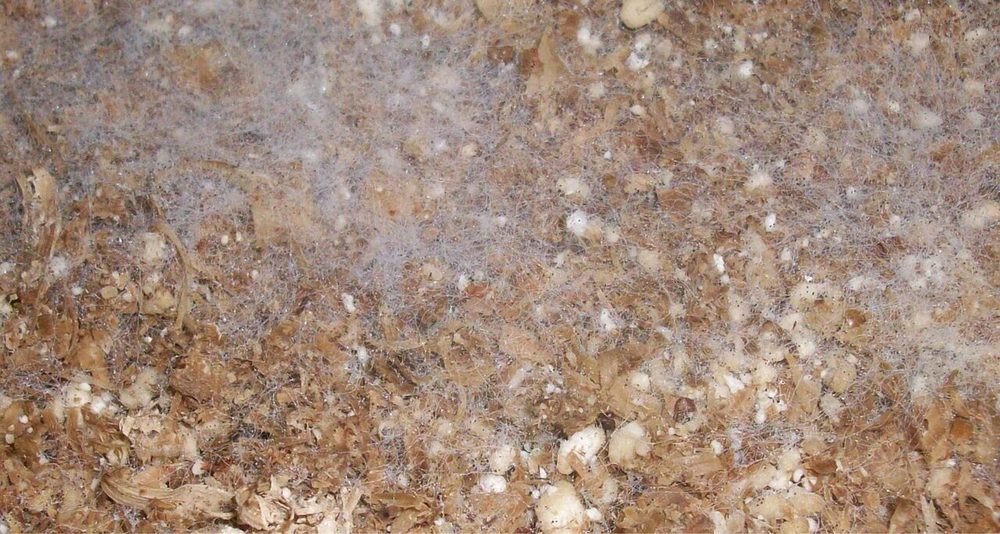
Healthy looks like white mycelium growing out from each piece of spawn and spreading until the whole bag is white (UF/IFAS); ATTRA's aim is even, white growth through the substrate. On logs, the University of Vermont guide watches the cut ends, where shiitake mycelium shows white and often slightly fluffy.
| What you see | What it points to | Source |
|---|---|---|
| Blue, green, black or yellow spots | Contamination by unwanted fungi or bacteria | UF/IFAS |
| Fast-spreading green growth | Trichoderma, one of the common contaminants | UF/IFAS |
| Off colors or a bad smell | A problem unit: take it out promptly | ATTRA |
| Dieback where two bags touch | Overheating from the mycelium's own heat | Cornell |
| Small mushrooms forming on an oyster bag | Colonized and ready to move to fruiting | Agromisa |
What to do with a contaminated bag. UF/IFAS says bags that are badly contaminated are best removed and discarded, but a partly contaminated bag may still give at least one flush if air exchange and humidity are kept right. Agromisa's benchmark for shiitake bags is that no more than 5% should become contaminated. The keeping it clean page covers where contamination comes from, and a bag that stops growing without visible contamination is covered on the stalled colonization page.
Shiitake blocks: the extra weeks
A white shiitake block is not finished. Agromisa says so directly: when the substrate has turned white it is not ready to fruit, and has to mature first. It describes five stages for shiitake in bags:
- Mycelial running, the white spawn run that every mushroom goes through.
- Coat formation: a thick white skin of mycelium forms on the surface, two to four weeks after inoculation. High CO2 makes it thicker.
- Bumps: clumps of mycelium form on the surface; some become primordia, most fall off. Temperature swings and high CO2 encourage them. If many form, Agromisa lowers the CO2 by slitting the plastic, because green molds can take hold on bumps later.
- Browning: with some air given once the bumps have formed, the mycelium turns reddish brown.
- Coat hardening: the outside hardens into a brown skin that, Agromisa says, works like bark: it keeps contaminants out and moisture in.
Cornell Small Farms gives the same process in the time it takes: after full colonization, shiitake needs another 4 to 5 weeks; the block becomes bumpy (“popcorning”) and around week 5 starts to turn brown. Its rules while that happens:
- Give each block a palm's width. Blocks that touch will not popcorn and will not produce mushrooms in that spot.
- Do not move them. Moving or rearranging the blocks is a physical shock that can start fruiting early. Cornell leaves shiitake on the shelf for 6 to 7 weeks.
- Keep the temperature steady. Swings, and a drop below 55°F after week 4 or 5, also start early fruiting and cut the yield.
Logs and outdoor beds
Outdoors the danger is drying out, not overheating. Cornell says the most important thing during outdoor incubation is that the mycelium does not dry out.
- Shade. The University of Vermont guide puts the laying yard, where logs incubate, under year-round shade of 75 to 100%, ideally beneath conifers; under a deciduous canopy it adds 80% shade cloth or pine boughs in winter.
- Moisture. Vermont keeps the log's moisture content well above 30%. Cornell's sign that a log needs water is cracking at the ends big enough to fit a dime: soak it for 6 to 8 hours, which in summer should not be needed more than once a month.
- Stacking. Vermont starts most logs in a crib stack, layers laid at right angles, with 1 to 2 inches between the logs in a layer for air.
- Wood chip beds. Cornell waters a bed at inoculation and once a week for a month after. A bed in shade with chips 4 inches deep or more holds its moisture.
Log times are long: 6 to 12 months for shiitake logs in UC's figures, 8 to 18 in Vermont's. Cornell gives 6 to 18 months for shiitake logs, 4 to 12 for oyster logs, 24 to 36 for stumps and 2 to 12 for wood chips.
When to move it on
Agromisa's rule is to change nothing until the mycelium has grown all the way through, because the changes that start fruiting slow the mycelium down. How you know, by kind of block:
- Oyster bags: the whole bag is white (UF/IFAS). Agromisa sees oyster colonize in two or three weeks and start to form small mushrooms; then either the room's conditions change or the bags move to the fruiting room.
- Shiitake blocks: Cornell waits until about 75% of the block has turned brown and popcorned. Agromisa, working with bags, takes the plastic off once a half or a third of the bag has turned brown. Penn State gives a 20 to 25 day spawn run in the bag, then about 4 weeks of browning with the bag removed.
- Logs: at the end of the spawn run, Penn State says logs often move to a raising yard that is cooler and moister. Soaking and forcing them are on the fruiting page.
The fruiting page picks up from here: opening the bag, the cold shock, humidity and fresh air.
Measuring it
Temperature is the one reading that matters in incubation, and the sources disagree on the number that matters most: how far your blocks run above your room. A thermometer at shelf height tells you the room. Our suggestion, not a source's: put a sealed temperature probe in the middle of one block near the centre of a full shelf, and treat that block as a test block, because the hole the probe makes is a way in for contamination. The temperature and humidity sensors page lists a sealed probe, the DS18B20, and how each sensor is rated.
Before and after this step
Sources
- University of California Cooperative Extension. 2011. Cultivating Mushrooms on Small Farms (slides). Spawn run conditions for oyster (p. 27) and shiitake (p. 45): substrate temperature, the upper limits, humidity, CO2, fresh air, light, duration.
- Cornell Small Farms Program. Methods of Commercial Mushroom Cultivation in the Northeastern United States: 2. Seven Stages of Cultivation. Leap-off and colonization, incubation times, room temperature and the warmer bag core, spacing, shiitake popcorning and browning, outdoor incubation of logs and beds.
- Crosby, W. (Fungi Ally) and S. Gabriel (Cornell Small Farms Program). 2021. Specialty Mushroom Farm Book. Northeast SARE. Creating an incubation room: temperature, bag heat, cooling, shelving, spacing, fans, lighting.
- Soto-Velez, G. 2026. Mushroom Cultivation (IP677). ATTRA, National Center for Appropriate Technology. Labelling and moving bags, colonization targets and times, checking for problem units (pp. 11 and 12).
- Liao, H.-L., C.-M. Hsu, K. Hameed and V. T. Cotter. 2018, revised 2025. D.I.Y. FunGuide: Grow Your Own Oyster Mushrooms at Home (SL448). UF/IFAS Extension. Incubating straw bags, what colonized looks like, contamination colors, what to do with a contaminated bag.
- Oei, P., with B. van Nieuwenhuijzen. 2005. Small-scale mushroom cultivation (Agrodok 40). Agromisa Foundation and CTA. Oyster spawn run (p. 47); shiitake spawn run, bag temperature, light and the five stages (pp. 60 and 61).
- ICAR-Directorate of Mushroom Research, Solan. 2020. Technologies Developed by ICAR-DMR for Commercial Use. Spawn run for shiitake strains (p. 8), pink oyster (p. 19), king oyster (p. 27), the short shiitake method (p. 29) and lion's mane (p. 49).
- Penn State Department of Plant Pathology and Environmental Microbiology. Specialty Mushrooms: Production Technology. Oyster substrate temperature and time; shiitake spawn run and browning; the raising yard for logs.
- University of Vermont Extension and Cornell University (project coordinators K. Mudge and A. Matthews). Best Management Practices for Log-Based Shiitake Cultivation in the Northeastern United States. Northeast SARE. The laying yard, shade, log moisture, crib stacks, incubation time (pp. 23 and 25).
Frequently asked questions.
How long does it take for mycelium to colonize a mushroom bag?
It depends on the mushroom and the substrate. Cornell Small Farms gives 14 to 28 days for oyster on straw, 10 to 20 days for oyster on sawdust, about 21 days for most specialty mushrooms on sawdust, and 42 to 84 days for shiitake on sawdust. UC Cooperative Extension gives 10 to 14 days for oyster. Logs take months: 6 to 18 for shiitake in Cornell's figures.
What temperature should I incubate mushroom bags at?
Cornell Small Farms keeps the incubation room at about 70 F and never above 80 F; the Cornell and Fungi Ally farm book gives 65 to 75 F. ATTRA gives 70 to 75 F for oyster and 65 to 70 F for shiitake. Keep in mind that the inside of a sawdust bag can run 10 to 15 F warmer than the room (Cornell).
Do mushroom bags need light while they colonize?
Most do not. UC Cooperative Extension incubates oyster in total darkness, and the Cornell and Fungi Ally farm book says light is only needed to work by. Shiitake blocks are the exception in some sources: Agromisa gives some light at least at the end of the spawn run, and ICAR-DMR runs shiitake with several hours of light a day.
Do mushroom grow bags need fresh air while colonizing?
No. UC Cooperative Extension gives no fresh air exchange during the spawn run, and gives about 20,000 ppm of CO2 for the oyster spawn run, with growth stimulated up to 28,000 ppm. Fresh air comes in at fruiting. An oscillating fan in the room keeps the air around the bags from going stagnant (Cornell and Fungi Ally farm book).
Why is my mycelium growing so slowly?
The usual reasons in the sources are a cold room, a dense or slow substrate, too little spawn, or the strain. Cornell Small Farms says a room as cool as 50 F still works but incubation takes longer, and that oyster is faster than shiitake and sawdust faster than logs. Agromisa adds the amount of spawn and the size of the bag. A bag that stops growing altogether is covered on the stalled colonization page.
Is green on my mushroom bag mold?
UF/IFAS Extension treats it as contamination: it says blue, green, black or yellow spots indicate contamination by unwanted fungi or bacteria, and names Trichoderma, which shows as rapid greenish growth, as a common one. It advises removing and discarding badly contaminated bags; a partly contaminated bag may still give one flush.
When is my shiitake block ready to fruit?
When it has browned, not when it is white. Cornell Small Farms waits until about 75% of the block has turned brown and bumpy, usually after 6 to 7 weeks on the shelf. Agromisa, growing in bags, removes the plastic once a half or a third of the bag has turned brown. Do not move the blocks before then: Cornell says moving them can start fruiting early and cut the yield.
Why do my mushroom bags get hot?
Because the mycelium makes heat as it grows. Cornell Small Farms says 5- or 10-pound sawdust bags can run 10 to 15 F warmer inside than the room, so an 80 F room can put the core near 95 F, warm enough to damage the mycelium and let contamination in. Keep a hand's width between bags and cool the room rather than heat it.