

Spawn is the mushroom already growing on a carrier of grain, sawdust or wooden plugs, and inoculation is putting it into prepared food quickly and cleanly enough that it gets established before anything else does. For a bag of pasteurized straw, UF/IFAS Extension mixes in 5 to 10% spawn once the straw has drained and cooled. For shiitake logs, the University of Vermont guide drills holes 3 inches apart, packs them with sawdust spawn and seals them with wax, within three weeks of felling. Straw and logs can be inoculated in the open with clean hands; richer, sterilized mixes need lab-like conditions (Cornell Small Farms).
What spawn is
Spawn is mycelium, the white threads of the mushroom, grown from a known strain on a carrier that you can handle and spread. Cornell Small Farms compares it to seed: most growers buy it from a supplier, who isolates the culture in a sterile lab so that it is free of contaminants. The University of Vermont guide stresses that it is the fungus's living threads, not its spores.
Why not spores? Agromisa gives three reasons: spores are too small to handle easily, their genetics may differ from the parent mushroom's, and they are slow to germinate while green molds germinate and spread much faster. Spawn arrives already growing, and Agromisa's point is that the mushroom has to colonize the substrate before other fungi or bacteria do. The substrate page covers preparing the food it goes into.
Grain, sawdust or plug
Cornell names three common forms of spawn: grain, sawdust and plug. Which one suits you depends on what you are inoculating.
| Spawn | Strengths | Drawbacks | Source |
|---|---|---|---|
| Grain | Very nutritious for the mushroom and vigorous; the kernels spread easily through the substrate | Feeds other organisms too, so it is more prone to contamination; spoils quickly; warms the substrate faster than sawdust spawn; rodents eat it, so it is unsuitable outdoors | Agromisa, pp. 33 and 35 |
| Sawdust | Keeps much longer at a higher temperature; the material costs less. In logs, its mycelium moves into the wood faster than plug spawn's, and work goes faster | For logs, needs an inoculation tool to push it into the holes | Agromisa, p. 35; University of Vermont, p. 18 |
| Plug | Wooden dowels colonized with mycelium; needs only a drill and a hammer or mallet | Slightly more costly per log than sawdust spawn; colonizes the log more slowly; inoculating is slower | University of Vermont, p. 18; Washington State University, p. 3 |
Agromisa's table of common pairings: shiitake in sterilized sawdust bags takes grain or sawdust spawn; oyster mushrooms on pasteurized or sterilized substrate take grain, sawdust or straw-based spawn. For shiitake logs, both the Vermont and Washington State guides use sawdust or plug spawn.
How much spawn
Spawn rate is the weight of spawn as a share of the substrate's weight. ATTRA's example: a 2% rate is 20 g of spawn per kilogram of wet substrate. The sources give different rates for different methods. The table gives each source's figure for its own way of growing.
| Substrate and method | Spawn rate | Source |
|---|---|---|
| Pasteurized wheat straw in bags, at home (oyster) | 5 to 10%, by volume or by weight | UF/IFAS |
| Pasteurized straw or other unsupplemented substrate, in buckets, bags or totes | 5 to 10% by weight | ATTRA, p. 11 |
| Sterilized sawdust or supplemented sawdust blocks, in bags or bottles indoors | 2 to 5% by weight, at least 2% in sterile conditions | ATTRA, p. 11 |
| Pasteurized substrate in bags (oyster) | 3 to 8% of the substrate's weight | Agromisa, p. 44 |
| Sterilized bags (oyster) | 7 to 10%; less if it gives similar results | Agromisa, p. 44 |
| Pasteurized cottonseed hulls and straw (oyster) | Up to 5% of the wet weight | Penn State |
| Pasteurized straw or other farm waste (oyster species) | 3% of the wet weight | ICAR-DMR, p. 19 |
| Spawning substrate in general | 2 to 4% | UN ESCAP training manual, p. 36 |
The mushroom substrate recipe tool works out the spawn for each published recipe on that recipe's own basis, wet or dry weight.
More spawn, faster growth. ATTRA, Penn State, Cornell and the UN ESCAP manual all say so. ATTRA puts it plainly: more spawn colonizes faster and lowers the risk of contamination, but costs more. ATTRA advises the higher 5 to 10% when pasteurizing or working outdoors, to outcompete contaminants.
More spawn, more mushrooms? The sources disagree. Penn State reports that raising spawn from 1.25% to 5% of the wet weight may raise oyster yields by nearly 50%, partly because the spawn adds food and partly because a faster spawn run leaves less time for weed molds. Cornell's guide says the extra spawn likely will not produce more mushrooms, only faster growth at a higher spawn cost, and the UN ESCAP manual says the quantity of spawn does not directly affect yield. Penn State's figure is for oyster on pasteurized hulls; Cornell's is from shiitake on supplemented sawdust, so both may hold for their own method.
Finding your own rate. Cornell suggests a high rate for a new grower, because it raises the success rate, and lowering it once the process is reliable. Cornell's guide reports a trial by the Fungi Ally farm on shiitake: one 5 lb bag of spawn did 20 five-pound bags of supplemented sawdust, then 30, then 40, and they still colonized in about 8 weeks with little or no rise in contamination. At 50 bags, colonization slowed and contamination rose. One bag of spawn to 200 lb of substrate is 2.5% (our arithmetic). As a worked example of the other end (also ours): 10 lb of wet, pasteurized straw at UF/IFAS's 5 to 10% takes 0.5 to 1 lb of spawn.
How clean to work
Inoculation is the step most likely to let contamination in (ATTRA; Agromisa). How clean you need to be depends on how rich the substrate is, and Cornell draws the line:
- Logs, wood chips and straw (low in nitrogen, high in carbon) are fine to inoculate outside in the open air, with a clean table and clean hands. Sterility is not a concern.
- Grain, supplemented sawdust and agar (high in nitrogen) are easy for other microorganisms to grow on and need a lab-like setting. Low-budget equipment can mimic one, at a lower success rate; a commercial lab has a separate, cleaned space, HEPA filters and steam equipment.
For sterilized bags and blocks, ATTRA's commercial practice: work under a laminar flow hood or a HEPA-filtered clean bench in a dedicated room; wipe benches and tools with alcohol; let sterilized substrate cool fully to room temperature before opening it; set out all supplies first so that bags are open as little as possible; wear clean gloves, a mask and a hair cover, sanitize gloved hands often, and do not talk over open bags. Agromisa adds clean clothes, holding spawn and substrate containers on their sides so that spores do not fall in, and keeping each bag open for as short a time as possible.
For pasteurized straw, cleanliness still matters: ATTRA suggests a simple still-air box or a very calm, clean room. Our reading of the two sources together: for a first bag of straw, a clean table, clean hands and a calm room meet both, and a still-air box is extra margin. UF/IFAS cleans the work desk and the room, and inoculates the straw as soon as it has drained and cooled, to give unwanted fungi less time. The keeping it clean page covers where contamination comes from at every stage.
Spawning a bag, step by step
These steps are for oyster mushrooms on pasteurized straw, the usual first grow, following UF/IFAS Extension unless another source is named. The substrate page covers soaking and pasteurizing the straw.
- Let the substrate cool. UF/IFAS drains pasteurized straw for an hour and inoculates it once it has drained and cooled. Agromisa spawns pasteurized substrate once it is down to 30°C (86°F), and sterilized bags as soon as they are below 30°C. ATTRA lets sterilized substrate cool fully to room temperature; Penn State cools sterilized shiitake bags for 16 to 20 hours.
- Bring the spawn to room temperature. The UN ESCAP manual says refrigerated spawn should be warmed to room temperature before it is used.
- Clean the space and your hands, as above.
- Weigh out the spawn. UF/IFAS uses 5 to 10% of the straw, by volume or weight.
- Mix it through. Either mix the spawn and straw in bulk and then fill the bags, or fill the bags in alternating layers of straw and spawn (UF/IFAS). Mixing it all the way through matters: when a Fungi Ally crew left the spawn on top of half their supplemented sawdust bags, the mixed bags were fully grown through in 14 days and the top-spawned bags took 24 (Cornell).
- Pack the bags firmly. UF/IFAS stuffs each bag tightly, leaving no big gaps, until it feels like a firm pillow; its bags are 25 to 30 cm by 50 to 60 cm (10 to 12 by 20 to 24 inches). Do not make them too big: Agromisa never fills more than 20 kg (44 lb) into a bag, because the substrate heats itself and the inside would pass 30°C (86°F), the upper limit for most oyster mushrooms' mycelium.
- Close the bag and give it air. UF/IFAS ties or staples the top and cuts 10 to 15 small crosses, about 1/2 cm (1/4 inch) across, 4 to 6 inches apart, near the top and bottom of the bag. Agromisa makes holes so that enough oxygen reaches the substrate.
- Label it and move it. ATTRA labels each bag with the date, batch and species, and moves it to incubation straight away.
Sterilized bags work a little differently. They are opened only in the clean space, spawned, and closed again at once: ATTRA presses out the extra air and heat-seals filter-patch bags; Penn State heat-seals sterilized shiitake bags and then shakes them to spread the spawn through the substrate.
Inoculating a log, step by step
These steps are for shiitake on hardwood logs and follow the University of Vermont and Cornell guide (Best Management Practices for Log-Based Shiitake Cultivation) unless another source is named. Washington State University's guide does several things differently; the table after the steps sets them side by side.
- Choose the logs. The Vermont guide's ideal is 4 to 6 inches across, because that size has the most sapwood for its volume, and 3 to 4 feet long so that one person can carry it. Keep the bark intact: damaged bark lets in competing fungi and loses moisture. Trees cut while fully dormant hold their bark better; Washington State fells while the tree is dormant, from late November to early March.
- Inoculate soon after felling. Vermont: any time from one day to three weeks after the tree is felled, sooner being better, with no need to let the logs cure. Its research found that the fewer days between felling and inoculation, the more each log produced. Trees felled in winter are the exception and can be stored for an early spring inoculation. Cornell's guide gives a little longer: within a month of cutting. Store logs out of the sun so they do not dry.
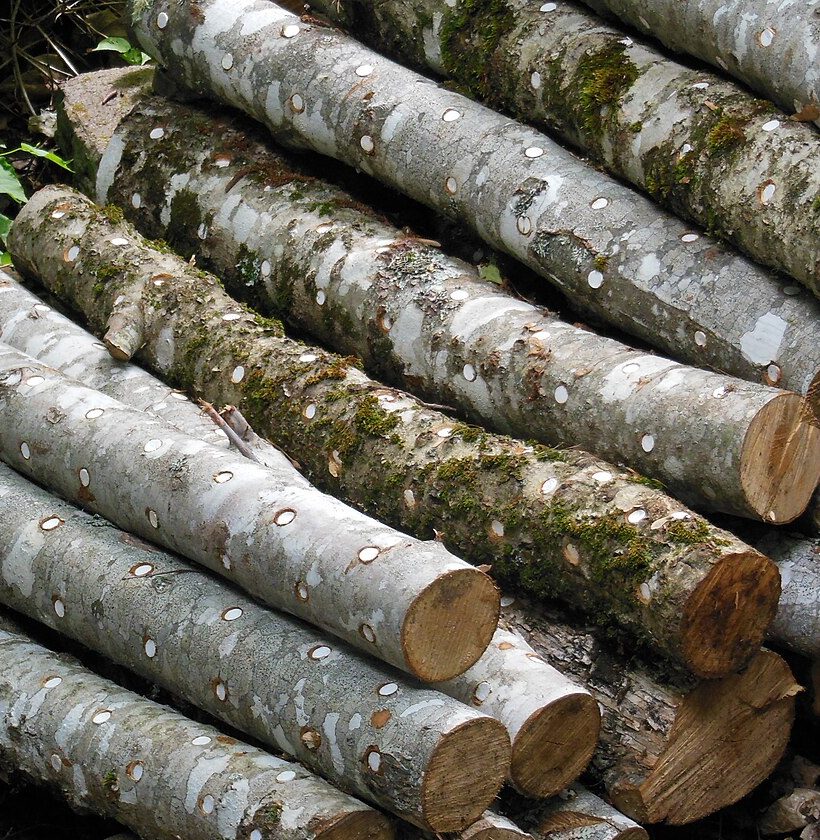
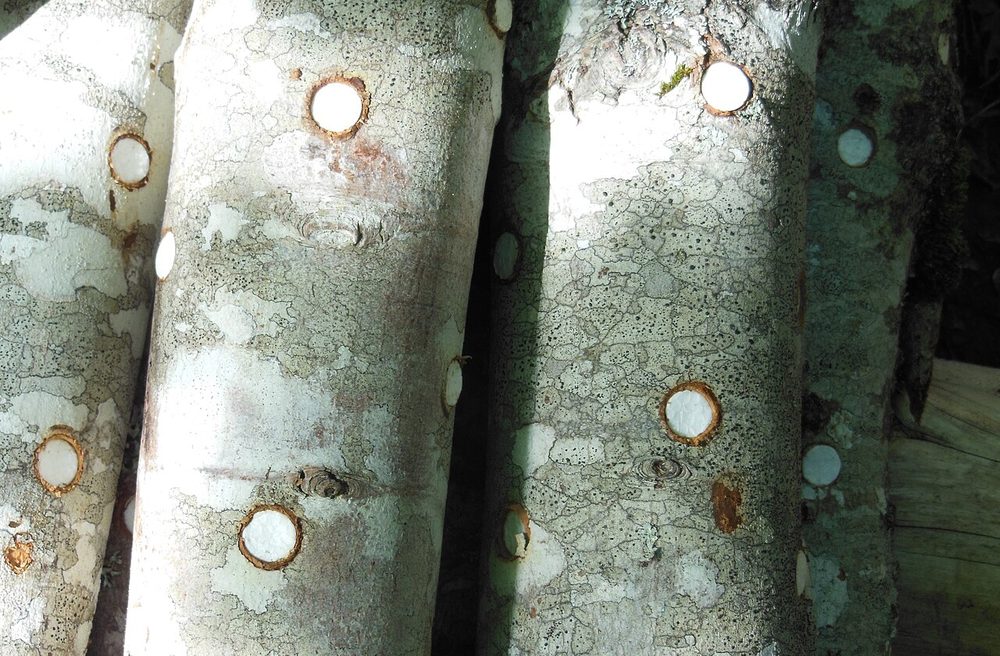
- Drill the holes. Vermont: 7/16 inch wide and 1.25 inches deep, to match the inoculation tool. Start 1 inch from the end, drill holes 3 inches apart along each row, and leave 3 to 4 inches between rows, staggered in a diamond pattern. As many rows as the log has inches of diameter: a 6-inch log gets 6 rows, and every log gets at least 30 to 40 holes. Closer spacing colonizes faster but costs more spawn. Drill bare or damaged patches of bark too; the wax will seal them.
- Fill the holes with spawn. Push the inoculation tool into the sawdust spawn a couple of times to fill it, set it over a hole and press the spawn in. Pack it tightly, to about 1/8 inch below the surface, so that the wax can seal over it. Handle the spawn as little as possible. Most Vermont growers find one 5 lb bag of sawdust spawn does 20 to 25 logs 4 to 6 inches across and 36 inches long.
- Seal every hole with wax. Food-grade wax keeps the spawn from drying out and keeps competing fungi out. Vermont applies it very hot, at 350 to 400°F, lightly smoking, and says wax that turns white at once was not hot enough. Waxing the log ends is optional: an experiment at Cornell's Arnot Forest found no difference in mushroom production between logs with waxed ends and logs without.
| Step | University of Vermont and Cornell | Washington State University |
|---|---|---|
| Hole size | 7/16 inch wide, 1.25 inches deep (sawdust spawn) | 1/2 inch for sawdust spawn, 5/16 inch for plugs, 1 inch deep |
| Spacing | 3 inches apart in a row, 3 to 4 inches between rows, diamond pattern | 4 inches apart in a row, 2 to 3 inches between rows, diamond pattern |
| Wax | Food-grade wax heated to 350 to 400°F, lightly smoking | Cheese wax at 200°F; above about 250°F it burns and smokes. Wax will not stick to wet logs |
| Felling | Inoculate 1 day to 3 weeks after felling | Fell while the tree is dormant, late November to early March |
The two guides disagree most on wax temperature. Both agree that the wax must be melted enough to stick and seal, and that hot wax needs care. Our suggestion, not theirs: where your wax maker gives a temperature, follow it.
Storing spawn
- Keep it cold until you need it. Agromisa keeps spawn in the refrigerator and takes it out only when needed. The exception it names is some strains of pink oyster (Pleurotus djamor), which are sensitive to cold and are kept above 12°C (54°F).
- Heat spoils grain spawn fast. Grain spawn can spoil in one night above 25°C (77°F) (Agromisa).
- Old spawn is weaker. Stored too long, spawn loses vigour; oyster spawn becomes very compact and hard to spread evenly (Agromisa). The UN ESCAP manual says to ask the spawn maker how long the spawn can be kept and to know its expiration date.
- Use an opened container whole. Once a container is opened, the UN ESCAP manual says to use all of it; an opened bag or bottle with no unwanted fungi on its surface can be kept in the refrigerator for 2 to 6 days.
- Warm it before use. Bring refrigerated spawn to room temperature before inoculating (UN ESCAP).
Making your own grain spawn is possible but is lab work: Cornell calls grain a substrate that is very easy to contaminate and not one for beginners, and Agromisa warns that in simple labs grain mother spawn should not be used to start another generation of grain mother spawn, because contamination and degeneration become too likely. The grain spawn recipe tool gives Agromisa's and UF/IFAS's published recipes.
Before and after this step
Sources
- Liao, H.-L., C.-M. Hsu, K. Hameed and V. T. Cotter. 2018, revised 2025. D.I.Y. FunGuide: Grow Your Own Oyster Mushrooms at Home (SL448). UF/IFAS Extension. Spawn rate, cooling, clean work, mixing or layering, bag size, packing, cross cuts.
- Soto-Velez, G. 2026. Mushroom Cultivation (IP677). ATTRA, National Center for Appropriate Technology. Spawn and its carriers (p. 10), the spawn rate table and clean inoculation practice (p. 11).
- Oei, P., with B. van Nieuwenhuijzen. 2005. Small-scale mushroom cultivation (Agrodok 40). Agromisa Foundation and CTA. Why spawn and not spores (p. 9), mother spawn, grain against sawdust spawn, and storage (pp. 32 to 36), spawning pasteurized and sterilized substrate (pp. 44 and 45).
- Cornell Small Farms Program. Methods of Commercial Mushroom Cultivation in the Northeastern United States: 2. Seven Stages of Cultivation. What spawn is, where to inoculate, inoculation rates and the Fungi Ally trials, top against through spawning, timing for logs.
- University of Vermont Extension and Cornell University (project coordinators K. Mudge, Cornell, and A. Matthews, Chatham University). Best Management Practices for Log-Based Shiitake Cultivation in the Northeastern United States. Northeast SARE. Log size (p. 14), when to inoculate (p. 16), spawn types (p. 18), drilling, filling and waxing (pp. 20 to 22), safety.
- Shults, P., J. O'Dea, K. W. Zobrist and E. Jones. 2025. A Hobbyist Guide to Growing Shiitake Mushrooms on Logs for Woodland Owners (FS394E). Washington State University Extension. Felling season (p. 2), spawn types (p. 3), drilling, spacing and wax (p. 5).
- Penn State Department of Plant Pathology and Environmental Microbiology. Specialty Mushrooms: Production Technology. Spawn rate and yield for oyster; cooling, sealing and shaking sterilized shiitake bags.
- ICAR-Directorate of Mushroom Research, Solan. 2020. Technologies Developed by ICAR-DMR for Commercial Use. Spawn rate for oyster species on straw (p. 19).
- Chang, S.-T. Training Manual on Mushroom Cultivation Technology. United Nations ESCAP, Asian and Pacific Centre for Agricultural Engineering and Machinery. Spawn handling, quantity and storage (p. 36).
Frequently asked questions.
How much spawn do I need per pound of substrate?
It depends on the method. UF/IFAS Extension uses 5 to 10% for oyster mushrooms on pasteurized straw at home, so 10 lb of wet straw takes 0.5 to 1 lb of spawn. ATTRA gives 5 to 10% by weight for pasteurized straw and 2 to 5% for sterilized sawdust blocks, at least 2%. More spawn colonizes faster and lowers the risk of contamination, at a higher cost.
Can I make my own mushroom spawn?
Yes, but it is lab work. Cornell Small Farms says grain spawn needs pressurized steam and lab conditions and is very easy to contaminate, so it is not a beginner substrate; most growers buy spawn the way a vegetable grower buys seed. Agromisa and UF/IFAS publish grain spawn recipes, which the OAT grain spawn recipe tool scales to your number of containers.
How long does mushroom spawn last in the fridge?
Ask the maker: the UN ESCAP training manual says to find out how long a spawn can be kept and to know its expiration date, because old spawn loses vigour. Agromisa keeps spawn refrigerated, except some pink oyster strains that are kept above 12 C. Once opened, the UN ESCAP manual says to use a container whole, or keep it refrigerated for 2 to 6 days if nothing else is growing on it.
When should I inoculate shiitake logs?
Soon after the tree is cut. The University of Vermont guide says any time from one day to three weeks after felling, sooner being better, with no need to let the logs cure; its research found that fewer days between felling and inoculation meant more mushrooms per log. Cornell Small Farms allows up to a month. Winter-felled logs can be stored for an early spring inoculation.
How far apart should I drill holes in shiitake logs?
The University of Vermont guide drills 7/16-inch holes 1.25 inches deep, 3 inches apart along each row, with 3 to 4 inches between rows in a diamond pattern and at least 30 to 40 holes a log. Washington State University spaces holes 4 inches apart with rows 2 to 3 inches apart, 1 inch deep. Closer spacing colonizes faster but uses more spawn.
What is the difference between grain spawn and sawdust spawn?
Grain spawn is very nutritious and vigorous and spreads easily through a substrate, but it is more prone to contamination, spoils quickly and is eaten by rodents outdoors (Agromisa). Sawdust spawn keeps much longer at a higher temperature and costs less. For logs, sawdust spawn moves into the wood faster than plug spawn and is quicker to use, but it needs an inoculation tool (University of Vermont).
Do I need a sterile room or a flow hood to inoculate mushrooms?
Not for straw or logs. Cornell Small Farms says logs, wood chips and straw are fine to inoculate in the open air with a clean table and clean hands. Grain and supplemented sawdust are easy for other microbes to grow on and need a lab-like setting; ATTRA describes commercial work under a laminar flow hood or HEPA-filtered bench, and a still-air box or calm, clean room for pasteurized straw.
How hot can the substrate be when I add spawn?
Let it cool first. Agromisa spawns pasteurized substrate once it has cooled to 30 C (86 F) and sterilized bags as soon as they are below 30 C; ATTRA lets sterilized substrate cool fully to room temperature before opening it. UF/IFAS inoculates straw as soon as it has drained and cooled, to give unwanted fungi less time.