

Pick a mushroom when its cap is still curled under at the edge, just before it flattens out: UC Cooperative Extension gives that stage for oyster and shiitake alike. Twist or cut the whole cluster off cleanly, cool it straight away, and keep it cold in a container that lets moisture out. ATTRA's 2026 guide expects most fresh mushrooms to keep five to seven days at 34 to 38°F. The block can then rest and fruit again.
When to pick
Pick by stage, not by size. For most cap-and-stem mushrooms, Cornell Small Farms picks when the gills are exposed but the edge of the cap is still curled under, and says this stage is best for quality and for keeping. UC Cooperative Extension gives the same stage for oyster and shiitake: just before the curled-under margin rises to flat. The University of Vermont's shiitake guide puts it the same way for logs, and adds that a flattened edge means the mushroom is slightly over-ripe but still edible.
| Mushroom | The stage to pick | Timing | Source |
|---|---|---|---|
| Oyster | Just before the curled-under edge of the cap rises to flat | About 10 days between flushes over a 5 to 7 week crop | UC, p. 34 |
| Shiitake on logs | Gills visible, edge slightly curled under but not tightly; a flat, wide cap is past its best | Usually 7 to 10 days after soaking, slower when cold | UVM, p. 39 |
| Shiitake on sawdust blocks | Not described | About 9 to 11 days after soaking | Penn State |
| King oyster | Mature fruit bodies | 3 to 4 days after pinning | ICAR-DMR, p. 27 |
| Lion's mane | Firm, with its form well developed | Not given | ATTRA, p. 16 |
Pick every day. The window is short: Cornell says it is especially short in summer or above 75°F, and that mushrooms need picking every day unless the fruiting room is below 60°F, when picking a few slightly early lets you skip a day. ATTRA adds a reason beyond quality: picking promptly stops caps over-maturing and dropping heavy loads of spores, which keeps surfaces cleaner and may lower what the people in the room breathe.
Pick them dry. Agromisa says mushrooms should be dry on the surface when picked, and that spraying, or rain, a few hours before picking shortens the shelf life of most cultivated mushrooms. The fruiting page has the misting schedule this fits around.
Picking, step by step
- Bring the container you will sell in. Agromisa and Cornell both say to grade at picking and pack straight into the final package, so each mushroom is handled once. Cornell's guide blames the broken edges on store-bought oyster mushrooms on handling between the picker and the buyer. Pick into something rigid that breathes: Cornell uses cardboard boxes, plastic with holes, or used bulb crates.
- Start with the newest blocks or rooms. This is the first of Agromisa's rules for pickers.
- Leave sick mushrooms for last. Agromisa: collect them at the end in a separate bag, then disinfect the picker's hands and clothes. The keeping it clean page covers what to do with them.
- Take the whole cluster. UF/IFAS twists and gently pulls oyster clusters off, or cuts them flush with the substrate with a knife. Agromisa notes oyster mushrooms can be sold as whole young bunches, which look better and keep longer, or as single mushrooms picked when the edge has only just rolled in. Cornell notes that the next flush comes from the same cut, and says to remove all the mushroom material when picking.
- Twist shiitake from logs. UVM's guide says most experienced growers twist and pull with their hands; a curved pair of scissors or a knife also works. A little bark coming away from a well-colonized log is not a worry. On bags, Agromisa breaks shiitake off by holding the stem and cuts the stem with a sharp knife straight after picking, so stem debris does not dirty the rest.
- Do not tear the block. Agromisa: break the mushrooms off gently, without pulling out chunks of substrate. Small dead pins left behind can be rubbed off the surface of a sawdust bag rather than scraped, which would slow the next pins.
- Brush, do not wash. UVM brushes off dirt and debris without putting shiitake under water, then places them in an open basket, paper sack or other vented container.
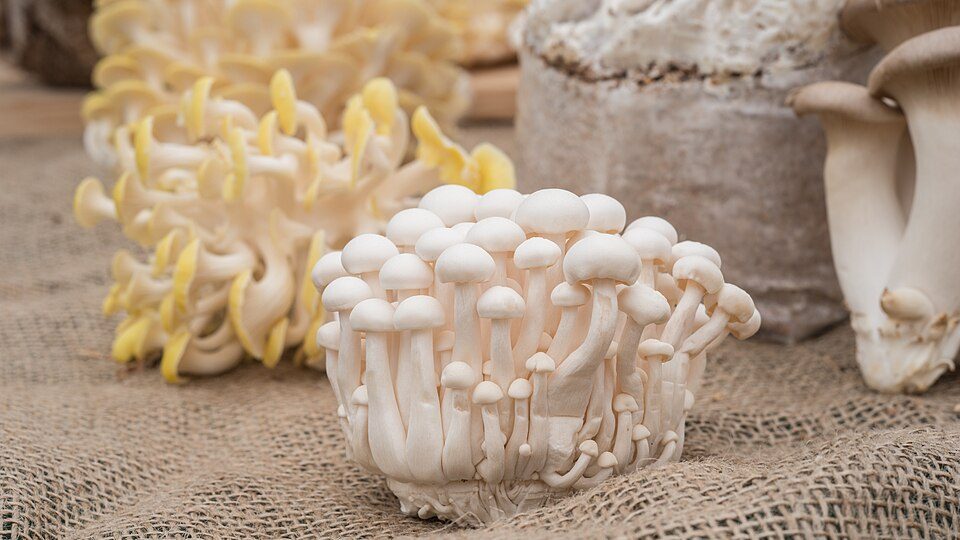
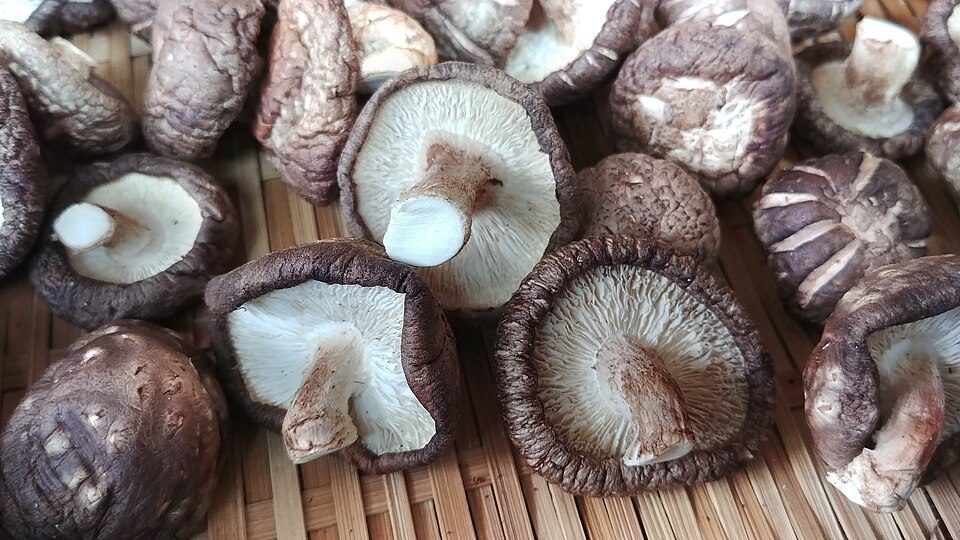
Cooling and storing
A mushroom keeps living after it is picked. ICAR's post-harvest bulletin, written mostly about button mushrooms, explains why speed matters: a mushroom at 10°C (50°F) respires about 3.5 times as fast as one at 0°C (32°F), and that respiration heats it further. The bulletin says to remove the field heat straight after harvest and bring mushrooms down to 4 to 5°C (39 to 41°F) as quickly as possible. UVM's shiitake guide says to get them into refrigerated storage within one hour of picking.
How cold. The sources give slightly different bands:
- Cornell Small Farms: 34 to 37°F, cooled immediately after picking.
- ATTRA: 34 to 38°F, to keep mushrooms firm and limit moisture loss.
- Cornell and Fungi Ally farm book: a cooler between 36 and 40°F.
- UVM, log-grown shiitake: cool (41°F), dry and dark.
The first three bands overlap at 36 to 37°F. That overlap is our reading of the sources, not a figure any of them gives; a household refrigerator, which ICAR's bulletin puts at 4 to 7°C (39 to 45°F), runs warmer than all three.
In what. All the sources want moisture to escape. ATTRA stores mushrooms in breathable containers such as paper bags or vented clamshells, so the caps do not turn slimy, and does not recommend sealing fresh mushrooms in plastic unless they will be eaten within a day. UVM says not to seal them airtight and that a paper bag, not plastic, works very well. For oyster mushrooms, ICAR packs them in polypropylene bags with perforations making up more than 5% of the area, and warns that oyster mushrooms stored very cold in unperforated bags gather condensation and turn slimy and soft. The farm book stores bulk mushrooms in bulb crates in a walk-in cooler with a towel on top to take up the moisture that forms.
Keep the temperature steady. Agromisa explains what swings do to packed mushrooms: when the temperature rises they lose water, and when it falls water condenses inside the package and on the mushrooms, and they wilt fast. ICAR's bulletin also says not to store mushrooms in the same cooler as fruit, because gases from fruit discolour them.
Do not overfill. A grower quoted in UVM's guide fits about 6 to 7 pounds of shiitake in a 15 by 20 by 4 inch box and no more, because the mushrooms at the bottom of a crowded box get no air and spoil first. Expect weight loss in storage either way: UVM notes that mushrooms dry out and lose weight the longer they are kept.
How long they keep
Shelf life depends on the mushroom, the stage it was picked at, the temperature and the package, and the sources measure it in different conditions. The table gives each source's figure with the conditions it was stated for.
| Mushroom | How long, and how kept | Source |
|---|---|---|
| Most fresh mushrooms | 5 to 7 days under ideal conditions, 34 to 38°F in breathable containers | ATTRA, p. 16 |
| Cap-and-stem mushrooms picked at the right stage | About 7 days at 34 to 37°F before they need to be sold | Cornell Small Farms |
| Oyster | 4 days at 8 to 10°C (46 to 50°F), pre-packed in perforated film, in experiments in the tropics | Agromisa, p. 71 |
| Shiitake from logs | Fresh and marketable for several weeks at 41°F, dry and dark, not sealed | UVM, p. 43 |
The sources do not agree on which mushroom keeps longest. Cornell says shiitake keeps better than oyster or lion's mane; ATTRA says lion's mane and chestnut can sometimes keep a little longer than most. Neither gives figures for the comparison.
A fuller set of storage figures by mushroom and temperature, with each study kept to its own conditions, is on the shelf life page.
When there are too many to sell
Agromisa's advice for a small grower is to sell fresh mushrooms straight after picking and, where that is not possible, to dry them. It notes that drying is mostly used for shiitake, and that shiitake and oyster mushrooms both become tastier when dried, though the market for dried oyster mushrooms is smaller. UVM adds that shiitake growers dry their overgrown and damaged mushrooms, and that dried shiitake keep up to a year.
- Spread them out. The mushrooms should not touch, and air has to move around them: Agromisa uses a grill rack or metal grid; UVM lays shiitake gills up.
- Low and slow. Agromisa says longer drying at a low temperature is safer than fast drying at a high one, which can toast them. UVM's oven method holds the chamber at 100 to 125°F for 24 hours.
- How dry. The sources differ: Agromisa and UVM say slightly flexible, not brittle; ATTRA dries until completely crisp and then stores the mushrooms in airtight containers for many months.
- How much is left. UVM: dried shiitake weigh about one seventh of their fresh weight, at around 13% moisture.
Selling dried or cooked mushroom products is governed by state and federal food rules; UVM's guide says each state differs and to take advice from a specialist in yours.
The next flush, and a spent block
After picking, a block rests and then fruits again. For oyster, UC gives about 10 days between flushes over a cropping period of 5 to 7 weeks, and UF/IFAS expects 2 to 4 more flushes after the first, depending on the strain and the room. ATTRA allows a rest of roughly 7 to 14 days between flushes, depending on the species and conditions, with the moisture and humidity kept up for regrowth. Keep misting through the rest: UC's misting also keeps resting pins alive.
Shiitake rests dry, then gets water again. On bags, Agromisa says not to water the scars left by picking for three or four days; white mycelium growing over a scar is the sign of recovery. Its shiitake schedule rests blocks for 7 to 21 days and may give them a cold-water bath to restore their moisture before the next flush. UC gives up to 4 flushes indoors, depending on the soaking schedule. On logs, UVM expects production to peak in the second and third years, and UC gives a log life of 3 to 5 years on oak and 2 to 3 on alder.
When a block is finished. Agromisa keeps harvesting oyster bags as long as the mycelium stays white and firm, for three or four flushes in all, and removes a bag when the substrate turns soft and colourless. Take spent blocks well away from the growing area: Agromisa warns that pests and diseases in used substrate spread easily to fresh blocks. ATTRA notes that many commercial growers harvest only the first flush, because starting a fresh block often makes more sense than waiting for later flushes that give less each time. ATTRA composts spent blocks until they are dark and crumbly before using them on beds or around crops.
What a block yields
Yield is usually stated as biological efficiency: the fresh weight of mushrooms picked, as a percentage of the dry weight of the substrate (UC). At 100%, a pound of dry substrate gives a pound of fresh mushrooms.
- Oyster: 100 to 200%, with an average commercial yield of 1 kg of fresh mushrooms per kilogram of dry substrate (UC); a Southern SARE trial measured 107% on a supplemented pellet mix. On plain pasteurized straw, a Fungi Ally trial for Northeast SARE averaged 18 to 41% by straw treatment, with a best of 65%.
- Shiitake on sawdust blocks: 50 to 145% (UC); Penn State gives an average of 75 to 125% over a cycle of about 4 months.
- Shiitake on logs: UC gives an average commercial yield of 2 to 3 lb of fresh mushrooms per log. UVM's guide expects 0.25 to 0.5 lb per log per flush in the peak years, with two soakings a season, and about 3 to 4 lb per log over five years.
- Maitake: 5 to 35% (UC).
As a worked example from the yield estimator: a 5 lb oyster block at 68% moisture holds 1.6 lb of dry substrate, so at UC's 100% it would give about 1.6 lb of mushrooms in total; the sources give totals, not a figure per flush. How the figure is worked out, and what growers report by mushroom and substrate, is on the biological efficiency page.
Before and after this step
Sources
- Asheville Fungi. Final Report for FS13-268 (waste-stream substrates for oyster mushroom production). Southern SARE producer grant. The standard mix of 80% oak fuel pellets, 18% wheat bran and 2% gypsum in 5 lb bags: 2.15 lb harvested per bag, 43% biological efficiency on wet weight and 107% on dry weight.
- Fungi Ally. Final Report for FNE15-825, Northeast SARE, and its oyster mushroom booklet (pp. 24 and 25). Straw in 10 lb bags at about 70% moisture, six strains, three runs: average biological efficiency 18% (fermented), 20% (wood ash), 29% (heat-pasteurized) and 41% (lime); best 65% (lime, Elm A strain).
- University of California Cooperative Extension. 2011. Cultivating Mushrooms on Small Farms (slides). Harvest stage and flush interval for oyster (p. 34) and shiitake (p. 53), oyster yield (p. 39), shiitake per log (p. 55), the definition of biological efficiency (p. 57) and the ranges by mushroom (p. 58).
- Cornell Small Farms Program. Methods of Commercial Mushroom Cultivation in the Northeastern United States: 2. Seven Stages of Cultivation. Section 7, Harvest: the stage to pick, picking daily, containers, cooling, storage temperature and keeping time; section 5, removing all the mushroom material.
- Crosby, W. (Fungi Ally) and S. Gabriel (Cornell Small Farms Program). 2021. Specialty Mushroom Farm Book. Northeast SARE. Packing and cold storage: crates, a towel on top, cooler temperature.
- University of Vermont Extension and Cornell University. 2013. Best Management Practices for Log-Based Shiitake Cultivation in the Northeastern United States. Northeast SARE project. Harvesting shiitake and yield per log (p. 39), storage and drying (pp. 43 and 44).
- Soto-Velez, G. 2026. Mushroom Cultivation (IP677). ATTRA, National Center for Appropriate Technology. Harvesting promptly, flush rest and first-flush-only growing, spent substrate (p. 14), harvest stage, cooling, containers, keeping time and drying (p. 16).
- Liao, H.-L., C.-M. Hsu, K. Hameed and V. T. Cotter. 2018, revised 2025. D.I.Y. FunGuide: Grow Your Own Oyster Mushrooms at Home (SL448). UF/IFAS Extension. Picking oyster clusters and the number of flushes (p. 4).
- Oei, P., with B. van Nieuwenhuijzen. 2005. Small-scale mushroom cultivation (Agrodok 40). Agromisa Foundation and CTA. Spent oyster bags (p. 51), shiitake after harvest (pp. 62 and 63), picking, grading, packing, keeping time and drying (pp. 69 to 72).
- Rai, R.D. and T. Arumuganathan. 2008. Post Harvest Technology of Mushrooms (technical bulletin). National Research Centre for Mushroom (ICAR), Solan. Respiration and cooling (printed pp. 12 and 13), packing oyster mushrooms (printed p. 16).
- ICAR-Directorate of Mushroom Research, Solan. 2020. Technologies Developed by ICAR-DMR for Commercial Use. King oyster harvest timing (p. 27).
- Penn State Department of Plant Pathology and Environmental Microbiology. Specialty Mushrooms: Production Technology. Shiitake on synthetic logs: days from soaking to harvest, cycle length and biological efficiency.
Frequently asked questions.
When should I harvest oyster mushrooms?
Just before the edge of the cap, which curls under while young, rises to flat. UC Cooperative Extension gives that stage for oyster mushrooms, and Agromisa describes it as the edge having only just rolled inwards, on the verge of becoming horizontal. Picked then, they keep longer. Pick the whole cluster at once.
How do you know when shiitake are ready to pick?
The gills are visible and the edge of the cap is still slightly curled under, but not tightly. The University of Vermont shiitake guide says a flattened edge means the mushroom is slightly over-ripe but still edible, and that log-grown shiitake are usually ready 7 to 10 days after soaking, more slowly in cold weather.
How long do fresh mushrooms last in the fridge?
About five to seven days for most mushrooms, according to ATTRA, at 34 to 38 F in a breathable container. Cornell Small Farms gives about 7 days at 34 to 37 F for mushrooms picked at the right stage. The University of Vermont says log-grown shiitake kept cool, dry and dark at 41 F stay marketable for several weeks.
Should I store mushrooms in a plastic bag?
Not sealed. ATTRA recommends breathable containers such as paper bags or vented clamshells and advises against sealing fresh mushrooms in plastic unless they will be eaten within a day, because trapped moisture spoils them faster. The University of Vermont says a paper bag works very well. ICAR packs oyster mushrooms in plastic bags with perforations over more than 5% of the area.
Should I wash mushrooms before storing them?
No. The University of Vermont shiitake guide brushes off dirt without putting the mushrooms under water. Agromisa says mushrooms should be dry on the surface when picked, and that spraying them a few hours before picking shortens their shelf life.
How many times will a mushroom block fruit?
For oyster, UF/IFAS expects 2 to 4 more flushes after the first, and Agromisa harvests three or four flushes in all, as long as the mycelium stays white and firm. UC gives up to 4 flushes for shiitake grown indoors. ATTRA notes many commercial growers pick only the first flush and start a fresh block.
How long between mushroom flushes?
UC Cooperative Extension gives about 10 days between oyster flushes. ATTRA allows a rest of roughly 7 to 14 days, depending on the species and conditions. For shiitake on bags, Agromisa rests the blocks 7 to 21 days and keeps the picking scars dry for the first three or four.
How much do mushrooms shrink when dried?
A lot. The University of Vermont says dried shiitake weigh about one seventh of their fresh weight, at around 13% moisture. UC Cooperative Extension puts fresh oyster mushrooms at 91% water and shiitake at 85%.