

Shiitake (Lentinula edodes) is grown two ways that are almost separate crops. On sterilized sawdust blocks indoors, Penn State gives a cycle of about four months from inoculation to cleanout. On fresh-cut hardwood logs outdoors, the University of Vermont and Cornell guide gives about a year of spawn run in the shade before the first mushrooms, and then fruiting for three to four years. Either way the mushroom is usually woken on purpose: a shiitake log soaked in cold water for 24 hours starts to pin in 3 to 5 days, in that guide's figures.
What it is and why grow it
Shiitake is a wood-decaying mushroom, and the University of Vermont and Cornell guide calls it the second most produced mushroom in the world after the button mushroom. The two methods trade time against equipment. Penn State sets them side by side: sawdust blocks take about one fifteenth of the time of natural logs and give about three times the biological efficiency. In our reading of the sources, blocks ask for sterilizing equipment and clean work indoors, and logs for a shady woodlot, water for soaking and patience. ATTRA's 2026 guide notes that log-grown shiitake are often considered better in texture, flavor and shelf life, which can bring a higher price for a small producer.
What it grows on
Logs. Shiitake grows on hardwoods. The University of Vermont and Cornell guide ranks them in tiers: oak and sugar maple excellent; ironwood (hophornbeam), musclewood (hornbeam) and American beech very good; birches and bitternut hickory good; red maple workable for a hobby grower but shorter-lived. It advises against white ash, elm, aspen and other soft hardwoods, conifers and fruit woods. In Cornell's four-year trial in the same guide, the greatest yields came from musclewood and red oak. Washington State University's guide, written for the Pacific Northwest, uses red alder, and notes that Oregon oak is a priority conservation species in Washington, so cutting it is discouraged. Both guides want logs about 4 to 6 inches across and 3 to 4 feet long, cut from living trees while they are dormant, with the bark kept intact: damaged bark lets in competing fungi and loses moisture.
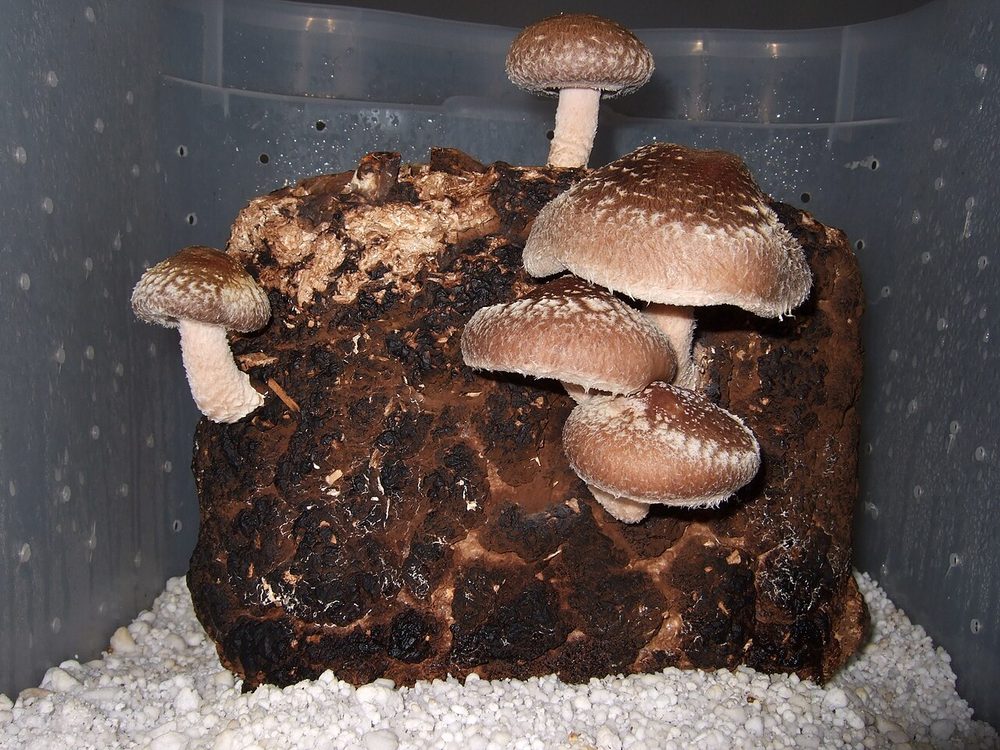
Blocks. Penn State's synthetic logs are hardwood sawdust with a starch supplement (wheat bran, rice bran, millet, rye or corn) at 10 to 40% of the sawdust's dry weight, wetted to about 60% moisture. ICAR, India's Directorate of Mushroom Research, publishes a recipe of 80 parts sawdust, 20 wheat bran, 1 calcium carbonate and 0.5 calcium sulfate. Agromisa's small-scale manual uses far less supplement, 3 to 4% rice bran with 1% corn meal or wheat bran and 1% chalk, at 55 to 65% moisture, and notes that fresh sawdust of oak, birch, chestnut and hornbeam needs no fermenting first. The substrate recipe tool scales ICAR's recipe to your bags, and the substrate page explains wetting and heating.
Step by step, from spawn to harvest
On sawdust blocks
- Mix and wet the substrate. Sawdust and supplement to about 60% moisture (Penn State). Agromisa warns that a mix that is too wet clogs the airflow, and that water collecting at the bottom of a bag means it is certainly too wet.
- Bag and sterilize it. Penn State sterilizes for 2 hours at 121°C (250°F); ICAR fills polypropylene bags with 1.2 to 1.5 kg of wet mix and sterilizes for 90 minutes at 22 psi. Agromisa reports that in Taiwan, steaming at 96 to 98°C gave better results than sterilizing under pressure, and that both work. The sterilize or pasteurize page covers the methods and their safety.
- Cool, then spawn. Agromisa lets the bags cool and spawns them the next day, with 10 g of sawdust spawn enough for a 1.2 kg bag. ICAR adds grain spawn at 3% of the wet weight, on top of the substrate. Spawning is the moment contamination most often gets in; the spawn and inoculation page covers clean work.
- Let it colonize. UC Cooperative Extension gives the fastest growth at a substrate temperature of 77°F, 90% humidity for blocks, no fresh air, no light required, and 30 to 60 days. ICAR's short method incubates at 22 to 25°C with 4 hours of light a day and takes 36 to 40 days. Cornell Small Farms gives 42 to 84 days for shiitake on sawdust and keeps a palm's width between blocks.
- Let it brown before you fruit it. White is not ready, Agromisa says: the block has to mature. Cornell describes another 4 to 5 weeks after full colonization, as the block turns bumpy (“popcorning”) and then, from about week 5, brown. It moves blocks on only when about 75% is brown, after 6 to 7 weeks on the shelf, and leaves them alone meanwhile: moving them, or a drop below 55°F after week 4 or 5, makes them fruit early with much lower yield. Agromisa takes the plastic off when a bag is half or one-third brown and gives some light at least at the end of the spawn run.
- Wake it with water or cold. Strip the bag and soak the block in cold water: Cornell soaks blocks for 5 to 12 hours, Penn State for 3 to 4 hours at 12°C (54°F), and ICAR's short method dips them in water at 6 to 8°C for 10 to 15 minutes. Cornell's other method is to chill blocks for 12 to 24 hours. The sources disagree widely on soak time; our suggestion, not theirs, is to ask the supplier of your strain, and to start at Cornell's 5 to 12 hours if the supplier gives none.
- Fruit it. UC gives 95% humidity at 59 to 68°F while pins form, 2 to 4 air changes an hour, and natural light; then 85 to 90% while the mushrooms grow, with carbon dioxide under 1,000 ppm. The Cornell and Fungi Ally farm book says shiitake does well sprayed directly with water for its first four days. In ICAR's short method, pins appear 2 to 3 days after the cold dip and are grown in another 3 to 4; Penn State picks 9 to 11 days after soaking.
- Pick, rest and repeat. Break each mushroom off holding the stalk, without tearing out substrate, and do not water the scars for three or four days; white growth on a scar is a sign the block is recovering (Agromisa). Agromisa's schedule then rests the block 7 to 21 days and may give it a cold-water bath to restore its moisture before the next flush. UC gives up to 4 flushes indoors, depending on the soaking schedule.
On logs
- Cut the logs while the trees are dormant. The University of Vermont and Cornell guide most often suggests early spring, before the trees leaf out, and allows winter cutting with the logs stored in shade or under clean snow. Washington State University fells from late November to early March. Bark is tighter in the dormant season, which helps keep it on.
- Inoculate soon after felling. Vermont: any time from one day to three weeks after felling, sooner being better, with no need to let the logs cure; its research found that the fewer days between felling and inoculation, the more each log produced. Penn State gives 15 to 30 days. Spawn comes as sawdust, plugs or thimbles; Vermont describes sawdust spawn, which it calls slightly less costly than plugs and quicker to move into the log, and estimates one 5 lb bag inoculates 20 to 25 logs of 4 to 6 inches by 36 inches.
- Drill, fill and wax. Vermont drills holes 7/16 inch wide and 1.25 inches deep, starting 1 inch from the end, 3 inches apart along each row, with 3 to 4 inches between rows in a diamond pattern, as many rows as the log has inches of diameter and at least 30 to 40 holes a log. It packs spawn to about 1/8 inch below the surface and seals each hole with food-grade wax heated until it lightly smokes, at 350 to 400°F. Washington State's spacing, hole size and wax temperature differ; the spawn and inoculation page sets the two guides side by side.
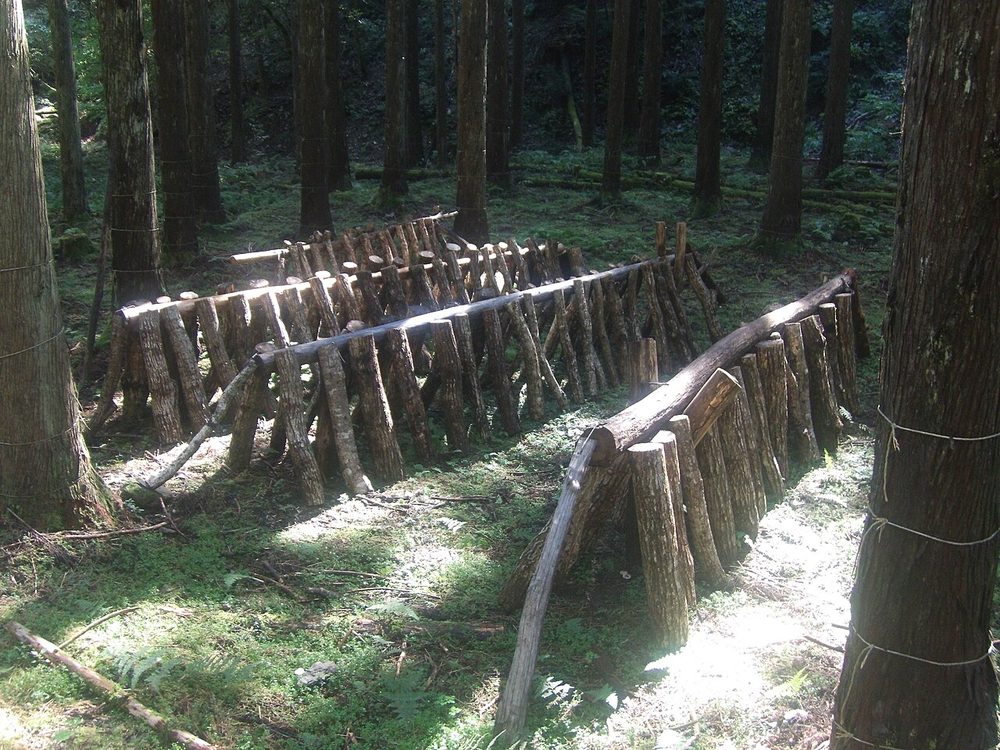
- Lay them up in deep shade. Vermont's laying yard has year-round shade of 75 to 100%, best under conifers, with 80% shade cloth over logs under a deciduous canopy in winter. Logs go in crib stacks about five layers high, 1 to 2 inches apart, off the ground. Logs start at about 40 to 45% moisture and should not drop below 30%; in dry spells they are soaked or sprinkled for a few hours.
- Wait out the spawn run. Vermont gives 8 to 18 months; Washington State a full year or more for wide-range and warm-weather strains in the Pacific Northwest, and 18 to 24 months in dense woods such as oak; Penn State 6 to 9 months. White mycelium showing on most of the log's cut end is a sign it is ready (Vermont; Washington State).
- Force it with a cold soak. Vermont waits until nights average above 50°F, then submerges the logs in the coldest water available for 24 hours; most growers first shock about a year after inoculation. Washington State wants the water about 12 to 20°F colder than the air. A Cornell researcher quoted in the Vermont guide found no statistical difference between 12- and 24-hour soaks of the same tree species, and named the water a log takes up as an important predictor of yield. After soaking, the logs stand in an A-frame for picking.
- Protect the flush and pick it. Pins appear in 3 to 5 days, and the mushrooms are usually ready 7 to 10 days after the soak, slower in cold weather (Vermont); Washington State gives 6 to 14 days. Vermont covers fruiting logs against wind, frost and especially rain in the last 2 to 3 days before picking, because rain makes the mushrooms soggy, and growers discount wet mushrooms by 20 to 25%, if they sell them at all.
- Rest the logs and repeat. Vermont rests logs 6 to 8 weeks before forcing again, because the mycelium needs about 40 days to build up for the next flush, and suggests two to three forcings a year; Washington State rests them 7 to 8 weeks. UC gives a productive life of 3 to 5 years on oak logs and 2 to 3 on alder.
Conditions by stage
The table below gives temperature, humidity, air, light and timing at each stage, for blocks and for logs, with each row taken from a single source. The sources do not all divide the grow into the same stages.
| Stage | What the source gives | Source |
|---|---|---|
| Blocks: spawn run | Fastest growth at 77°F in the substrate; growth stops below 41°F and above 95°F; 90% humidity; 30 to 60 days; no fresh air; no light required | UC, p. 45 |
| Blocks: browning | 4 to 5 more weeks after full colonization; brown from about week 5; move on at about 75% brown; keep above 55°F and do not move the blocks | Cornell Small Farms |
| Blocks: starting fruit | 2 to 4 days at 10 to 20°C (50 to 68°F), 500 to 1,000 lux, 85 to 95% humidity | Agromisa, p. 62 (after B. Chalmers) |
| Blocks and logs: pinning | After a cold soak; 95% humidity; 59 to 68°F; 2 to 4 air changes an hour; natural light, or about 10 lux of 370 to 420 nm light; 7 to 14 days after soaking | UC, p. 48 |
| Blocks and logs: cropping | 85 to 90% humidity; 59 to 68°F; carbon dioxide under 1,000 ppm; 2 to 4 air changes an hour | UC, p. 53 |
| Blocks: rest | 7 to 21 days at 20 to 30°C (68 to 86°F), no light, 65 to 70% humidity; kept dry so picking scars do not spoil | Agromisa, p. 62 (after B. Chalmers) |
| Logs: spawn run | 8 to 18 months; year-round shade of 75 to 100%; log moisture kept well above 30% | University of Vermont, pp. 23 and 25 |
| Logs: forcing | Nights averaging above 50°F; 24 hours in the coldest water available; pins in 3 to 5 days; mushrooms 7 to 10 days after the soak | University of Vermont, pp. 32, 33 and 39 |
| Logs: rest | 6 to 8 weeks between forcings | University of Vermont, p. 33 |
Sources differ on the spawn run for logs (UC gives 6 to 12 months, Penn State 6 to 9, Vermont 8 to 18) and on light for blocks during the spawn run (UC: none required; Agromisa and ICAR give some). The incubation and fruiting pages cover the shared conditions in more depth.
Varieties and strains worth knowing
Shiitake strains are sold by the temperature at which they fruit. Strain names vary by supplier, so ATTRA advises checking each seller's temperature notes and matching the strain to your season.
- Wide range. Reliable, with a fast spawn run, easy to force and quick to recover after fruiting; the University of Vermont guide recommends a wide-range strain if you try only one. Washington State notes that wide-range strains fruit from late spring to fall but yield less than warm-weather strains in the heat.
- Warm weather. Fruit best in summer and early fall, respond well to soaking and tolerate warmer soak water (Vermont); ATTRA puts their season in late spring and summer, with daytime highs around 70 to 80°F. Vermont suggests them for softer hardwoods such as red maple.
- Cold weather. Fruit in early spring and late fall, need a longer spawn run, and do not fruit reliably after forcing, so most growers let the weather start them (Vermont). ATTRA gives roughly 50 to 65°F and thicker, darker caps. Washington State adds that, because they are not soaked, cold-weather logs dry out more in dry summers and produce less each year.
Strain matters as much as method. Cornell Small Farms reports Fungi Ally's trials: average yields ranged from 0.5 to 2.3 lb per log by strain (LE-46 best) and from 0.3 to 1.4 lb per block (3782 best, 46 worst), showing that a strain bred for one substrate can do poorly on another. Agromisa warns of the same: some strains sold for logs gave very low yields on sawdust. ATTRA suggests starting with two or three strains, recording fruiting temperature, cap quality and days from soaking to the next flush, and keeping the ones that suit your site.
Harvest, yield and keeping
When to pick. UC picks shiitake just before the curled-under edge of the cap straightens and the cap opens flat. The University of Vermont guide says the gills should show and the edge be slightly curled under, not tightly; a flattened edge means slightly over-ripe but still edible. Washington State says the same, and that the stem is woody: the cap is the part to eat.
How to pick. On logs, most Vermont growers twist the mushroom off by hand; scissors or a knife avoid tearing bark (Vermont; Washington State). On blocks, Agromisa breaks the mushroom off holding the stalk. The harvest and storage page covers cooling, packing and drying.
What to expect.
- Blocks: UC gives a biological efficiency of 50 to 145%, and Penn State an average of 75 to 125% over its four-month cycle; Agromisa gives normal yields of 15 to 35% of the wet substrate weight; ICAR's short method gives 600 to 800 g of fresh mushrooms per kilogram of dry substrate.
- Logs: UC gives an average of 2 to 3 lb of fresh mushrooms per log. The Vermont guide expects production to peak in the second and third years, at 0.25 to 0.5 lb per log per flush with two forcings a season, and about 3 to 4 lb per log over five years. Washington State gives a conservative 0.25 lb per log per forcing. Penn State puts natural logs at around 33% biological efficiency at most, over about six years.
The yield estimator works these out for your blocks or logs, and the biological efficiency page explains how the measures compare.
Keeping. Vermont gets log-grown shiitake into refrigeration within an hour of picking and finds they stay fresh and marketable for several weeks at 41°F, dry, dark and not sealed in plastic; Washington State also gives several weeks in a paper bag in the refrigerator. A 2021 review of shelf-life studies gives shiitake only 3 to 5 days at 4°C. The two figures have different scopes: the review summarizes laboratory studies of shiitake in general, while Vermont's is growers' experience with log-grown shiitake kept dry, dark and unsealed. The shelf life page sets them out. Washington State adds a caution for the kitchen: shiitake should never be eaten raw, because some people develop an itchy skin reaction, shiitake flagellate dermatitis, from raw or undercooked shiitake.
What goes wrong with this one
- Blocks that fruit too early, or never brown. Cornell: blocks moved, knocked or chilled below 55°F after week 4 or 5 fruit early and yield much less, and blocks that touch each other do not popcorn where they touch. Agromisa: deformed mushrooms in the first flush point to a spawn run that was too short or carbon dioxide that was too high. See won't pin.
- Logs that do not respond to a soak. The log may not be ready, the nights may be too cool, or the strain may be a cold-weather one that does not force reliably (Vermont); Washington State wants soak water 12 to 20°F colder than the air. Vermont says to try again about two months later if a first flush is small.
- Green mold on blocks. Agromisa calls green molds the most common contaminants at spawning, and on bumpy blocks; it keeps blocks dry between flushes and washes the mold off with a strong spray of water after harvest, as the shiitake forms a crust beneath it. See green mold.
- Competing fungi on logs. The Vermont guide lists Trichoderma (a green mold on log ends), Hypoxylon (favored by direct sun on the bark and dry logs), turkey tail, split gill and the black jelly drops fungus. Its prevention is timely felling and inoculation, shade, and logs that stay moist inside with dry surfaces; a log badly taken over can be removed from the yard so it does not spread spores.
- Logs that dry out. Vermont says shiitake spawn cannot survive in logs below 23% moisture, does best at 35% or more, and that a dry log favors competitors. Washington State reports spawn runs delayed by up to three years in dry Pacific Northwest summers when moisture was not managed.
- Pests and weather on logs. Slugs and woodlice are the common pests in Washington State's guide; Vermont growers drape agricultural cloth over fruiting logs against wind and pests, and one reports losing 25 to 30% of a week's crop to pleasing fungus beetles, stopped by cloth on the ground around the A-frames and over the logs. Rain on the last days before picking leaves soggy mushrooms that sell for less (Vermont).
- Cracked caps. On shiitake, dry conditions after pinning can crack the caps into a pattern that some markets value as “flower” shiitake. See dry or cracked caps.
Related pages
Sources
- University of Vermont Extension and Cornell University. 2013. Best Management Practices for Log-Based Shiitake Cultivation in the Northeastern United States. Northeast SARE project. Basics (p. 7), tree species (pp. 11 to 12), felling and log size (pp. 13 to 14), timing and spawn (pp. 16 to 19), drilling, filling and waxing (pp. 20 to 22), laying yard, spawn run and moisture (pp. 23 to 26), competitors (pp. 27 to 29), forcing and rest (pp. 30 to 33), pests and covers (pp. 35 to 36), harvest and yield (p. 39).
- Shults, P., J. O'Dea, K. W. Zobrist and E. Jones. 2025. A Hobbyist Guide to Growing Shiitake Mushrooms on Logs for Woodland Owners (FS394E). Washington State University Extension. Felling and red alder (p. 2), strains (pp. 3 to 4), spawn run (pp. 6 to 8), forcing, fruiting and pests (p. 9), harvest, storage, rest and yield (p. 10).
- Penn State Department of Plant Pathology and Environmental Microbiology. Specialty Mushrooms: Production Technology. Shiitake on natural logs and on synthetic logs: timing, supplements, moisture, sterilizing, browning, soaking, cycle and biological efficiency.
- University of California Cooperative Extension. 2011. Cultivating Mushrooms on Small Farms (slides). Shiitake spawn run (p. 45), pinning (p. 48), cropping, log life and flushes (p. 53), yield (pp. 55 and 58).
- Cornell Small Farms Program. Methods of Commercial Mushroom Cultivation in the Northeastern United States: 2. Seven Stages of Cultivation. Strain trials, incubation times, shiitake browning, soaking and chilling blocks.
- Crosby, W. (Fungi Ally) and S. Gabriel (Cornell Small Farms Program). 2021. Specialty Mushroom Farm Book. Northeast SARE. Spraying shiitake in its first four days.
- Oei, P., with B. van Nieuwenhuijzen. 2005. Small-scale mushroom cultivation (Agrodok 40). Agromisa Foundation and CTA. Chapter 6, shiitake on plastic bags: substrate (p. 58), heat treatment and spawning (p. 59), spawn run and maturing (pp. 60 to 61), the cultivation schedule (p. 62), harvest and green mold (pp. 63 to 64).
- Castellanos-Reyes, K., R. Villalobos-Carvajal and T. Beldarrain-Iznaga. 2021. Fresh Mushroom Preservation Techniques. Foods 10: 2126 (review). Shiitake shelf life at 4°C, from its summary of earlier studies.
- ICAR-Directorate of Mushroom Research, Solan. 2020. Technologies Developed by ICAR-DMR for Commercial Use. The short-duration shiitake method (p. 29).
- Soto-Velez, G. 2026. Mushroom Cultivation (IP677). ATTRA, National Center for Appropriate Technology. Log-grown quality and shiitake strains (pp. 7 and 8).
Frequently asked questions.
How long does it take to grow shiitake mushrooms?
It depends on the method. On sterilized sawdust blocks, Penn State gives about four months from inoculation to cleanout, with a 20 to 25 day spawn run and about four weeks of browning before the first soak. On hardwood logs, the University of Vermont and Cornell guide gives a spawn run of 8 to 18 months in shade, and most growers first force their logs about a year after inoculation.
What wood is best for growing shiitake on logs?
Hardwoods. The University of Vermont and Cornell guide rates oak and sugar maple excellent, and ironwood, musclewood and American beech very good; in Cornell's four-year trial the highest yields came from musclewood and red oak. It advises against white ash, elm, aspen, conifers and fruit woods. Logs about 4 to 6 inches across and 3 to 4 feet long, cut while the tree is dormant, work best.
How long should I soak shiitake logs to make them fruit?
The University of Vermont and Cornell guide submerges logs for 24 hours in the coldest water available, once nights average above 50 F, and Washington State University also soaks for about 24 hours in water 12 to 20 F colder than the air. A Cornell researcher found no statistical difference between 12- and 24-hour soaks. Pins appear in 3 to 5 days.
How long do you soak a shiitake block?
Shorter than a log. Cornell Small Farms soaks blocks for 5 to 12 hours, or chills them for 12 to 24 hours instead; Penn State soaks for 3 to 4 hours at 54 F. The sources disagree, so ask the supplier of your strain; Penn State notes a soak gives enough water for one flush.
When is a shiitake block ready to fruit?
When it has browned, not just turned white. Agromisa says a white block is not ready and has to mature. Cornell Small Farms leaves blocks on the shelf 6 to 7 weeks and moves them on when about 75% of the block is brown and bumpy, keeping them above 55 F and unmoved until then.
How many pounds of shiitake does a log produce?
UC Cooperative Extension gives an average of 2 to 3 lb of fresh mushrooms per log. The University of Vermont and Cornell guide expects 0.25 to 0.5 lb per log per flush in the peak second and third years, with two forcings a season, and about 3 to 4 lb over five years. Washington State University gives a conservative 0.25 lb per log per forcing.
What is the difference between wide range, warm weather and cold weather shiitake strains?
The temperature at which they fruit. Wide-range strains are reliable, force easily and recover quickly, and the University of Vermont guide recommends one for a first try. Warm-weather strains fruit in summer and respond well to soaking. Cold-weather strains fruit in early spring and late fall, need a longer spawn run, and do not fruit reliably after forcing, so the weather starts them.
Why are my shiitake logs not producing?
The logs may not have finished their spawn run (white mycelium on most of the cut end is a sign they are ready), the nights may be below 50 F, the strain may be a cold-weather one that does not force reliably, or the logs may have dried out: the University of Vermont guide says shiitake spawn cannot survive below 23% log moisture. If the first flush is small, it suggests trying again about two months later.