

Lion’s mane (Hericium erinaceus) is grown indoors in bags of sterilized hardwood sawdust with bran, which colonize in about three weeks and then fruit from small cuts in the plastic. ICAR, India’s Directorate of Mushroom Research, runs the spawn at 23 to 25°C (73 to 77°F) for 20 to 25 days and fruits it at 18 to 20°C (64 to 68°F), with mushrooms starting 7 to 10 days after the bag is opened. It needs humid air but should not be wetted directly, and ATTRA notes that dry air turns its long spines into small, dense lumps.
What it is and why grow it
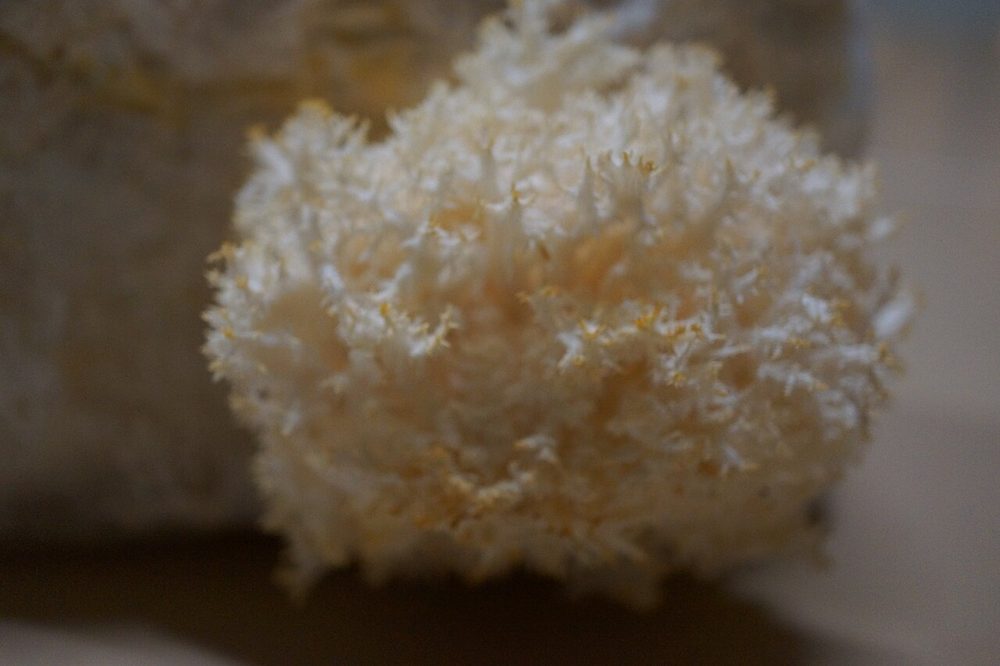
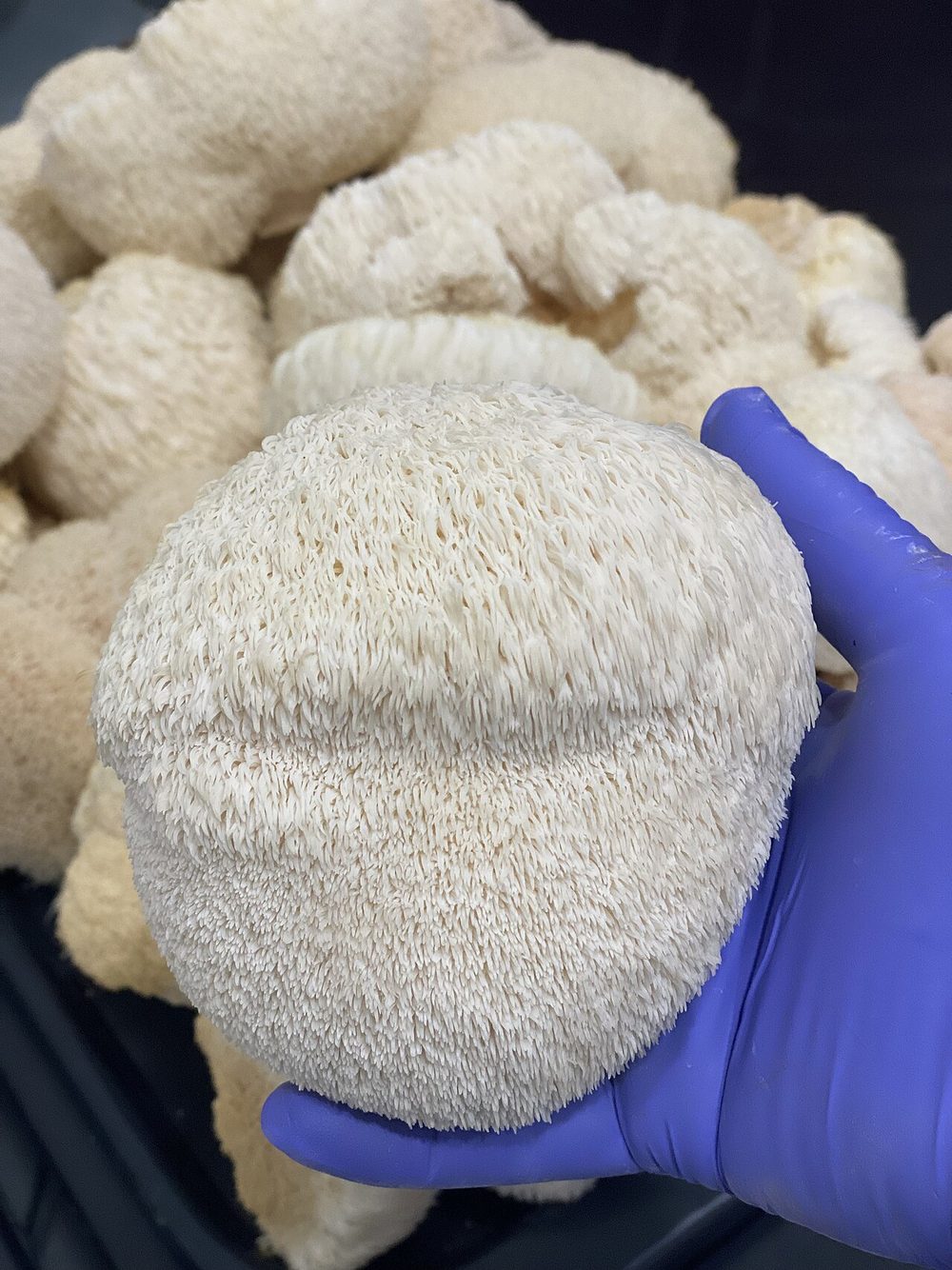
Lion’s mane forms a white, rounded cluster of hanging spines rather than a cap and stem, with a mild flavour that ATTRA says is often compared to seafood. ATTRA recommends growing it indoors on supplemented hardwood sawdust, and describes the dense, snowball-like clusters it gives when its needs are met as striking and highly marketable to chefs. On supplemented sawdust, the usual way to grow it, it asks more of a grower than oyster: Cornell Small Farms says supplemented sawdust needs steam sterilization and clean, lab-like work, and lion’s mane is particular about humidity.
What it grows on
ATTRA says lion’s mane performs best on hardwood-based materials. ICAR grows it on sawdust, sugar cane bagasse, cottonseed hulls or chopped paddy straw, with 5% wheat bran added; ICAR does not say whether the 5% is of the wet or dry weight. The Chinese provincial standards in the 2026 review use richer mixes. Three of them (Fujian, the Qiandongnan pine-forest standard in Guizhou, and Sichuan) give the same sawdust formula: 78% sawdust, 20% wheat bran and 1% gypsum. Others build on cottonseed hulls, corn cobs or mulberry branch chips, the materials each region has to hand.
ATTRA also lists lion’s mane among the mushrooms that can grow in five-gallon buckets or totes of pasteurized straw, though its section on the species recommends supplemented hardwood sawdust indoors. This page follows the sawdust method. Because that mix carries bran, it is sterilized under pressure rather than pasteurized. The sterilize or pasteurize page explains why, and the substrate recipe tool scales ICAR’s lion’s mane recipe to your bags.
Step by step, from spawn to harvest
These steps follow ICAR’s method for sawdust bags unless another source is named. The section’s step pages, linked in each step, give the general detail.
- Mix the substrate. Wet the sawdust (or bagasse, cottonseed hulls or chopped straw) thoroughly and add 5% wheat bran (ICAR). The substrate page covers materials and the squeeze test.
- Get the moisture right. ICAR gives no moisture figure. Two of the Chinese standards do: 58 to 62% in Hailin, Heilongjiang, where the review says the lower range is set to reduce mold in less evaporative conditions, and 62 to 65% in the humid Sichuan basin.
- Bag it. ICAR fills 2 kg (4.4 lb) per polypropylene bag and plugs the mouth with non-absorbent cotton through a ring.
- Sterilize it. ICAR autoclaves the bags at 1.54 kg/cm² (about 22 psi) for 1 to 2 hours. Pressure equipment needs care; the sterilize or pasteurize page sets out the safety points.
- Spawn it once cool. ICAR adds spawn at 3% of the wet weight, which is 60 g (about 2 oz) for a 2 kg bag (our arithmetic). Work as cleanly as the spawn and inoculation page describes for sterilized bags.
- Incubate. ICAR holds the bags at 23 to 25°C (73 to 77°F) for 20 to 25 days. Cornell Small Farms gives 21 days for most specialty mushrooms on sawdust. A bag runs warmer inside than the room, so the incubation page’s spacing and temperature points apply.
- Open the bag. Cornell cuts small V or X slits, typically two on the broad side and one on the narrow side, and spaces them well apart, because a lion’s mane can grow to the size of a fist from a small hole. Fruit it from the side: Cornell warns that a top-fruited bag can gather water and encourage disease.
- Fruit it. ICAR puts the best fruiting temperature at 18 to 20°C (64 to 68°F); ATTRA gives 60 to 68°F. ICAR’s mushrooms start 7 to 10 days after the bag is opened. Keep the air humid, but do not spray the mushrooms: the Cornell and Fungi Ally farm book says lion’s mane becomes waterlogged when sprayed. ATTRA says it benefits from steady light, and the farm book says it tolerates carbon dioxide at 1,000 to 1,300 ppm. The fruiting page covers how to hold humidity and fresh air together.
- Harvest it. ATTRA picks lion’s mane when its texture is firm and its form is well developed; its general advice is to cut cleanly with a knife or twist gently. Details are under harvest below.
Conditions by stage
The table sets the sourced figures for each stage side by side. Two rows come from one experiment in China (Lu and others, 2024), and they are marked as such.
| Stage | Conditions | Source |
|---|---|---|
| Spawn run | 23 to 25°C (73 to 77°F) for 20 to 25 days; humidity and light not given | ICAR-DMR |
| Spawn run, then a rest | 25°C (77°F), 60% air humidity, dark, for 30 days; then 17 to 22°C (63 to 72°F) for 10 days before fruiting | Lu and others, 2024: one study in Jilin, China |
| Fruiting | 18 to 20°C (64 to 68°F); mushrooms start 7 to 10 days after opening; humidity not given | ICAR-DMR |
| Fruiting | 60 to 68°F; high humidity, being especially sensitive to dry air; steady light; enough fresh air | ATTRA |
| Fruiting | 15 to 18°C (59 to 64°F), 90 to 95% humidity, carbon dioxide 0.03%, weak scattered light | Lu and others, 2024: the same study |
| Fruiting, carbon dioxide | Tolerates 1,000 to 1,300 ppm | Cornell and Fungi Ally farm book |
The Lu study’s conditions are the settings of one experiment, not a recommendation. Most other figures for lion’s mane come from the Chinese provincial standards below.
The 2026 review of lion’s mane growing in China (Yang, Zhu and Zheng) compiles the fruiting setpoints written into eight local technical standards, each reflecting at least five years of practice in its region. The review says the figures are practice-based references and not a dataset for comparing zones, so they are given here region by region.
| Region and climate | Temperature and humidity | Carbon dioxide and light |
|---|---|---|
| Hailin, Heilongjiang (cold temperate) | 18 to 22°C; 60 to 85% | Carbon dioxide not given; 100 to 200 lux |
| Fujian (subtropical) | Pins 12 to 18°C at 80 to 85%; fruit bodies 15 to 20°C at 85 to 95% | Under 0.08%; 200 to 600 lux |
| Zhejiang (subtropical) | 14 to 18°C; 80 to 85% to start, 85 to 90% for fruit bodies | Under 0.07%; 200 to 400 lux |
| Qiandongnan, Guizhou (under pine forest) | 18 to 22°C in the forest; 85 to 90% | Not given |
| Henan (temperate) | 16 to 20°C; 85 to 95% | Under 0.1%; 200 to 400 lux |
| Sichuan (southwest) | 16 to 20°C; 90 to 95% | Not given; 50 to 150 lux for pins, 200 to 400 lux after |
| Hebei (temperate) | 15 to 20°C; 80 to 90% | About 0.03%, at most 0.1%; 200 to 500 lux |
| Tibet (plateau, greenhouses) | 15 to 20°C; 80 to 90% | Not given |
Carbon dioxide is given as a percentage of the air: 0.1% is 1,000 ppm, 0.08% is 800 ppm and 0.07% is 700 ppm (our conversion). For Hailin the review’s text and table differ: the text says the region’s cold-tolerant strains fruit in a window of 14 to 18°C, while the table gives 18 to 22°C for the standard.
Varieties and strains worth knowing
Strain choice matters for every mushroom: Cornell Small Farms lists fruiting temperature, colour, shelf life and yield among the traits a strain sets, and suggests that growers making their own spawn trial four or five strains side by side. ATTRA’s general advice is to match strains to the season.
For lion’s mane, the named strains we found are Chinese, from the 2026 review:
- Cold-tolerant, for the northeast: ‘Heiwei 9910’, ‘Xing’an Houtou 1’ and ‘Mu Hou 1’, certified varieties from Hailin, which the review says survive −2 to 0°C while dormant.
- Heat- and humidity-tolerant, for the subtropical southeast: ‘Changshan 99’ and ‘Zhelin Hou 2’.
- Wide-range, for the temperate north: the review describes strains selected to grow across 10 to 30°C without naming them.
We found no source saying whether these strains are sold outside China. A grower elsewhere is choosing among a spawn supplier’s strains, and the supplier’s fruiting temperature for a strain is the figure to plan the room around; that is our suggestion, not a source’s.
Harvest, yield and keeping
When and how. ATTRA picks lion’s mane when its texture is firm and its form is well developed, rather than by a cap stage, and its general harvest advice is to cut cleanly with a knife or twist gently. Cornell Small Farms picks every day unless the fruiting room is below 60°F, because the harvest window is short when it is warm.
Keeping. ATTRA stores fresh mushrooms at 34 to 38°F, where most keep five to seven days, and says lion’s mane can sometimes keep a little longer. Cornell Small Farms says shiitake keeps better than oyster or lion’s mane. The two sources differ, and neither gives a lion’s mane figure. ATTRA lists lion’s mane among the mushrooms that dry well, in a dehydrator or low oven until completely crisp. The harvest and storage and shelf life pages cover cooling and storage.
Yield. No university or extension source we read gives a lion’s mane yield, which is why the yield estimator leaves it out. Single studies report its biological efficiency, the weight of fresh mushrooms per weight of dry substrate:
- Egypt (Hassan 2007, as tabulated in the review by Kumla and others, 2020): 33.9% on rice straw, 39.4 to 43.5% on wheat straw and 47.5 to 50.3% on hardwood sawdust.
- Jilin, China (Lu and others, 2024, one strain, 20 replicates): 89.1% on a straw and corn cob formula and 92.5% on the study’s control formula.
Each is one experiment, on its own strain and substrate. The biological efficiency page explains the measure and how far single studies can be trusted.
What goes wrong with this one
| What you see | What it points to, and where to look |
|---|---|
| Small, dense lumps instead of a cluster with long spines | Air too dry; ATTRA says lion’s mane is especially sensitive to low humidity. See Dry or cracked caps. |
| Fuzzy, misshapen fruit, a musty smell, condensation | Too little fresh air (ATTRA). See CO2 and fresh air. |
| Soggy, waterlogged mushrooms | Sprayed directly (Cornell and Fungi Ally farm book), or fruited from the top so water collects (Cornell). See Fruiting: humidity. |
| Green or other coloured patches in the bag | Contamination; supplemented, sterilized bags need clean work. See Green mold. |
| The bag is slow to turn white | Often temperature or spawn. See Stalled colonization. |
| White through, but nothing forms | Not opened, too warm, too dry or too little air. See Won’t pin. |
Five of the eight Chinese standards in the 2026 review bar pesticides while the mushrooms are fruiting, and the Qiandongnan standard names physical methods such as sticky boards and nets first. The keeping it clean page covers the routine.
Related pages
Sources
- ICAR-Directorate of Mushroom Research, Solan. 2020. Technologies Developed by ICAR-DMR for Commercial Use. The Hericium erinaceus method: substrates, bran, bagging, sterilizing (p. 47); spawn rate, spawn run, fruiting temperature and days to fruit (p. 49).
- Soto-Velez, G. 2026. Mushroom Cultivation (IP677). ATTRA, National Center for Appropriate Technology. Hardwood substrates (p. 6), indoor growing and the clusters (pp. 8 and 9), light and dry-air signs (p. 12), fruiting temperature, stale-air signs and cutting (p. 13), harvest stage, drying and keeping (p. 16).
- Cornell Small Farms Program. Methods of Commercial Mushroom Cultivation in the Northeastern United States: 2. Seven Stages of Cultivation. Strain traits and trials, incubation time on sawdust, the cuts and side-fruiting, daily picking, keeping.
- Crosby, W. (Fungi Ally) and S. Gabriel (Cornell Small Farms Program). 2021. Specialty Mushroom Farm Book. Northeast SARE. Creating a fruiting room: lion’s mane waterlogged when sprayed, carbon dioxide tolerance.
- Yang, D., L. Zhu and Q. Zheng. 2026. Regional Cultivation Forms of Hericium erinaceus Across China’s Climatic Zones: A Scoping Review and Analytical Lens for Climate-Adaptive Production. Journal of Fungi 12: 285. Table 1 (eight provincial standards: substrates and fruiting setpoints), the moisture ranges and named strains (section 3).
- Lu, Z. and others. 2024. Optimization of substrate formulation for Hericium erinaceus by replacing wood by straw and their effect on enzyme activities. Frontiers in Plant Science 15: 1436385. One study’s incubation and fruiting settings and its biological efficiency.
- Kumla, J. and others. 2020. Cultivation of Mushrooms and Their Lignocellulolytic Enzyme Production Through the Utilization of Agro-Industrial Waste. Molecules 25: 2811. Tables 3 and 4, compiling Hassan, F.R.H. 2007, on lion’s mane in Egypt.
Frequently asked questions.
How do you grow lion's mane mushrooms at home?
In bags of sterilized hardwood sawdust with bran. ICAR, India's Directorate of Mushroom Research, adds 5% wheat bran, fills 2 kg bags, sterilizes them at about 22 psi for 1 to 2 hours, spawns at 3% of the wet weight and incubates at 23 to 25 C for 20 to 25 days. Then cut small slits in the side of the bag (Cornell Small Farms) and fruit it in humid air at 18 to 20 C. Buying a ready-to-fruit block, already colonized by a supplier, skips everything up to the slits; the how-to-start page compares the ways in.
How long does lion's mane take to grow?
About four to five weeks from spawning to the first mushrooms in ICAR's method: a 20 to 25 day spawn run, then mushrooms starting 7 to 10 days after the bag is opened, which adds up to 27 to 35 days (our arithmetic). One study in China, with a 30 day spawn run and a 10 day rest, gives about 50 to 60 days from inoculation to mushrooms (Lu and others, 2024).
What temperature does lion's mane fruit at?
ICAR gives 18 to 20 C (64 to 68 F) as the best fruiting temperature, and ATTRA gives 60 to 68 F. The Chinese provincial standards compiled in a 2026 review run from 14 to 22 C, depending on the region and its strains.
What humidity does lion's mane need?
High. ATTRA says lion's mane is especially sensitive to low humidity. Neither ICAR nor ATTRA gives a lion's mane figure; the Chinese provincial standards in a 2026 review set 80 to 95% for fruiting, depending on the region. Keep the air humid without spraying the mushrooms themselves.
Why is my lion's mane forming small dense lumps instead of spines?
Usually dry air. ATTRA says lion's mane is especially sensitive to low humidity and that, instead of developing full, cascading clusters, it may form small, dense blobs that never mature properly. Raise the humidity, and use a gentle fan rather than a direct blast, as ATTRA advises for fruiting rooms.
Should I spray water on lion's mane?
Not on the mushroom. The Cornell and Fungi Ally farm book says lion's mane becomes waterlogged when water is sprayed onto it, and Cornell Small Farms fruits it from the side of the bag because a top-fruited bag can gather water and encourage disease. Hold the humidity of the air instead.
When should I harvest lion's mane?
When it is firm and its form is well developed, in ATTRA's words; lion's mane is judged by its texture and shape rather than by a cap opening. ATTRA's general advice is to cut cleanly with a knife or twist gently. Cornell Small Farms picks every day unless the room is below 60 F, because the window is short in warm rooms.
How much lion's mane does one bag produce?
No university or extension source we read gives a figure. Single studies report biological efficiency, the fresh weight per weight of dry substrate: 33.9 to 50.3% on straws and sawdust in one study in Egypt, and 89.1 and 92.5% on two formulas in one study in China. Your own records are the better guide.