

A small mushroom farm grows in rooms, each holding one stage: a clean lab where blocks are made, a warm incubation room where they colonize, a humid fruiting room where they crop, and a cold room for the harvest. A farm that buys ready-to-fruit blocks needs only the last two. The Cornell and Fungi Ally farm book says an 8 by 16 foot fruiting room “can easily grow 150 lb per week” when kept full of fruiting blocks. In its 2020 study of five farms, the blocks averaged 0.88 lb of mushrooms each, and labor was two thirds of operating costs.
This page is about the rooms and the business of running them. How to fruit, incubate, harvest and keep a grow clean is on the step-by-step pages linked throughout.
What changes when you grow for sale
At home, a grower fruits a few bags when they are ready. A farm has to have mushrooms every week, so the stages run side by side: while one batch fruits, the next is colonizing and the one after is being made. Each stage wants different conditions, so each gets its own room.
The first decision is whether to make blocks or buy them ready to fruit. The farm book weighs the two: buying cuts labor and infrastructure but needs more cash up front, brings shipping and logistics, and ties the farm to a supplier; making blocks costs more labor and equipment but gives control over materials and timing, and can bring the cost per block down over time. It notes a grower might start by buying while learning, or buy to try a new mushroom before committing. The how to start page sets out the same choice for a first grow.
The rooms a small farm runs
| Room | What happens there | What the farm book says it needs |
|---|---|---|
| Lab | Making spawn and inoculating blocks (only if the farm makes its own) | Surfaces that clean easily (corrugated plastic or thick contractor plastic on the walls, a concrete floor); filtered air pushed in so the room sits at positive pressure, through a HEPA filter rated 99.99% at 0.3 micron; a sterilizer |
| Incubation | Blocks colonize in the dark | 65 to 75°F; likely an air conditioner, since bags make heat; oscillating fans; shelves with bags a palm's width apart; 3 ft aisles and wheeled carts |
| Fruiting | Blocks crop | Cleanable walls and a floor with a drain; light, humidity, fresh air and temperature controlled (below) |
| Packing and cold storage | Harvest is packed and held | 36 to 40°F; breathable containers with something on top to soak up moisture |
The lab. The farm book calls it the room where everything starts, and the one to keep cleanest; a smaller lab is easier to keep clean, but it needs room for bulk substrate to cool. Two small-scale ways to sterilize supplemented substrate are described: steam pumped into a metal container to about 208°F and held for 16 hours, or a barrel with a heating element under a false bottom. For agar and grain, table-top pressure cookers at 15 to 20 psi reach 250°F or more. The farm book puts a lab at closer to $4,000 for a grower with the knowledge, skill and time to build it (2021). The sterilize or pasteurize page compares the methods.
The order of traffic. The farm book's rule is one way: start lab days after a shower and in freshly washed clothes, and never go into the lab after picking or being in the fruiting room, which is full of spores and bacteria. The keeping it clean page lists the seven ways contamination gets in.
The incubation room. The farm book calls it the easiest room to build. As bags grow they make heat, running 7 or 8 degrees above the room; with the room in the 80s they approach the 90s, where they can suffocate and contaminate. An insulated room usually needs no winter heat, but likely needs air conditioning, and it does not need fresh air from outside. The incubation page covers temperature in detail.
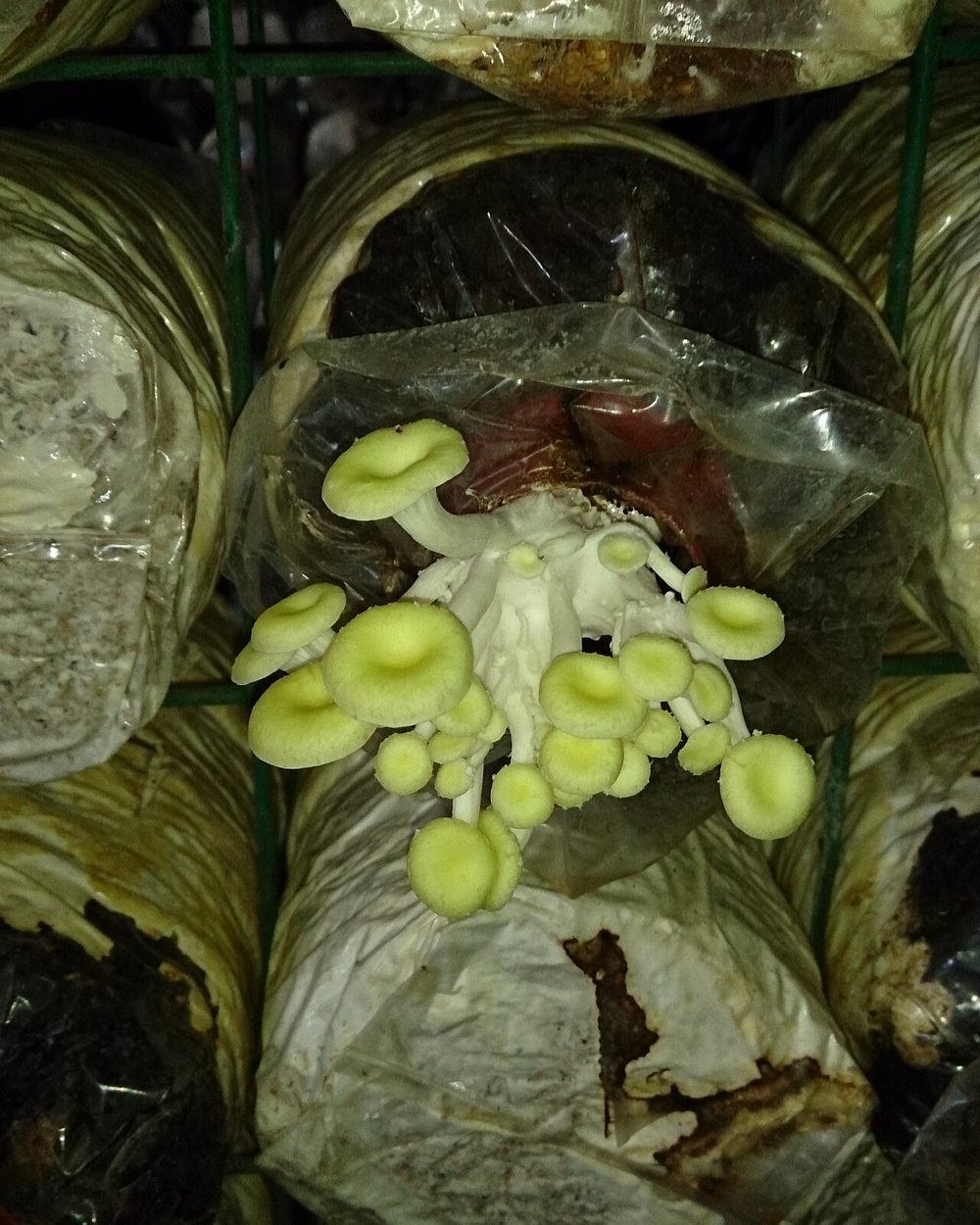
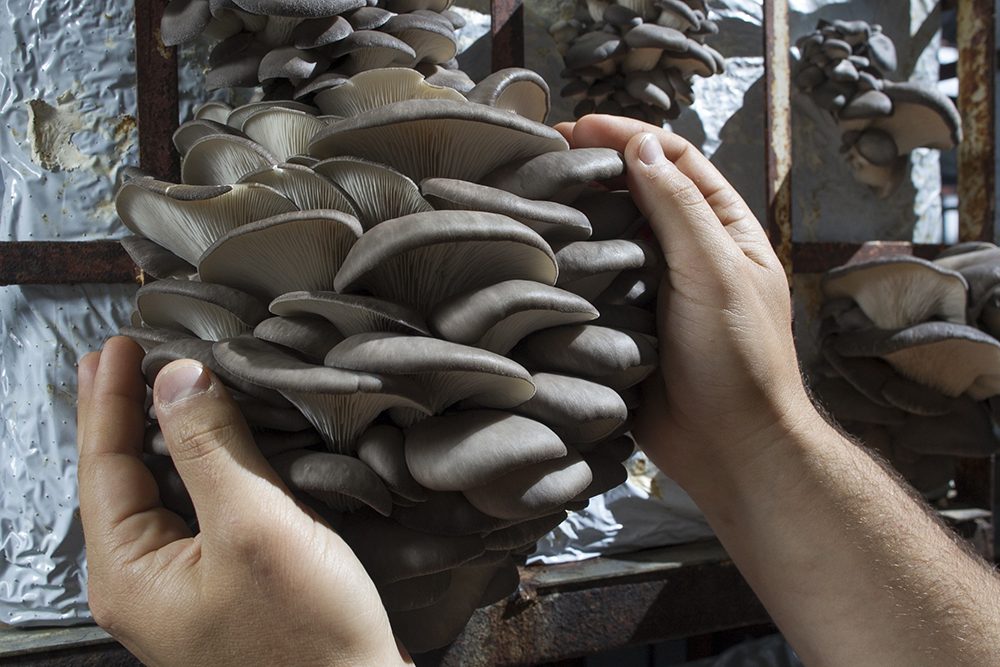
Building a fruiting room
The farm book's figures, in the order a grower meets them:
- Pick the space. A basement with steady temperatures is ideal; barns, warehouses, high tunnels and greenhouses also work. Not much space is needed: the farm book says an 8 by 16 foot room “can easily grow 150 lb per week.”
- Build cleanable walls. A simple frame of 2 by 4s with 6 mil plastic stapled around the inside makes a durable room that is easy to clean; corrugated plastic also works for walls.
- Put in a floor with a drain. Concrete with a drain is ideal; linoleum also cleans easily.
- Light it. Household-type LED or fluorescent fixtures are enough, since mushrooms need no particular spectrum; the farm book runs them 18 hours on and 6 off, and lights an 8 by 16 foot room well with four 4 ft fixtures. Lights collect spores and need cleaning now and then; some growers mount them outside the room behind a clear panel in the ceiling.
- Add humidity. Hold 80 to 90%, close to 90% to start fruiting. Options run from home humidifiers to ultrasonic misters, pressurized atomizing nozzles, or wetting the floor and walls several times a day. The farm book finds ultrasonic units sufficient for rooms up to 400 square feet, and pressurized misting systems better for larger rectangular rooms. Keep the water off the mushrooms themselves.
- Bring in fresh air. Change all the room's air at least every 10 minutes; in a closed room the farm book finds CO2 too high for proper fruiting after about 10 minutes.
- Hold the temperature. 62 to 68°F for the best yields, though 55 to 75°F gives good results. Growing warm- or cold-loving mushrooms with the seasons cuts heating and cooling: yellow, pink and phoenix oysters for heat; king oyster, enoki and chestnut for cold.
The fruiting page explains why humidity and fresh air fight; the CO2 and fresh air page works out a fan, and sizing a humidifier how much water a room needs. Our reading of the farm book's figures, not a figure it states: the 150 lb a week is for a room kept full with new blocks coming in, since a room's output depends on how many blocks pass through it.
Packing and cold storage. The farm book harvests straight into the package the mushrooms are sold in where it can, or into bulb crates with a towel on top to soak up moisture. Common packs are 3.5 oz containers and 3 or 5 lb cases. The cooler runs at 36 to 40°F; the book's lower-cost route is an air conditioner with an add-on controller that lets it cool an old walk-in, a refrigerated trailer or an insulated room into the high 30s, for about $1,000 (2021). A farm buying blocks needs cooler space for twice the mushrooms it grows plus 3 to 4 weeks of blocks. The harvest and storage page covers cooling.
Running it week to week
- Start blocks on a schedule. The study measures each farm by the blocks it starts per week. One farm that brought in blocks only once or twice a month had weeks with no harvest and weeks of 50 to 90 lb (five-farm study).
- Pick every day. Cornell Small Farms picks daily unless the room is below 60°F, because the window to pick is short when it is warm.
- Turn the room over. Most farms in the study took blocks out after the first big harvest to make room for new ones; the SARE report describes rotating every 2 to 4 weeks. Cornell's own trial blocks stayed 8 weeks to measure all they would give, and the report notes growers' worry that blocks left long bring insect and disease pressure.
- Clean as part of the work. Growers told the study that cleaning takes a substantial share of their time, and the authors wish they had tracked it separately. The keeping it clean page has a routine for each room.
- Keep the numbers. The study's farmers recorded labor, yield and sales every week. The farm book's advice is to track labor and yield per block and make the record-keeping simple enough not to get in the way of the work.
The work and the numbers
In 2020 the Cornell Small Farms Program and Fungi Ally followed five farms in the eastern United States for 16 to 69 weeks each, alongside Cornell's own block trials. Two of the five bought ready-to-fruit blocks and three made their own; all were converted to 5 lb block equivalents. The figures cover operating costs only, labor at $15 an hour plus materials: rent, utilities and equipment varied too much to compare (from $694.85 to $10,665.00, about $4,751 on average, as the farms reported them). The farm book warns against comparing one farm with another or drawing conclusions about the right scale from so few.
| Farm | Blocks a week | What happened |
|---|---|---|
| A (West Virginia), made on site | 16 | About 15 lb a week; labor 80% of costs; a loss |
| B (Massachusetts), bought blocks | 24 | 28 lb a week; blocks added once or twice a month; a loss |
| C (Vermont), made on site | 90 | About 59 lb a week; labor 67% of costs; a profit |
| D (eastern New York), made on site | 117 | About 89 lb a week; the lowest yield per block of the five; a profit |
| E (New York), bought blocks | 313 | 284 lb a week; materials 67% of costs, almost all blocks; a profit |
The farm book names the farms by letter only. Several sold workshops, kits or other products too, so it deliberately gives no price per pound from these figures.
What the study drew from them:
- Yield per block. 0.88 lb per 5 lb block on average, from 0.66 to 1.17 lb by farm (the book’s Table 2): strain, substrate and method choices can halve or double it. The book’s summary gives the top of the range as 1.36 lb, which is one of Cornell’s own trial blocks, left in fruiting for 8 weeks and kept out of the farm averages.
- Labor. 0.56 hours per pound of mushrooms on average; by farm, from 0.14 to 1.52 hours per block (Table 2). Labor was 67% of operating costs and materials 32%. Farms making blocks ran about 80% labor and 20% materials; farms buying blocks 42% labor and 58% materials.
- Making against buying. Both can be profitable or not; neither was the clear winner. The study notes that labor is something a grower can improve, while the cost of bought blocks is largely out of their hands.
- Scale. The farms at 16 to 24 blocks a week ran at a loss; those at 90 and up showed gains, and the farms producing 50 lb or more a week were consistently profitable. Cornell's trials suggested about 60 blocks a week as a possible break-even, which the authors say does not guarantee profit. In the study's projections, 160 to 180 blocks a week becomes a full-time job for one person.
The mushroom yield estimator works out what your own blocks should give, and the biological efficiency page explains why yields differ so much by substrate.
What goes wrong at farm scale
- Too few blocks. The two smallest farms in the study lost money on operating costs alone; the authors' advice for both was to grow more each week, and for one of them also to cut labor.
- Labor you do not count. Several farms said their real hours were higher than recorded, and cleaning hid inside other tasks. Without a count, the cost per pound is a guess.
- Uneven supply. Blocks started in bursts give a crop in bursts, which is hard to sell week to week (Farm B in the study).
- A hot incubation room. In summer, a room in the 80s puts bags near the 90s, where they suffocate and contaminate (farm book).
- Contamination carried between rooms. Spores from the fruiting room carried into the lab on people and clothes (farm book).
- Fixed costs. The study left out rent, utilities and equipment because they varied too much; a budget has to add them back.
Measuring it
Each room has a number to hold: temperature in incubation, humidity and CO2 in fruiting, temperature in the cooler. A sensor in each room shows when one drifts. The sensors in a fruiting room page covers which sensors their makers rate for a wet room.
Related pages
Sources
- Crosby, W. (Fungi Ally) and S. Gabriel (Cornell Small Farms Program). 2021. Specialty Mushroom Farm Book. Northeast SARE. The lab (pp. 5 to 9), the incubation room (pp. 9 and 10), the fruiting room (pp. 11 and 12), packing and cold storage (p. 13), and the five-farm study (pp. 13 to 23).
- Northeast SARE. Final report for LNE19-376. The project behind the farm book: the five farms, block rotation, and the per-block values used in its projections.
- Cornell Small Farms Program. Methods of Commercial Mushroom Cultivation in the Northeastern United States: 2. Seven Stages of Cultivation. Picking every day unless the room is below 60°F.
Frequently asked questions.
How big does a mushroom fruiting room need to be?
Not very big. The Cornell and Fungi Ally farm book says an 8 by 16 foot room can easily grow 150 lb of mushrooms a week, lit well by four 4 foot fixtures. That is a room kept full of fruiting blocks; what a room actually gives depends on how many blocks pass through it each week and what each yields.
How do you build a mushroom grow room?
The farm book frames a room with 2 by 4s and staples 6 mil plastic around the inside, or uses corrugated plastic, over a concrete floor with a drain. Then it adds household-type lights run 18 hours a day, a humidifier to hold 80 to 90%, fans that change all the air at least every 10 minutes, and a way to hold 62 to 68 F.
How many mushroom blocks a week does it take to make a profit?
In the Cornell and Fungi Ally study of five farms in 2020, the farms at 16 to 24 blocks a week lost money on operating costs, and those at 90 blocks a week and up made a profit; farms producing 50 lb or more a week were consistently profitable. The figures leave out rent, utilities and equipment, so a real budget has to add those.
How much does a mushroom block yield on a small farm?
The five farms in the Cornell and Fungi Ally study averaged 0.88 lb of mushrooms per 5 lb block, from 0.66 to 1.17 lb by farm. The authors say strain, substrate and method choices can halve or double the figure, so they advise tracking it on your own farm.
Should I make my own mushroom blocks or buy ready-to-fruit blocks?
Either can work. In the five-farm study neither was the clear winner on profit. Farms making blocks spent about 80% of operating costs on labor; farms buying blocks spent 58% on materials. Buying needs less labor and equipment but more cash and a reliable supplier; making blocks needs a clean lab but gives more control.
How much labor does a mushroom farm take?
The five farms in the Cornell and Fungi Ally study averaged 0.56 hours of labor per pound of mushrooms (by farm, 0.14 to 1.52 hours per block), and labor was 67% of operating costs. In the study's projections, 160 to 180 blocks a week becomes a full-time job for one person.
How cold should a mushroom cooler be?
The Cornell and Fungi Ally farm book keeps mushrooms at 36 to 40 F. It describes a lower-cost cooler built from an old walk-in, a refrigerated trailer or an insulated room, cooled by an air conditioner with an add-on controller, for about $1,000 in 2021.
Do I need a lab to grow mushrooms commercially?
Only if you make your own blocks. A farm that buys ready-to-fruit blocks needs a fruiting room and cold storage. A lab for making blocks needs easy-to-clean surfaces, HEPA-filtered air at positive pressure and a sterilizer; the farm book puts one at closer to $4,000 for a grower who can build it.