

A mushroom fruiting room runs at 85 to 95% relative humidity, and only some sensors are rated by their makers to work there. Of the common low-cost parts, the SCD40 and SCD41 CO2 sensors and the MH-Z19C are rated to 95%, and the SHT31, BME280 and DHT22 humidity sensors to 100%. Every one of those ratings excludes condensation, and Sensirion adds that its SHT31 performs best between 20 and 80%, giving the example of a reading about 3% high after 60 hours above 80%. So the choice of part matters less than keeping water off it, checking it against a reference, and knowing which way it is likely to be wrong.
This page is the detail behind the measuring section of the fruiting page. The full spec of each part, with accuracy and price, is on the temperature and humidity sensors and CO2 and air sensors pages; the figures here are the same ones, from the same datasheets.
Why a fruiting room is hard on a sensor
UC Cooperative Extension gives oyster mushrooms 95% relative humidity while pins form and 85 to 92% while they crop, with misting once or twice a day. ATTRA's 2026 guide aims for 85 to 95% through fruiting for most species, and calls a simple hygrometer an invaluable tool for watching it. That puts the room at the top end of the humidity scale for weeks on end, with water in the air from misters or a humidifier and, when the balance tips, on the walls and ceiling.
Most humidity sensors are built and specified for the middle of that scale. A fruiting room asks a part to live at the edge of its rating, all the time, and to read accurately there, because the targets themselves are that close together: UC's figures for oyster move from 95% while pins form to 85 to 92% while they crop.
What the makers rate each part for
The figure to read in a datasheet is the humidity the part is rated to operate in, and what the maker attaches to it. These are the humidity and CO2 parts the OAT sensor pages cover, each from its maker's own document.
| Part | Rated humidity | What the maker adds | Source |
|---|---|---|---|
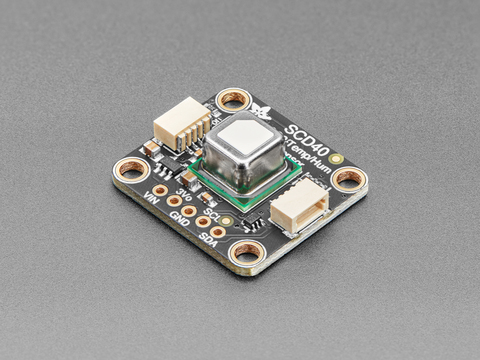
| SCD40, SCD41 (CO2) | 0 to 95%, non-condensing | Accuracy can be reduced below 10% | Sensirion SCD4x datasheet, version 1.7, April 2025 |
| MH-Z19C (CO2) | 0 to 95%, no condensation | Winsen's FAQ adds that outside 15 to 90%, or long-term high temperature and humidity, affects the sensor's life. The MH-Z19B carries the same rating and is discontinued | Winsen product pages, read 2026-11-24 |
| SHT31 (humidity) | 0 to 100% | Best performance from 20 to 80%; long exposure above 80% can offset the reading | Sensirion SHT3x-DIS datasheet, version 7, December 2022 |
| BME280 (humidity) | 0 to 100%, non-condensing | Its ±3% accuracy is stated for 20 to 80% | Bosch Sensortec BME280 datasheet, revision 1.24, February 2024 |
| DHT22 / AM2302 (humidity) | 0 to 100% | Accuracy ±2%, at most ±5% | Aosong DHT22 datasheet (no version or date printed) |
| DHT11 (humidity) | Not stated | Avoid long-term condensation | Aosong DHT11 product manual (no version or date printed) |
The SCD4x and MH-Z19C ratings stop at 95%, the humidity UC gives for pinning, so a room held at the top of its range sits at the edge of them. Two air-quality parts do not belong in the room at all: Sensirion says its SGP30 and SGP40 must never be exposed to condensing conditions, which it defines as above 90%. The BME680 is rated 0 to 100% non-condensing, with full humidity accuracy from 10 to 90% (Bosch Sensortec, revision 1.9, February 2024). The PMS5003 particle sensor gives a working range of 0 to 99% (Plantower, V2.3).
What the ratings leave out
Water on the part. Every rating in the table that says anything about it says non-condensing: Sensirion and Bosch write “non-condensing”, Winsen “no condensation”, and Aosong tells DHT11 users to avoid long-term condensation. A sensor in the path of a mister, or on a cold wall where water forms first, is outside what any of these makers rate. None of the datasheets and product pages listed under Sources describes a part that is rated to be wet.
Accuracy at the top of the range. Bosch states the BME280's ±3% accuracy for 20 to 80% humidity. Sensirion states that the SHT31 performs best between 20 and 80%. A rating that runs to 100% says the part will work up there, not that it will be as accurate there as in the middle.
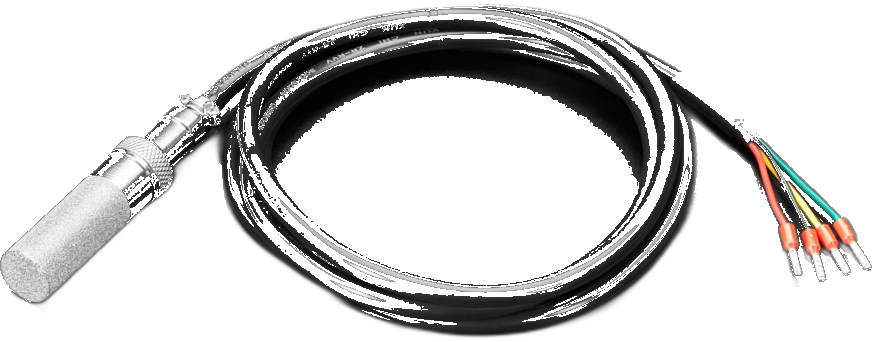
The probe around the chip. A datasheet covers the sensor chip. A weatherproof probe, a filter cap or a board it is mounted on is the work of whoever built it, and the chip's rating does not tell you whether that housing keeps water out. This applies to the sealed DS18B20 temperature probe too; we could not get the maker's datasheet for it, so its rating is not given here.
How sensors go wrong in wet air
The datasheets describe three ways a humidity sensor goes wrong, and one way a CO2 sensor can.
- A slow offset that comes back. Sensirion: long-term exposure outside the 20 to 80% range, especially at high humidity, may temporarily offset the SHT31's humidity signal; its example is +3% after 60 hours above 80%. Back in the normal range the sensor slowly returns to calibration by itself. The DHT11 manual describes the same pattern: drift outside its proposed range and a slow return. In a fruiting room the sensor does not go back into the normal range, so on our reading of the datasheet, not Sensirion's words, the offset may last for as long as the sensor stays in the room.
- Faster ageing. Sensirion says prolonged exposure to extreme conditions may accelerate ageing, and the DHT11 manual says prolonged use outside normal conditions accelerates the product's ageing.
- Degraded until reconditioned. Bosch Sensortec: when the BME280 or BME680 is taken past its operating range, humidity sensing is temporarily degraded and the maker recommends reconditioning. Its BME280 procedure is a dry bake at 120°C followed by re-hydration at a set humidity, written for parts after reflow soldering.
- Chemicals. The DHT11 manual warns that chemical vapours diffusing into the sensing layer cause drift, and that a high concentration of a chemical such as ethanol can damage the layer completely. Growers wipe and spray surfaces with alcohol (see keeping it clean), so our advice, not a maker's, is to keep sensors out of the spray or take them out of the room while cleaning.
- A CO2 sensor that calibrates itself to the wrong baseline. Sensirion's automatic self-calibration on the SCD40 and SCD41 assumes the sensor sees outdoor fresh air at 400 ppm for more than 3 minutes at least once a week. Our reading: a sensor that lives in a room full of breathing mushroom blocks may never see air that fresh, and then the assumption the calibration rests on is not true. Sensirion's answer for that case is a forced recalibration against a known reference, below.
The SHT31 has a small built-in heater, and it is tempting to read it as a way to dry the sensor. Sensirion says the heater is meant for plausibility checking only, and that it raises the temperature by a few degrees.
Where to put them
None of the datasheets says where a sensor goes in a mushroom room. Our advice, as on the fruiting page:
- At the height of the blocks, so the sensors read the air the mushrooms are in, not the air near the ceiling or floor.
- Out of the path of the mist and away from the humidifier's outlet, where the air is wetter than the room and water can land on the part.
- Off cold walls, where water forms first.
- The humidity sensor and the CO2 sensor together, so that a humidity dip after each air change and the CO2 fall that goes with it are in the same record.
- In a block during incubation, if you want the temperature inside the bag rather than the room: the incubation page puts a sealed probe in one test block, accepting the probe hole as a way in for contamination.
A CO2 controller can then run the exhaust fan from the CO2 reading instead of a timer. That controller page warns that only a true NDIR sensor, such as the SCD40 or MH-Z19, should drive it, never an eCO2 sensor that estimates CO2 from other gases.
Checking them against a reference
Because a humidity sensor in a fruiting room may carry an offset it never recovers from, a check against something known is worth more here than in most rooms.
Humidity: the salt test. The Trust Your Gauge page describes it: seal the sensor in a jar with a little damp table salt, wait, and read the gap from 75%, which is the humidity the air over the salt settles at. A check at 75% says how the sensor reads at 75%, not at 90%; our suggestion is to do it on a schedule and write the result down, so a sensor whose gap keeps growing shows itself.
CO2: fresh air, or a forced recalibration. Sensirion offers two ways to keep an SCD40 or SCD41 accurate: automatic self-calibration, which depends on that weekly 400 ppm of fresh air, and forced recalibration, in which the sensor runs for at least 3 minutes in air of a steady, known CO2 level and is then told that value. Where the sensor can be taken outside or to a fresh-air intake for a few minutes each week, the first can work; our suggestion is to do that on a schedule and note it. Where it cannot, Sensirion's answer is the forced recalibration against a known reference.
What commercial sensors add
Sensors sold for mushroom farms are built around the same problem. E+E Elektronik, a sensor maker, lists what wears its sensors in mushroom rooms (substrate, continuous high humidity, biofilm, dust, and hydrogen peroxide used for cleaning) and describes what its commercial line adds against them: humidity sensors with built-in heating to prevent condensation on the element, IP65 and IP67 enclosures with replaceable filters, a protective coating on the sensing element, and sensing modules that can be swapped without recalibrating on site. These are the maker's descriptions of its own products.
Related pages
Sources
- Sensirion. SHT3x-DIS datasheet, version 7, December 2022. Specified range 0 to 100%, best performance 20 to 80%, the offset above 80% and slow recovery, faster ageing, the heater for plausibility checking only.
- Sensirion. SCD4x datasheet, version 1.7, April 2025. Operating humidity 0 to 95%, non-condensing; automatic self-calibration and its 400 ppm assumption; forced recalibration.
- Sensirion. SGP30 datasheet, version 1.0, May 2020, and SGP40 datasheet, version 1.2, February 2022. Never in condensing conditions, defined as above 90%.
- Bosch Sensortec. BME280 datasheet, revision 1.24, February 2024, and BME680 datasheet, revision 1.9, February 2024. Operating range, non-condensing, accuracy band, degradation past the operating range and reconditioning.
- Winsen. MH-Z19C and MH-Z19B product pages, read 2026-11-24. Working humidity 0 to 95%, no condensation; humidity outside 15 to 90% affects the sensor's life (FAQ, item 5); the B discontinued.
- Aosong. DHT22 datasheet and DHT11 product manual (copies hosted by SparkFun and CUNY; no version or date printed). Operating range and accuracy; condensation, drift and chemical vapours.
- Plantower. PMS5003 series data manual, V2.3, 2016-06-01 (copy hosted by Adafruit). Working humidity 0 to 99%.
- University of California Cooperative Extension. 2011. Cultivating Mushrooms on Small Farms (slides). Oyster humidity while pinning (p. 29) and cropping (p. 34).
- Soto-Velez, G. 2026. Mushroom Cultivation (IP677). ATTRA, National Center for Appropriate Technology. The 85 to 95% target and the hygrometer (p. 12).
- Vendor: E+E Elektronik. Precise Climate Control for Mushroom Growing (application page). What wears sensors in mushroom rooms and what its commercial sensors add.
Frequently asked questions.
What humidity sensor works in a mushroom fruiting room?
Look for a part whose maker rates it to the room's humidity. Sensirion rates the SHT31 from 0 to 100%, Bosch Sensortec rates the BME280 0 to 100% non-condensing, and Aosong gives the DHT22 0 to 100%. None is rated to be wet, and Sensirion says the SHT31 performs best between 20 and 80% and can read about 3% high after 60 hours above 80%. Keep the sensor out of the mist and check it against a reference.
Will a CO2 sensor survive high humidity in a grow room?
The common NDIR CO2 sensors are rated to 95% relative humidity without condensation: Sensirion gives 0 to 95% non-condensing for the SCD40 and SCD41, and Winsen 0 to 95% for the MH-Z19C. UC Cooperative Extension gives 95% for oyster pinning, so a room held there sits at the edge of the rating. Keep the sensor out of the path of the mist.
Why does my humidity sensor read high or stuck near 100% in my fruiting chamber?
Two things the datasheets describe can do it. Water on the sensor is outside every rating we read, which all say non-condensing. And long spells at high humidity can offset a reading: Sensirion gives an example of 3% high for the SHT31 after 60 hours above 80%, recovering slowly once the air is drier. Move the sensor out of the mist and check it against the salt test.
How do I calibrate a humidity sensor for a mushroom grow?
Use the salt test described on the Trust Your Gauge page: seal the sensor in a jar with a little damp table salt, wait, and compare its reading with 75%, the humidity the air over the salt settles at. That gives the sensor's error at 75%, not at 90%, so repeat it on a schedule and write the results down to see whether the gap grows.
Do I need to calibrate an SCD40 or SCD41 CO2 sensor in a mushroom room?
Its automatic self-calibration assumes it sees outdoor fresh air at 400 ppm for more than 3 minutes at least once a week (Sensirion). A sensor that never leaves a room of mushroom blocks may not see air that fresh. Either take it to fresh air for a few minutes each week, or use Sensirion's forced recalibration against a known reference.
Where should I put the sensors in a mushroom fruiting room?
No datasheet says. Our advice: at the height of the blocks, out of the path of the mist and away from the humidifier's outlet, off cold walls where water forms first, and with the humidity and CO2 sensors together so their readings line up. In incubation, a sealed probe in one test block reads the temperature inside the bag.
Can I use a DHT22 or DHT11 in a mushroom grow?
Aosong gives the DHT22 an operating range of 0 to 100% with accuracy of plus or minus 2%, at most 5%. The DHT11 manual states no humidity range, tells users to avoid long-term condensation, and warns that chemical vapours such as ethanol can damage the sensing layer, which matters where surfaces are sprayed with alcohol.
Can I put an air quality sensor like the SGP40 or BME680 in a fruiting room?
Not the SGP30 or SGP40: Sensirion says they must never be exposed to condensing conditions, which it defines as above 90% relative humidity, below what UC gives for oyster pinning. Bosch Sensortec rates the BME680 0 to 100% non-condensing, with full humidity accuracy from 10 to 90%.