

At home, mushrooms come from a kit that arrives already grown through, or from a bucket, tote or plastic bag of straw that you pasteurize and spawn yourself. The method is the one a farm uses; what differs is the space, and on plain straw the yield. Oyster mushrooms fruit at 85 to 92% humidity (UC Cooperative Extension), so a box, tub or hamper around the bags holds the humid air, and short openings let fresh air in. UF/IFAS Extension’s home method for oyster mushrooms runs from bagging to grown clusters in about 25 days.
What changes at this size
Not much equipment. ATTRA’s 2026 guide notes that some of the most successful small-scale growers started with a few buckets in a closet, and that oyster, lion’s mane and chestnut mushrooms can grow in five-gallon buckets or plastic totes filled with pasteurized straw. It describes these setups as popular in cities, where growers turn closets, basements or spare rooms into small mushroom farms.
What a farm does with a fruiting room, a home grow does with a container around the bags. The house sets the starting conditions; the box or tub holds the humidity close to the mushrooms; and you supply the fresh air by opening it. The method itself, from substrate to harvest, is on the grow pages, starting with how to start and the oyster grow guide. This page covers what is particular to a home.
A kit
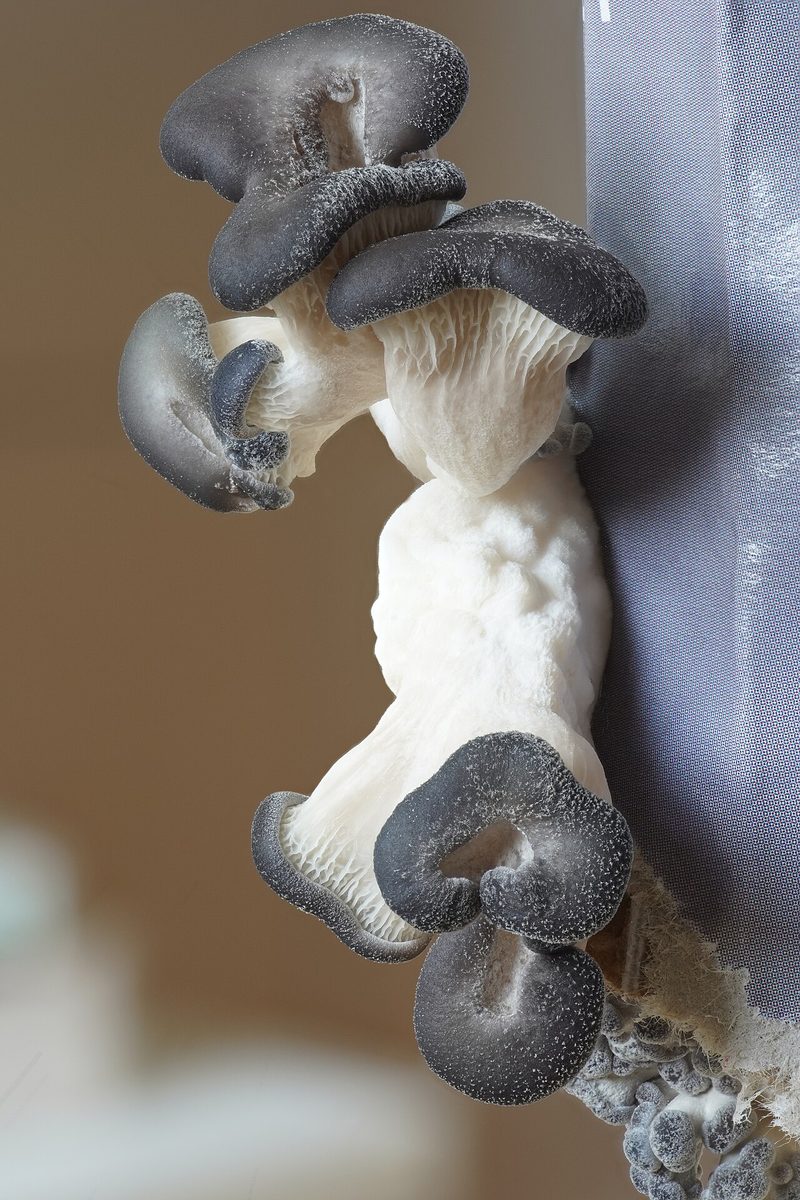
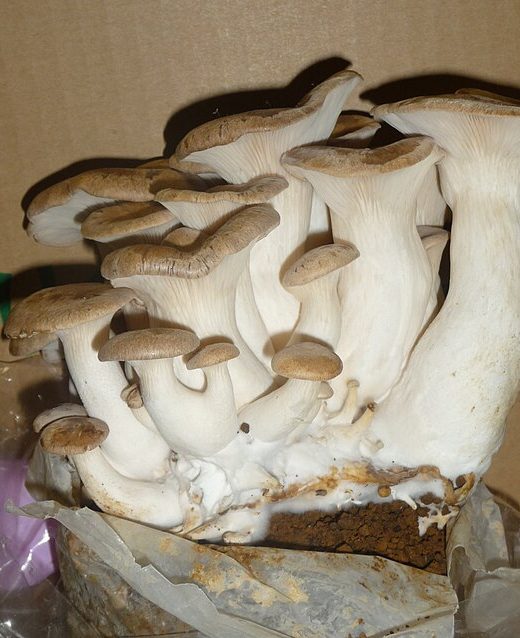
A kit is the shortest way in. UF/IFAS Extension describes it as a ready-made, already colonized kit: one simply sets it up in a suitable environment for fruiting. Everything before fruiting, the substrate, the spawn and the clean work, has been done for you.
- Read the kit’s own instructions first. Kits differ in how they open and how they are misted. In Consumer Reports’ test of home kits, the instructions varied, and the reviewer wanted more of them to give benchmarks, such as one kit’s advice to wait until the mist on its humidity cover has evaporated before misting again.
- Open it where the instructions say. That is where the mushrooms will form. Agromisa notes that a larger opening gives smaller mushrooms and lets the substrate dry faster.
- Give it the fruiting conditions. High humidity, fresh air, light and, for most oyster strains, a cooler room. The fruiting page gives the figures; UF/IFAS’s home chamber runs at about 68°F and 90% humidity.
- Mist lightly and often. ATTRA suggests light, frequent misting for small setups rather than soaking. Do not soak mushrooms that are nearly ready to pick (Agromisa).
- Pick, then let it rest. Twist or cut the cluster off cleanly (UF/IFAS), then keep it humid for the next flush. Picking and keeping are on the harvest page.
A bucket, tote or bag, step by step
These steps follow UF/IFAS Extension’s home method for oyster mushrooms on wheat straw in plastic bags. ATTRA names five-gallon buckets and plastic totes of pasteurized straw as working the same way; neither source gives a hole pattern for a bucket or a tote, so for those the bag’s pattern is the nearest guide (our suggestion).
- Cut and soak the straw. Cut wheat straw into 4 to 5 inch pieces and soak it overnight in water (UF/IFAS).
- Pasteurize it. Drain it, then hold it at 165°F in a water bath for 1 to 2 hours (UF/IFAS). The substrate page has the detail.
- Drain and cool. Let it drain for about an hour, and work in a clean space from here on: clean the table and the room. Spawn the straw as soon as it has drained and cooled (UF/IFAS); Agromisa lets pasteurized substrate cool to 30°C (86°F) before spawn goes in.
- Mix in the spawn. Add spawn at 5 to 10% of the straw, by volume or by weight, either mixed through or in layers as you fill (UF/IFAS). The spawn page covers clean work.
- Pack it firmly. UF/IFAS fills bags about 10 to 12 by 20 to 24 inches until they feel like a firm pillow, with no big gaps, and closes the tops.
- Make the openings. UF/IFAS cuts 10 to 15 small cross cuts, about 1/4 inch long and 4 to 6 inches apart, in two rings, a few inches from the top and the bottom of the bag. For a bucket or tote, the same spacing of small holes is our suggestion; Agromisa’s point that larger openings dry the substrate faster applies here too.
- Let it colonize in the dark. UF/IFAS keeps the bags off the floor, on blocks or hung up, in a clean, dark place at 75 to 77°F and 80 to 90% humidity, until the whole bag turns white in two to three weeks.
- Move it to fruit. Then light, a cooler room and fresh air start the mushrooms; the next two sections cover how to give them that at home.
Humidity and fresh air at home
The fruiting conditions are the same at every size; the fruiting page has them. At home they are held by the container around the bags.
- While it colonizes: UF/IFAS makes an incubation space from a cardboard box or a large plastic bin turned upside down over the bags, with wet cloth towels or cups of water underneath to keep it humid.
- While it fruits: UF/IFAS’s example of a fruiting chamber is a laundry hamper. It holds about 90% humidity around the bags, with a humidifier or fogger in a larger chamber, and needs good air exchange to stop carbon dioxide building up, without letting the humidity fall.
- For fresh air: ATTRA’s small-setup advice is to crack the bags open, cut small slits in the blocks, or open the tent flaps during the day, with a small oscillating fan for gentle movement and never a direct blast.
- For humidity: ATTRA suggests light, frequent misting for small setups, or a simple tray of damp perlite, and a hygrometer to check that you are in the range.
The two work against each other in a box as much as in a room: every time you open it for air, the humidity drops. The fruiting page explains why, and why it is worst in winter, when heated indoor air is dry.
Where in the house
- A steady, cool spot. Cornell Small Farms puts the best fruiting temperature for most species in the low 60s °F, and notes that a basement holds 50 to 65°F with little heating or cooling. Above 75°F, many species give fewer and poorer mushrooms.
- Light, but not sun. Light enough to read a book by is enough (Cornell). Keep hot, direct sun off the bags, because it dries the surface (ATTRA).
- Off the floor and protected. UF/IFAS raises the bags off the floor and warns to protect them from crawling and flying insects and from rodents.
- Away from where you sleep, if you grow oyster. That is our advice, from the note on spores below.
What to expect
Time. In UF/IFAS’s home method, counted from the day the bags go in to incubate, the straw is white through in two to three weeks, fruiting starts at about three weeks, and the guide’s photographs show grown clusters at about 25 days. ATTRA says indoor methods can give a harvest within three to five weeks. After the first flush, UF/IFAS expects 2 to 4 more, depending on the strain and the conditions.
From a kit. Consumer Reports weighed the harvests of the home kits it tested. One 4 lb oyster kit gave 147 g of mushrooms on its first harvest and 90.7 g on its second; other kits regrew only about a third of their first harvest. That is one magazine’s test of a handful of kits, not a figure for kits in general.
From straw. Plain straw gives less than a supplemented commercial block. In a Fungi Ally trial for Northeast SARE, six oyster strains on straw in 10 lb bags at about 70% moisture averaged 29% biological efficiency on heat-pasteurized straw and 41% on lime-treated straw, with a best single result of 65%. Such a bag holds about 3 lb of dry straw, so 29% is about 0.9 lb of mushrooms over its flushes and 65% about 2 lb (our arithmetic). The yield estimator works it out for your bags, and the biological efficiency page explains the measure.
What goes wrong at home
| What you see | What it points to | Where to look |
|---|---|---|
| Cracked caps, or pins that stall | Air too dry (ATTRA); opening the box and dry indoor heat both dry it (our reading) | Dry or cracked caps |
| Long stems and small caps | Too little fresh air or light in a closed box (Cornell) | Long stems and small caps |
| A white bag that does not fruit | No trigger yet: light, fresh air or a cooler spot | Won’t pin |
| Blue, green, black or yellow spots in the straw | Contamination by another mold or bacteria (UF/IFAS) | A contaminated bag |
| Small flies around the bags | Insects; UF/IFAS warns to protect bags from them | Pests |
UF/IFAS says heavily contaminated bags are best removed and thrown away, though a partly contaminated bag may still give one flush if air exchange and humidity are kept up.
Related pages
Sources
- Liao, H.-L., C.-M. Hsu, K. Hameed and V. T. Cotter. 2018, revised 2025. D.I.Y. FunGuide: Grow Your Own Oyster Mushrooms at Home (SL448). UF/IFAS Extension. The kit, the straw method, bag size and cuts, the incubation box, the laundry-hamper fruiting chamber, timing, flushes, contamination and pests.
- Soto-Velez, G. 2026. Mushroom Cultivation (IP677). ATTRA, National Center for Appropriate Technology. Buckets and totes, closets and spare rooms, 3 to 5 weeks (pp. 4 and 5); spores (p. 7); misting, perlite, hygrometer, dry air (p. 12); small setups and fans (p. 13).
- Cornell Small Farms Program. Methods of Commercial Mushroom Cultivation in the Northeastern United States: 2. Seven Stages of Cultivation. Fruiting temperatures, basements, light, long stems.
- University of California Cooperative Extension. 2011. Cultivating Mushrooms on Small Farms (slides). Oyster cropping humidity, 85 to 92% (p. 34).
- Oei, P., with B. van Nieuwenhuijzen. 2005. Small-scale mushroom cultivation (Agrodok 40). Agromisa Foundation and CTA. Cooling before spawning (p. 44); opening size and drying (p. 48); not spraying mushrooms ready to pick (p. 49).
- Fungi Ally. Final Report for FNE15-825, Northeast SARE, and its oyster mushroom booklet (pp. 24 and 25). Straw bags, moisture and biological efficiency by straw treatment.
- Consumer Reports. Best Mushroom Growing Kits. A consumer magazine’s test of home kits: harvest weights and instructions. No kit is named here.
Frequently asked questions.
Can I grow mushrooms at home without special equipment?
Yes, at a small scale. ATTRA notes that some of the most successful small-scale growers started with a few buckets in a closet, and that oyster, lion's mane and chestnut mushrooms grow in five-gallon buckets or plastic totes of pasteurized straw. UF/IFAS Extension's home method needs straw, a pot for a 165 F water bath, spawn, plastic bags and a box or tub to hold humidity, such as a laundry hamper.
How do I use a mushroom grow kit?
Follow the kit's own instructions, because kits differ in how they open and how they are misted. UF/IFAS Extension describes a kit as ready-made and already colonized: you set it up somewhere suitable for fruiting, with high humidity, fresh air, light and a cool room. Mist lightly and often rather than soaking (ATTRA), and pick by twisting or cutting the cluster off cleanly (UF/IFAS).
How much do mushroom grow kits produce?
In Consumer Reports' test of home kits, one 4 lb oyster kit gave 147 g of mushrooms on its first harvest and 90.7 g on its second, while other kits regrew only about a third of their first harvest. That is one magazine's test of a few kits, not a figure for kits in general.
How do I grow oyster mushrooms in a bucket?
ATTRA says oyster mushrooms grow in five-gallon buckets or totes of pasteurized straw. UF/IFAS Extension's home method, written for bags, is the nearest set of steps: cut and soak straw, hold it at 165 F for 1 to 2 hours, drain and cool it, mix in 5 to 10% spawn, pack it firmly, and keep it dark at 75 to 77 F until it is white, in about two to three weeks. Neither source gives a hole pattern for a bucket; using the bag's small cuts 4 to 6 inches apart is our suggestion.
How do I keep humidity up for mushrooms at home?
Put a container around them. UF/IFAS Extension uses a cardboard box or an upturned plastic bin with wet towels or cups of water while the bags colonize, and a laundry hamper as a fruiting chamber at about 90% humidity. ATTRA suggests light, frequent misting or a tray of damp perlite, and a hygrometer to check the reading.
Where should I put my mushroom kit in the house?
Somewhere steady and cool, with light but no direct sun. Cornell Small Farms puts the best fruiting temperature for most species in the low 60s F and notes that a basement holds 50 to 65 F with little heating or cooling; above 75 F many species do poorly. ATTRA warns that hot, direct sun dries the surface.
How long does it take to grow mushrooms at home?
With UF/IFAS Extension's home straw method for oyster mushrooms, bags are white in two to three weeks, start to fruit at about three weeks, and carry grown clusters at about 25 days from the start of incubation. ATTRA says indoor methods can give a harvest within three to five weeks.
Why is my mushroom kit not growing?
Dry air is the first thing to check: ATTRA says pins stall or wither, and caps crack, when the air is too dry, which happens easily in a heated house. Then check that it has fresh air, light and a cool enough spot. The won't-pin and dry-caps pages go through the causes in order.