

Outdoors, mushrooms grow in freshly cut hardwood logs, in stumps, and in beds of wood chips, with the weather doing much of what a fruiting room does indoors. It takes little equipment but a lot of patience: ATTRA puts shiitake logs at six to twelve months before the first harvest, after which they can produce for up to five years, while a wine cap bed of wood chips can fruit within two to six months (Brooklyn Botanic Garden). The grower's main job is to keep the wood or the bed shaded and moist without leaving it soaked.
What changes outdoors
Indoors, the grower holds the temperature, humidity and fresh air. Outdoors, the weather sets them, so the work moves to choosing the site, the wood and the mushroom, and then to keeping things moist. ATTRA notes that cool nights in many northern states make outdoor flushes easier for oyster, shiitake and lion's mane, while in much of the South long hot spells and warm nights slow pinning and invite pests; there it advises planning outdoor crops for fall, winter and early spring, with shade and steady water.
The cleanliness bar is lower too. Cornell Small Farms explains that low-nitrogen, high-carbon materials like logs, wood chips and straw are fine to inoculate in the open air: clean hands and a clean table help, but sterility is not a concern. Its table of methods lists fresh logs, stumps, wood chips and straw as needing no equipment or extra treatment, with the trade-off of a long incubation time and low yields for the weight of the material.
The site and the wood
The site. The University of Missouri's agroforestry guide looks for a cultivation area with shade and protection from wind, notes that north- to east-facing slopes help protect against sun and heat, and that ravines and valleys often give both water and shade. Evergreens give the most useful spring and autumn shade, and a curtain of shade fabric around the edges adds shade and wind protection. The University of Vermont guide calls year-round shade of 75 to 100% essential for shiitake, names a conifer canopy as best (hemlock gives especially dense shade), and says a deciduous canopy will do if the logs are protected with 80% shade cloth or pine boughs in winter. Water within reach matters for soaking and for dry spells (Missouri).
The wood. The University of Kentucky's crop profile asks for logs about 3 to 8 inches across and 3 to 4 feet long, cut from decay-free live trees with intact bark; it says oaks seem to be preferred, and that beech or maple can be used. Missouri's research found sugar maple and white oak superior for shiitake and says pines and other conifers are not effective hosts. Oregon State's reishi guide uses oak or maple, 2 to 4 feet long and 4 to 7 inches across.
| Mushroom | How it is grown outdoors | Time, as the source gives it |
|---|---|---|
| Shiitake | Hardwood logs, stacked in shade | Six to twelve months before the first harvest, then up to five years (ATTRA) |
| Oyster | Logs | 4 to 12 months to colonize (Cornell Small Farms) |
| Lion's mane | Logs, often buried upright to a third of their length | About 18 months to harvestable mushrooms (University of Kentucky) |
| Maitake | Logs or freshly cut stumps | Stumps take one to three years to fruit (University of Kentucky) |
| Reishi | Logs, planted in a shaded greenhouse in Oregon State's method | A spawn run of 9 to 18 months, then two flushes over the growing season (Oregon State) |
| Wine cap | Beds of wood chips or straw, garden paths, around plants | Two to six months (Brooklyn Botanic Garden) |
Each row is one source's figure for its own method and place, and the sources measure different things: some count to the first harvest, some to full colonization. For stumps in general, Cornell Small Farms gives 24 to 36 months to colonize. Our reading: where sources differ, follow the one written for a climate closest to yours, and plan on the longer figure for a first attempt.
Logs and stumps, step by step
These steps are general to log-grown mushrooms. Shiitake is the most grown on logs and has its own guide, with the drilling and soaking figures in full: growing shiitake.
- Cut the logs in the dormant season. Missouri fells in mid- to late winter for early spring inoculation, for example in February for inoculation in April or early May, and keeps felled logs out of wind and sun so they stay above 35% moisture.
- Inoculate soon. Cornell Small Farms inoculates within a month of cutting, and calls the idea that logs must sit for two weeks first a common misconception. Oregon State's reishi guide waits at least two days and inoculates within 30 days. If the log ends have cracks wide enough to fit a dime, Cornell soaks the logs for 24 hours first.
- Drill, fill and seal. Holes go in a staggered diamond pattern and are filled with sawdust or dowel spawn and sealed with hot cheese wax (University of Kentucky; Missouri). The guides space them differently: Missouri drills holes 1 inch deep, 6 inches apart along rows 2 inches apart; Oregon State 1 inch deep, 3 to 6 inches apart in rows 2 to 3 inches apart. The shiitake guide gives Vermont's and Washington State's closer spacing. Kentucky also describes wedge cuts and slicing a log into disks that are nailed back together.
- Stack them in moist shade, off the soil. Kentucky stacks logs crisscross, in an X or leaning, with gravel or fabric between the logs and the soil; Missouri lays them on rails 4 to 6 inches off the ground and never lets them touch the soil, to avoid contamination. Lion's mane is an exception: its logs are often buried upright to a third of their length, and maitake or reishi logs may be buried lying down (Kentucky).
- Inoculate stumps on the cut face. Kentucky fills drilled holes in the cut surface of a freshly cut hardwood stump with dowel or sawdust spawn, uses natural cracks too, and seals with hot wax; the wedge and disk methods work on stumps as well. A cool, moist site is best.
- Wait for the spawn run. Missouri expects about a year for shiitake; Cornell Small Farms gives the ranges by mushroom in the table above.
Wood-chip beds, step by step
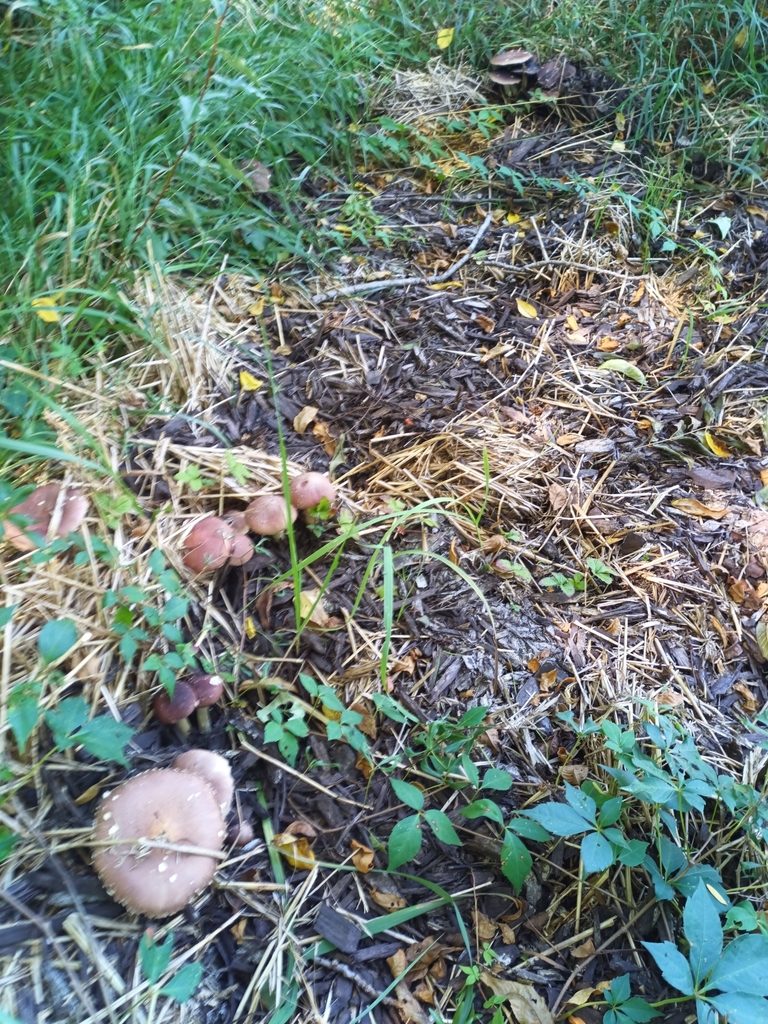
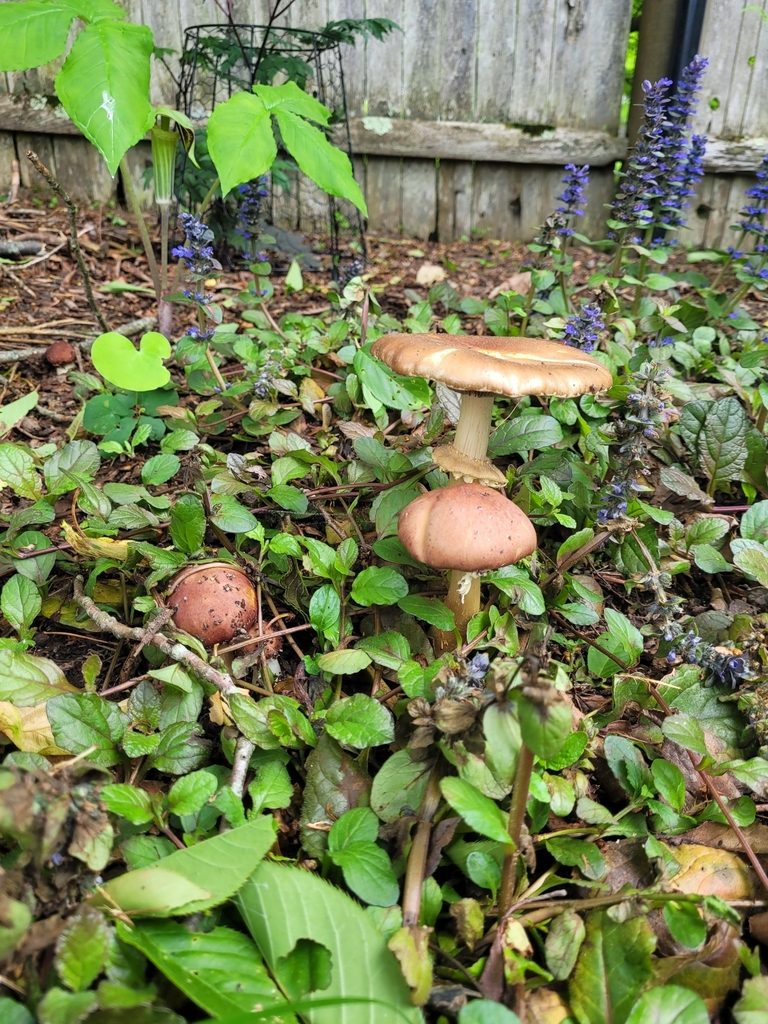
Wine cap, also called king stropharia, is the bed mushroom of the sources: it grows on wood chips or straw, in garden beds, wood-chip paths and around fruit trees (ATTRA; Brooklyn Botanic Garden). The two methods below differ in detail; both build the bed in layers.
- Pick the spot. Brooklyn Botanic Garden needs only a few square feet in partial shade, even under tomato plants or around a fruit tree. Kentucky chooses a wooded site or mulch bed on a north- or east-facing slope, which stays cooler and moister, clears an area about 4 by 8 feet and loosens the soil 8 inches deep.
- Use fresh chips. Brooklyn Botanic Garden uses freshly cut wood chips, so another fungus has not already moved in.
- Layer chips and spawn. Brooklyn Botanic Garden spreads 1 to 2 inches of chips on bare soil, sprinkles grain spawn over it, repeats about three times, and tops it with chips to about 6 inches in all. Kentucky lays 2 inches of chips, waters them, broadcasts the spawn, adds 2 to 3 inches more and stirs the bed gently. Cornell Small Farms calls this layering “like lasagna” and notes it colonizes faster than spawn left on top. ATTRA gives 5 to 20% spawn for outdoor beds, depending on conditions and how far the bed should spread.
- Water it in. Kentucky keeps the bed heavily watered for the first four days. Cornell waters at inoculation and once a week for a month, and says a bed in the shade with chips 4 inches or deeper will hold its moisture. Brooklyn Botanic Garden waters every few days, as for a vegetable garden, so the chips a few inches down feel like a wrung-out sponge.
- Watch for mushrooms. Kentucky stirs the bed again after three to four months of regular watering and expects mushrooms within a couple of weeks after that; Brooklyn Botanic Garden expects them in two to six months and checks the bed often, especially after rain. Cornell Small Farms gives 2 to 12 months for wood chips to colonize; the two measure different things, colonized chips against first mushrooms in one garden's beds, and no source we read ties them together.
- Feed it each year. Brooklyn Botanic Garden's bed fruits for about three years with a layer of fresh chips added each year, and pieces of a healthy bed can start a new one; Kentucky adds chips each year for three to four seasons.
Moisture and shade
Outdoors, drying out is the first risk. Cornell Small Farms calls keeping the mycelium from drying out the most important part of outdoor incubation: when a log's ends crack wide enough to fit a dime, it soaks the log for 6 to 8 hours, no more than about once a month in summer.
Too much water is the opposite risk. Missouri gives 35 to 45% as the best log moisture during the spawn run, and sprinkles logs in dry weather to simulate a soaking rain while leaving enough air for the bark to dry between waterings; constantly wet bark breeds molds and competing decay fungi. During fruiting, Missouri covers logs with horticultural fabric against both drying and heavy rain, and warns that fabric that blocks too much light gives longer stems and smaller caps. Oregon State, growing reishi logs in a greenhouse through noncoastal Oregon summers, waters briefly once or twice a day and judges by weight: a log should always feel heavy.
Shade is the other half. Beyond the University of Vermont's 75 to 100% for shiitake, Brooklyn Botanic Garden notes that wine caps prefer partial shade but tolerate more sun than many mushrooms.
Through the seasons
- Late winter: fell the trees while they are dormant (Missouri).
- Spring: inoculate logs (Missouri; ATTRA). Wine cap beds can be started any time from the last frost to a few weeks before the first; in New York City that is early April to mid-October (Brooklyn Botanic Garden).
- The first autumn: Missouri's logs inoculated between December and May give a few mushrooms the following autumn, but are not forced to fruit until the spring after, so the spawn run can finish.
- Fruiting years: after a flush, Missouri rests a shiitake log 10 to 12 weeks, longer than the 6 to 8 weeks (Vermont) and 7 to 8 weeks (Washington State) in the shiitake guide. Warm-weather and wide-range shiitake strains respond to soaking; cool-weather strains fruit with the swings of spring and autumn air and do not respond to soaking (Missouri). ATTRA puts warm-weather strains at daytime highs of about 70 to 80°F and cool-weather strains at about 50 to 65°F, and suggests starting with two or three strains.
The work and the numbers
The University of Kentucky's crop profile, drawing on its 2019 estimates for a small shiitake enterprise of about 500 logs, gives these labor figures; it notes they are for shiitake and that budgets for other log-grown mushrooms are not available.
| Item | Figure | Source and scope |
|---|---|---|
| Drilling and inoculating | About 5 minutes a log; about 8 hours per 100 logs | University of Kentucky, shiitake, 2019 estimates |
| Harvesting | 30 to 60 minutes per 100 logs per harvest | University of Kentucky, shiitake, 2019 estimates |
| A 500-log operation | About 42 hours of pre-harvest labor and 18 hours of harvest labor | University of Kentucky, shiitake, 2019 estimates |
| Yield per log | About 6 lb over four years | Kentucky Shiitake Production Workbook (FOR-88), three forced fruitings a year |
| Yield per log | 2 to 3 lb average commercial yield | UC Cooperative Extension, shiitake (no period stated) |
On money, the same Kentucky estimates put net returns negative in the first two years, with a positive annual return from the third year; in full production a family-run 500-log enterprise was estimated to make about $2,800, or about $2,175 with hired labor at $625. They are 2019 figures for one scenario, and Kentucky asks every grower to work out their own. The main start-up costs it lists for log and stump production are a refrigeration unit, a high-speed drill, spawn and wax.
What goes wrong outdoors
The outdoor problems the sources name come down to drying out, other fungi getting into the wood, and animals:
| Problem | What the sources say | Source |
|---|---|---|
| Logs drying out | Cracked ends wide enough for a dime mean soak 6 to 8 hours; keep logs in shade and out of wind | Cornell Small Farms; Missouri |
| Competing fungi on the logs | Trichoderma, Hypoxylon and Polyporus versicolor compete; logs with the blue-green Trichoderma are removed from the log area and destroyed | University of Kentucky |
| Holes too far apart | The spawn run is incomplete and contaminating fungi gain a foothold | Missouri |
| Logs touching the soil | Soil-borne decay fungi such as Armillaria, the honey mushroom, move in; keep log ends off the ground or on weed barrier fabric | Missouri |
| Insects and animals | Termites, bark beetles and springtails damage logs; slugs, snails, birds, squirrels and deer eat the mushrooms if logs are left unprotected | University of Kentucky |
| Spent and infected logs | Remove spent logs, and logs fruiting competing fungi, from the production area; the competitors' mushrooms spread spores | Missouri |
Contamination indoors and out is covered on the keeping it clean page, and the named diseases on diseases and hygiene.
Related pages
Sources
- Kaiser, C. and M. Ernst. 2021. Gourmet and Medicinal Mushrooms (CCD-CP-79). University of Kentucky Center for Crop Diversification. Log size and wood, log and stump inoculation, stacking, the wood-chip bed method, lion's mane and maitake timing, outdoor pests, labor and the 2019 cost and return estimates.
- Szymanski, M., D. Hill and T. Woods. Kentucky Shiitake Production Workbook: Potential Profits from a Small-Scale Shiitake Enterprise (FOR-88). University of Kentucky Cooperative Extension. Yield per log over four years.
- Bruhn, J. and M. Hall. 2022. Growing Shiitake Mushrooms in an Agroforestry Practice (Agroforestry in Action). University of Missouri Center for Agroforestry. Site, shade and wind, felling time, wood species, hole spacing, log moisture, stacking off the soil, resting and forcing, problems.
- University of Vermont Extension and Cornell University. Best Management Practices for Log-Based Shiitake Cultivation in the Northeastern United States. Year-round shade of 75 to 100% and the laying yard (p. 23).
- Muhammad, B., T. Hopkins and M. Powell. 2022. Nontimber Forest Products for Small Woodland Owners: Reishi Mushroom Growing Guide (EM 9364). Oregon State University Extension Service. Reishi logs, timing, spacing and watering.
- Cornell Small Farms Program. Methods of Commercial Mushroom Cultivation in the Northeastern United States: 2. Seven Stages of Cultivation. Inoculating logs, stumps and chips, layering, incubation times, keeping logs and beds moist.
- Soto-Velez, G. 2026. Mushroom Cultivation (IP677). ATTRA, National Center for Appropriate Technology. Outdoor growing by region and the shiitake log timeline (p. 5), shiitake strains (pp. 7 and 8), wine cap (p. 9), spawn for outdoor beds (p. 11).
- Griffin, H. 2024. How to Grow Your Own Winecap Mushrooms. Brooklyn Botanic Garden. Site, building and watering a wine cap bed, timing and how long a bed lasts.
- University of California Cooperative Extension. Cultivating Mushrooms on Small Farms (slides). Shiitake yield per log (p. 55).
Frequently asked questions.
How long does it take to grow mushrooms on logs?
Months to years, depending on the mushroom. ATTRA puts shiitake logs at six to twelve months before the first harvest, after which they can produce for up to five years. Cornell Small Farms gives 4 to 12 months for oyster logs to colonize and 24 to 36 months for stumps, and the University of Kentucky about 18 months for lion's mane on logs.
Can I grow mushrooms in my garden?
Yes. Wine cap mushrooms grow in beds of wood chips or straw, garden paths and around fruit trees (ATTRA). Brooklyn Botanic Garden grows them in a few square feet of partial shade, even under tomato plants, and expects mushrooms in two to six months.
How do I make a wine cap mushroom bed?
Brooklyn Botanic Garden spreads 1 to 2 inches of fresh wood chips on bare soil, sprinkles grain spawn over them, repeats about three times, and tops the bed with chips to about 6 inches in all, then waters it regularly so it stays like a wrung-out sponge. The University of Kentucky's method uses an area about 4 by 8 feet on a north- or east-facing slope, with the bed kept heavily watered for the first four days.
What kind of wood is best for mushroom logs?
Hardwood from healthy, freshly cut trees with the bark intact. The University of Kentucky asks for logs about 3 to 8 inches across and 3 to 4 feet long, with oaks preferred and beech or maple usable. Missouri found sugar maple and white oak best for shiitake, and says pines and other conifers do not work.
Do mushroom logs need shade?
Yes. The University of Vermont calls year-round shade of 75 to 100% essential for shiitake logs, with a conifer canopy best, and 80% shade cloth or pine boughs in winter under a deciduous canopy. Missouri looks for shade and wind protection, and north- to east-facing slopes.
How often should I water mushroom logs?
When they start to dry. Cornell Small Farms soaks a log for 6 to 8 hours when its ends crack wide enough to fit a dime, no more than about once a month in summer. Missouri sprinkles logs in dry weather but lets the bark dry between waterings, because constantly wet bark breeds molds; it gives 35 to 45% as the best log moisture during the spawn run.
Can you grow mushrooms on a tree stump?
Yes. The University of Kentucky inoculates the cut face of a freshly cut hardwood stump with dowel or sawdust spawn in drilled holes or natural cracks, sealed with hot wax, for maitake, lion's mane and reishi. Cornell Small Farms gives 24 to 36 months for a stump to colonize, and Kentucky one to three years before maitake stumps fruit.
How many mushrooms does one log produce?
For shiitake, the Kentucky Shiitake Production Workbook expects about 6 pounds a log over four years with three forced fruitings a year, and UC Cooperative Extension gives an average commercial yield of 2 to 3 pounds a log. Other mushrooms on logs have no comparable extension figure.