

Ammonia, nitrite and nitrate are the three steps of the nitrogen cycle that keeps fish alive in aquaponics and aquaculture. Fish give off ammonia, bacteria turn it into nitrite and then nitrate, and plants or water changes take the nitrate away. Probes for all three exist and are cheap enough for a small system, but they work well only in fresh water, they drift, and they are better at showing a trend than a precise number. Pair them with a pH probe and a test kit and they become very useful.
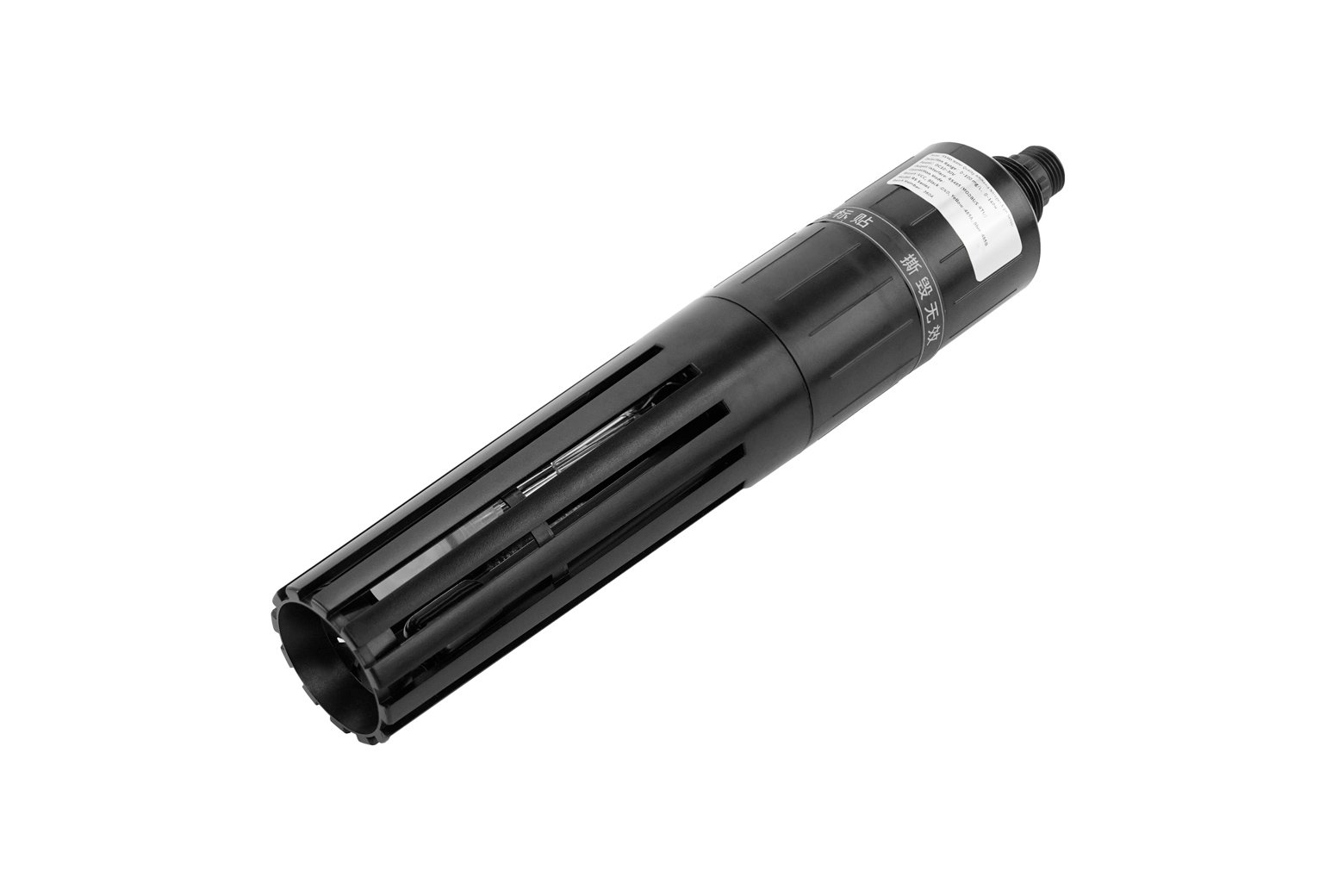
What they measure.
An ammonium probe reads total ammonia nitrogen (TAN): the ammonium ion (NH₄⁺) plus the free ammonia (NH₃) in balance with it. A nitrite probe reads the middle step, which is toxic to fish in its own right. A nitrate probe reads the end product, which plants use as food and fish tolerate far better. All three are ion-selective electrodes: a membrane that lets one kind of ion build a small voltage, read the same way a pH probe is read. Most sold for continuous use are RS-485 Modbus probes with temperature built in, powered at 12 to 24 volts.
Free ammonia is calculated, not measured.
The ammonia that harms fish is the free NH₃, and no in-tank probe reads it directly. It is worked out from three numbers: total ammonia, pH and water temperature. The share that is free climbs steeply with pH. At 77°F (25°C) it is about 0.6% of the total at pH 7, about 5% at pH 8, and about a third at pH 9, and warmer water raises all of those. So the same reading can be harmless in an aquaponic system held near pH 7 and serious in a pond that swings to pH 9 on a sunny afternoon.
That makes a pH probe part of any ammonia setup. Without it the ammonia number cannot tell you how worried to be. The Free Ammonia Calculator does the arithmetic, and a monitoring node can do the same sum on every reading.
The three readings.
They answer different questions, in the order the biofilter produces them. During cycling you see ammonia rise and fall, then nitrite rise and fall, then nitrate climb and stay. Once a system is running, ammonia and nitrite should sit near zero and nitrate tells you whether fish and plants are in balance.
| Reading | Ammonium (TAN) | Nitrite | Nitrate |
|---|---|---|---|
| Where it comes from | Fish gills and waste | Bacteria turning ammonia over | Bacteria finishing the job |
| Why you watch it | Toxic as free NH₃; a lagging biofilter | Toxic to fish; the second cycling peak | Plant food; the balance of the system |
| How a probe reads it | Ion-selective electrode | Ion-selective electrode | Ion-selective electrode |
| What fools the probe | Potassium, then sodium | Chloride | Chloride, nitrite |
| In salt water | Unreliable | Unreliable | Unreliable |
| Most useful in | Fresh water, every system | Aquaponics, cycling, RAS | Aquaponics, RAS |
“What fools the probe” lists the other ions the membrane partly mistakes for the one it is meant to read. In fresh water they are usually low enough to live with. In brackish and sea water they swamp the reading.
What the probes can and cannot do.
Read the accuracy line on the datasheet closely. These probes quote accuracy as a percentage of full scale, not of the reading. A common rating is ±5% on a 0 to 1000 mg/L range, and even a better ±3% on a 0 to 100 mg/L range allows an error of 3 mg/L. The levels that matter in fish water sit around 0.5 to 2 mg/L of total ammonia. So a probe will show you clearly that ammonia is rising, falling or stuck, and only roughly how much is there.
They are also consumables. The membranes age, the reading drifts, and calibration against two standard solutions close to your working range belongs in the weekly routine. Expect to replace the sensing tip within months rather than years, and expect little or no warranty on it.
By system.
The same probes earn their place in some water and waste money in others. Salt is the dividing line.
| System | Probes worth running | Watch most |
|---|---|---|
| Aquaponics | All three, with pH | Nitrite (no salt to protect the fish); nitrate as plant food |
| Freshwater ponds | Ammonium, with pH | Free ammonia at the afternoon pH |
| Freshwater RAS | All three, with pH | A biofilter that can crash in hours |
| A new system cycling | Ammonium and nitrite | Both peaks passing, then several days near zero before stocking |
| Brackish and marine | None; use test kits | Dissolved oxygen, salinity, pH and temperature instead |
Two habits change what a probe sees. Aquaponic growers often buffer pH with potassium hydroxide, and the potassium it leaves behind makes an ammonium probe read high; buffering with calcium carbonate (oyster shell) avoids that. Pond farmers often add salt so that chloride protects fish from nitrite, and the same chloride blinds a nitrite probe.
Where they fit, and where they don’t.
Where they fit
- Fresh water: aquaponics, ponds, freshwater RAS.
- Watching a new system cycle.
- An early alarm when a biofilter falls behind.
- Paired with pH and a weekly test kit.
Where they don’t
- Brackish or sea water, where other ions swamp them.
- Exact numbers at the low levels fish care about.
- Set-and-forget use; they need weekly care.
- A first purchase; dissolved oxygen comes first.
Resources & where to buy.
Free Ammonia Calculator DFRobot SEN0711 NT Sensors Hanna Instruments Where to buy
Frequently asked questions.
Can a sensor measure free ammonia (NH3) directly?
Not with the probes sold for continuous use in tanks and ponds. They read total ammonia (ammonium plus free ammonia), and the free part is calculated from that total, the pH and the water temperature. A few optical aquarium monitors read free ammonia directly, at small scale.
Are ammonium and nitrite probes accurate enough for aquaculture?
For trends and alarms, yes. For exact numbers at the low levels that matter to fish, not on their own: accuracy is quoted as a share of full scale, which is large next to readings under 2 mg/L. Check them weekly against a photometer test and correct the offset.
Do ammonia and nitrite probes work in salt water?
Not reliably. An ammonium membrane partly responds to potassium and sodium, and a nitrite membrane to chloride. Sea water and brackish water carry so much of those ions that they swamp the reading. Use photometer tests for nitrogen in marine and shrimp systems.
Which nitrogen reading matters most in aquaponics?
Nitrite, while the system cycles and whenever the biofilter is stressed, because aquaponic growers cannot add the salt that protects fish in ponds. Ammonia matters less at the near-neutral pH aquaponics holds, and nitrate tells you whether fish and plants are in balance.
How often do ion-selective probes need calibration?
Plan on weekly, against two standard solutions near your working range, plus a weekly check against a test kit. The sensing membranes wear out within months, so budget for replacements.