

A dissolved oxygen sensor measures how much oxygen is dissolved in water, the oxygen that roots and fish actually breathe. In deep water culture and aquaponics it is the reading that warns you before roots suffocate or fish gasp. It is a specialist probe: add it when something lives in your water, not before.
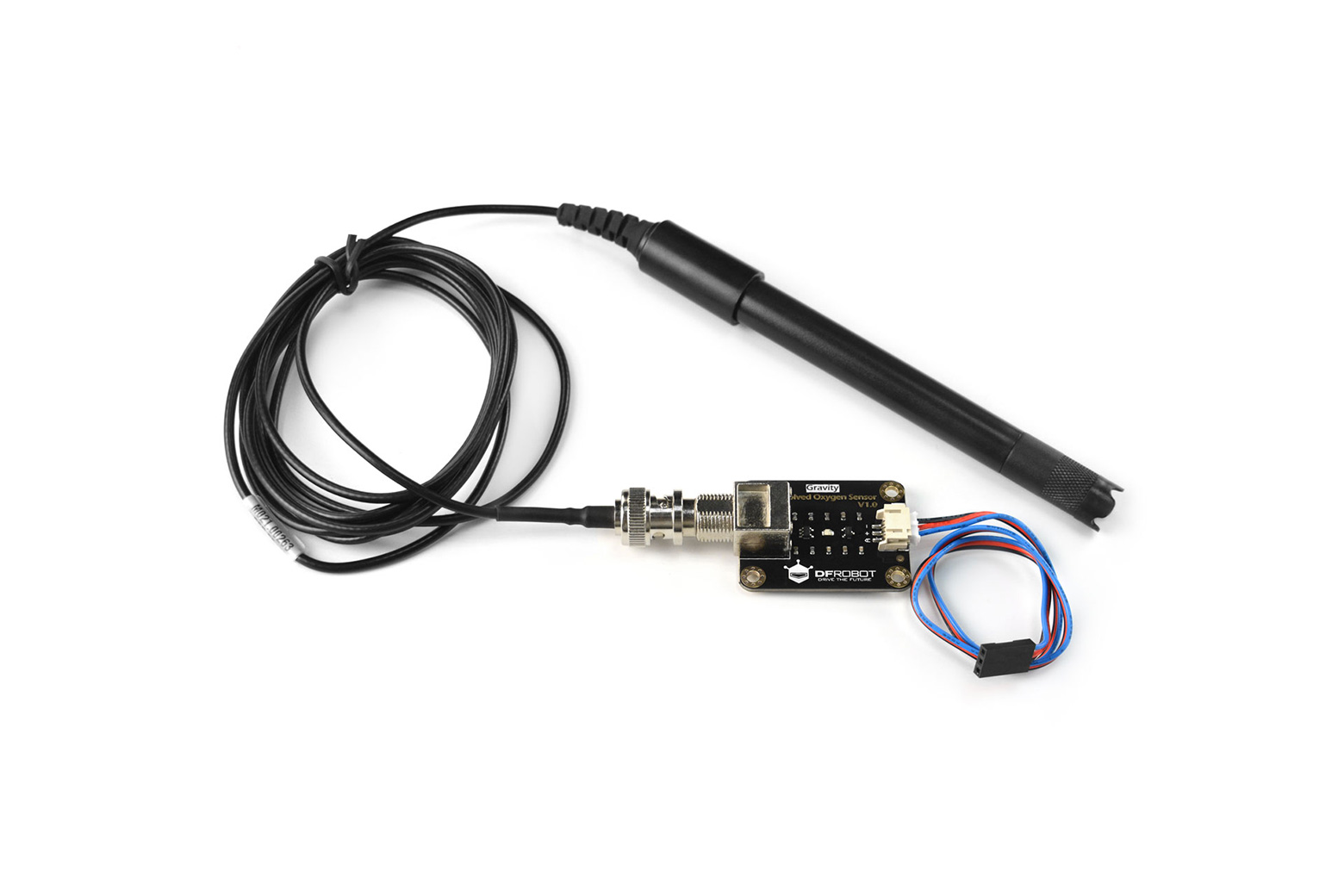
What it is.
A DO probe reports the oxygen in the water, usually in milligrams per liter or as a percentage of saturation. The common probes are galvanic or optical: galvanic probes are cheaper and use a membrane and fill solution that need occasional service; optical probes cost more and drift less. Either way the reading depends on temperature, and on pressure and salinity, so an accurate setup compensates for those. The Atlas Scientific EZO-DO circuit handles that and reports over I²C or serial.
Why it matters.
Plant roots respire, and in water culture they take their oxygen from the water itself. Warm water holds less oxygen, and a heavy root mass plus warm nutrient solution is exactly the recipe for a low-oxygen crash that rots roots and stalls growth. In aquaponics the stakes are higher still, because the fish need it too. A DO reading lets you see the dip coming and run an air pump or chiller before it bites, rather than discovering the problem in the plants.
Key facts.
Calibration and care.
A DO probe is calibrated against a known point, commonly air (which is at a known oxygen saturation) and, for the low end, a zero-oxygen solution. Galvanic probes consume their membrane and fill solution and need periodic service or replacement; optical probes last longer but cost more up front. As with every probe here, temperature compensation is essential, and you should read Trust Your Gauge before trusting a DO number to run an aerator.
Where it fits, and where it doesn’t.
Where it fits
- Deep water culture, where roots breathe the water.
- Aquaponics, where fish need oxygen too.
- Warm nutrient solutions prone to oxygen crashes.
- Driving an air pump or chiller from the reading.
Where it doesn’t
Resources & where to buy.
ESPHome: Atlas EZO Atlas Scientific DO Where to buy Water & chemistry overview
Frequently asked questions.
What is a dissolved oxygen sensor for?
It measures the oxygen dissolved in water, which roots and fish breathe. In deep water culture and aquaponics it warns you before a low-oxygen crash rots roots or stresses fish, so you can run an air pump or chiller in time.
Do I need a dissolved oxygen sensor for hydroponics?
Only if roots sit in water, as in deep water culture, or you run aquaponics. For media or drip systems, pH and EC are the essentials and a DO sensor is usually unnecessary. It is a specialist probe to add when oxygen in the water is at stake.
What is the difference between galvanic and optical DO probes?
Galvanic probes are cheaper and use a membrane and fill solution that need occasional service. Optical probes cost more up front but drift less and need less maintenance. Both must be temperature compensated for an accurate reading.
Can I read a dissolved oxygen sensor with ESPHome?
Yes, most directly with an Atlas Scientific EZO-DO circuit through ESPHome EZO component over I2C, which also handles compensation. The reading then appears in Home Assistant alongside pH and EC.