

A solar charge controller is the part that sits between a solar panel and a battery and makes the two work together safely. It takes the panel’s wandering output, charges the battery without overcharging it, and runs your device the whole time, from the panel when the sun is up and from the battery when it is not. It is the heart of an off-grid field node: the piece that lets a sensor at the back of the property run for years with no wire to it.
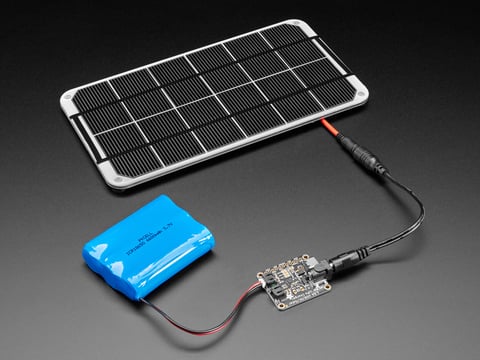
What it is.
A small board with three connections: the panel in, the battery, and the load out. It manages the charge so the battery fills safely and stops at full, and the good ones do load-sharing (sometimes called power-path): they run your device straight off the panel when the sun is out and only draw from the battery when it is not, which makes the battery last longer. For a single-cell lithium node, a charger like this is all you need; for a larger off-grid system, you step up to a dedicated MPPT controller, below.
MPPT vs a simple charger.
Two tiers, by how much solar you are running. A simple charge controller (the small board pictured) is right for a single lithium cell and a small panel, the size of most sensor nodes. A maximum power point tracking controller, or MPPT, is the upgrade for bigger systems: it actively tunes how it draws from the panel to squeeze out noticeably more energy, which matters once panels get into the tens of watts and the battery is a larger 12-volt pack. The older PWM-style controllers are cheaper but waste some of that. For a small node, do not overthink it; for a system running a camera or a hub off-grid, an MPPT controller earns its keep.
Sizing the panel and battery.
The whole job is making sure the sun puts back more than the node takes out, with margin for grey days. Work out the node’s daily energy use, then pick a panel big enough to replace that in the few good sun-hours a day gives you, and a battery big enough to ride through the cloudy stretches in between. Match the panel’s voltage to what the controller accepts, and err generous on both: a node that dies every overcast week is worse than one slightly oversized. The deep guidance is on the solar and batteries page.
Key facts.
Where it fits, and where it doesn’t.
Where it fits
- An off-grid sensor node with no wire to it.
- A remote LoRa node running for years on sun.
- Keeping a small load alive through cloudy stretches.
- Bigger off-grid loads, with an MPPT controller.
Where it doesn’t
Resources & where to buy.
Adafruit solar charger The battery it charges Regulators (the clean rail) Solar & batteries overview
Frequently asked questions.
What does a solar charge controller do?
It sits between a solar panel and a battery, charging the battery safely without overcharging it and running your device the whole time, from the panel when the sun is up and from the battery when it is not. It is the part that lets an off-grid field node run on sun instead of a wall, for years with no wire to it.
What is the difference between MPPT and a simple charger?
A simple charge controller is right for a single lithium cell and a small panel, the size of most sensor nodes. An MPPT (maximum power point tracking) controller actively tunes how it draws from the panel to harvest noticeably more energy, which matters once panels reach tens of watts and the battery is a larger 12-volt pack. For a small node, a simple charger is fine; for a camera or hub off-grid, MPPT pays off.
How do I size the solar panel and battery for a node?
Work out the node’s daily energy use, then pick a panel big enough to replace that in the few good sun-hours a day gives you, and a battery big enough to ride through cloudy stretches. Match the panel voltage to what the controller accepts, and err generous on both, since a node that dies every overcast week is worse than one slightly oversized.
What is load-sharing on a solar charger?
Load-sharing, or power-path, means the charger runs your device directly off the panel when the sun is out and only draws from the battery when it is not. That spares the battery from constant cycling, so it lasts longer. It is a feature worth looking for on a solar charger for a node you want to run untouched for years.