

Few real builds run on a single voltage. An ESP32 wants 3.3 volts, many sensors want 3.3 or 5, a relay coil or a small pump might want 12, and a battery or solar panel hands you a number that wanders as it charges and drains. A DC-DC regulator takes whatever voltage you have and gives back a steady one you asked for. Getting this layer right is what keeps a node from browning out, and getting it wrong is one of the most common reasons a field build misbehaves.
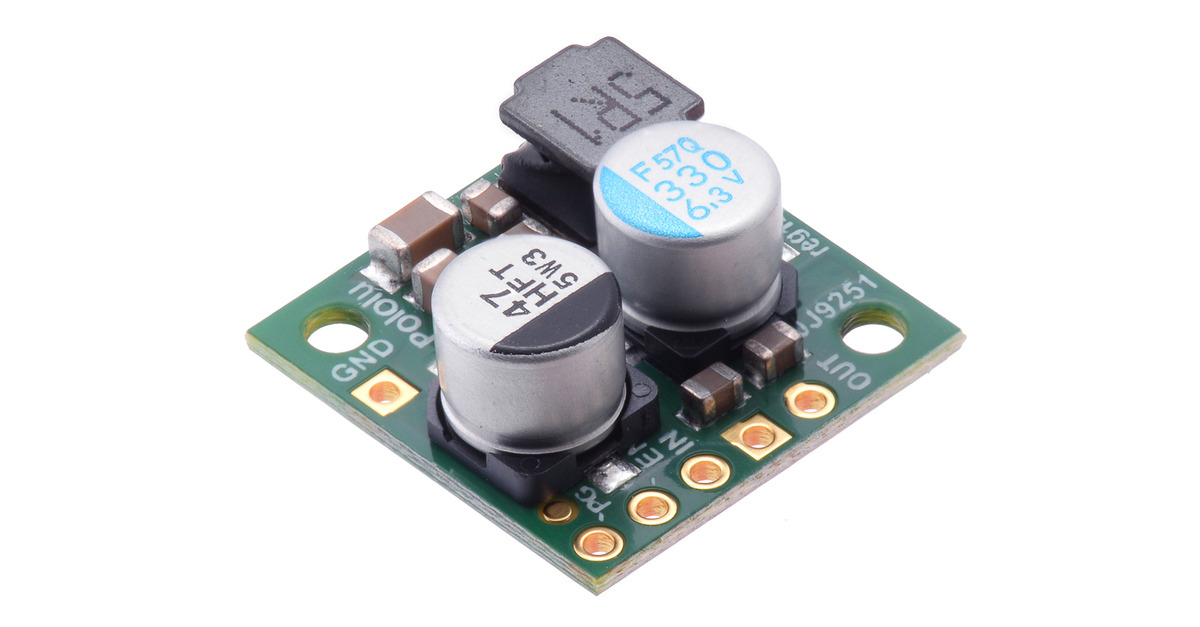
Why you need one.
Two reasons. The first is matching: a part needs the voltage it was designed for, and feeding 12 volts to a 3.3 volt chip ends the chip. The second is steadiness. A battery reads over 4 volts full and under 3.5 empty; a solar panel swings with the sun; a long wire run sags under load. A regulator flattens all of that into a clean, constant rail, so the controller and sensors see the same voltage whether the source is full, empty, or working hard.
Linear, buck, and boost.
Three ways to do the job, plus one combination. A linear regulator (an AMS1117 or an LM7805) is the simplest: cheap, very clean output, but it throws away the voltage difference as heat, so it is only sensible for a small drop at low current. A buck, or step-down, converter switches the power on and off quickly to drop voltage efficiently, wasting little as heat; this is the workhorse that turns 12 volts into a tidy 5 or 3.3. A boost, or step-up, converter goes the other way, raising a low voltage, such as lifting a single 3.7 volt cell to 5. A buck-boost does both, holding a fixed output even as the input rises above and falls below it, which is exactly what a battery that crosses your target voltage needs.
Compare the types.
The four kinds, side by side. The tinted column is the one most builds lean on: a step-down converter for the main rail. The big idea is efficiency: a linear regulator dropping 12 volts to 5 wastes more than half the power as heat, while a buck converter doing the same job keeps most of it, which matters enormously on a battery.
| Spec | Linear | Buck (step-down)Workhorse | Boost (step-up) | Buck-boost |
|---|---|---|---|---|
| What it does | Drops voltage down | Drops voltage down | Raises voltage up | Holds output as input crosses it |
| Efficiency | Low (wastes the difference) | High (~85 to 95 %) | High (~85 to 95 %) | High |
| Output vs in | Out < in only | Out < in only | Out > in only | Out above or below in |
| Heat | High on a big drop | Low | Low | Low |
| Noise | Very clean | Some switching noise | Some switching noise | Some switching noise |
| Best for | Small drop, low current, clean rail | 12 V to 5/3.3 V, the workhorse | 3.7 V cell up to 5 V | A battery that swings across the target |
For a clean, reliable rail, a quality module earns its keep. The Pololu step-down regulators are the dependable choice where the cheap adjustable modules are a gamble. For getting power to a remote node in the first place, see solar and batteries and supplies and UPS.
The cheap-module trap.
The little blue LM2596 step-down module is everywhere for about a dollar, and for plenty of jobs it is fine. The trap is in the no-name versions: their current ratings are often optimistic, the output can be electrically noisy, and a few are downright unsafe near their limit. For a quick bench job, fine. For a node you bury in a field and expect to run for a year, spend a few dollars more on a regulator from a maker that publishes honest numbers. A clean rail you can trust is cheap insurance against a brownout you cannot diagnose from afar.
Where they fit, and where they don’t.
Where they fit
- Running a 3.3 or 5 V node from a 12 V supply.
- Off-grid nodes on solar and a battery.
- Mixed-voltage builds with a relay or pump.
- Flattening a battery’s wandering voltage into a clean rail.
Where they don’t
- Turning wall AC into DC; that is a power supply.
- A tiny drop at low current, where a linear is simpler.
- Switching a load on and off; that is a relay or a driver.
- High-precision analog references without extra filtering.
Datasheets and modules.
Straight from the makers; these open in a new tab:
Pololu step-down regulators Pololu step-up regulators TI switching regulators Power overview
Frequently asked questions.
What is a DC-DC regulator?
It is a part that takes one DC voltage and gives back a steady, different one. You use it to match a part to the voltage it needs, like running a 3.3 V chip from a 12 V supply, and to flatten a source that wanders, like a battery or solar panel, into a clean constant rail.
What is the difference between a buck and a boost converter?
A buck, or step-down, converter lowers voltage, such as 12 V to 5 V. A boost, or step-up, converter raises it, such as a single 3.7 V cell up to 5 V. Both are efficient switching designs. If the input sometimes sits above and sometimes below your target, you want a buck-boost, which holds the output steady across that crossover.
Why not just use a linear regulator?
A linear regulator is simple and very clean, but it wastes the voltage difference as heat. Dropping 12 V to 5 V, it throws away more than half the power. That is fine for a small drop at low current, but for a big drop or on a battery, a buck converter wastes far less and runs cool.
Are the cheap LM2596 modules any good?
For a quick bench job, often yes. The catch with the no-name versions is that current ratings can be optimistic and the output noisy. For a node you leave running in a field for a long time, a regulator from a maker that publishes honest numbers, like Pololu, is worth the few extra dollars.