

Pololu’s D24V step-down regulators are small buck converters that do one job well: take a higher voltage in and hand back a clean, steady lower one. They are the part we reach for when a rail has to be dependable, because Pololu publishes honest current ratings and builds in the protection that the dollar modules skip. For a node that has to run untouched in a field, that reliability is the whole point.
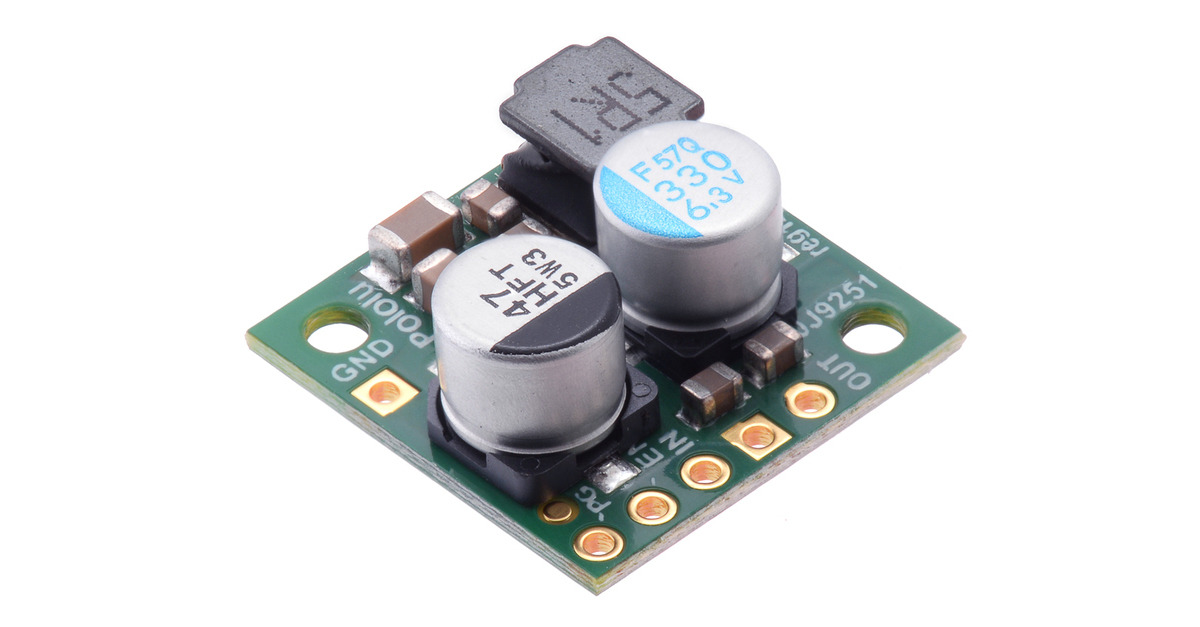
What it is.
A family of tiny buck (step-down) regulator boards, most no bigger than a postage stamp. They come in fixed outputs (3.3, 5, and other common voltages) and adjustable versions, and in a range of current sizes, from a few hundred milliamps up to several amps, so you pick the model that matches your load. The number in the name hints at the current: a bigger number means a beefier board. Each takes a wide input voltage and converts it efficiently, wasting little as heat.
Why over a cheap module.
A no-name LM2596 module costs about a dollar and often works, but you are trusting numbers nobody stands behind. The Pololu boards are different in the ways that bite you later: the current ratings are real, the output is cleaner, and most include reverse-voltage protection and thermal and overcurrent shutdown, so a wiring slip or an overload trips a safe stop instead of a small fire. You pay a few dollars more and get a rail you can stop worrying about.
The battery-node versions.
Some D24V models are built for power-sipping designs. Their quiescent current, the trickle the regulator itself burns just sitting there, is tiny, measured in microamps. On a node that spends most of its life in deep sleep and wakes for a moment to send a reading, that idle draw is what decides whether a battery lasts weeks or months. A regulator that drinks milliamps while your ESP32 sleeps in microamps would undo the whole point. For solar and battery nodes, those low-quiescent versions are the ones to choose.
Key facts.
Where it fits, and where it doesn’t.
Where it fits
- A clean 5 or 3.3 V rail from a 12 V supply or battery.
- Solar and battery nodes, with a low-quiescent model.
- A field build that must run untouched and reliably.
- Any spot where a noisy cheap module has burned you.
Where it doesn’t
- Turning wall AC into DC; that is a power supply.
- Raising voltage; you want a boost or buck-boost.
- Very high current; size up to a proper supply.
- A throwaway bench test where a dollar module is fine.
Resources & where to buy.
Pololu step-down regulators Pololu D24V (example) Powering a field node Regulators overview
Frequently asked questions.
What is a Pololu D24V regulator?
It is a small, efficient buck (step-down) voltage regulator board from Pololu. It takes a higher input voltage and hands back a clean, steady lower one, in fixed outputs like 3.3 or 5 volts or adjustable, and in a range of current sizes. It is the dependable choice for a rail that has to be reliable.
Why pick a Pololu regulator over a cheap LM2596 module?
The dollar modules often work, but their current ratings can be optimistic and their output noisy. The Pololu boards publish honest ratings, give a cleaner output, and most add reverse-voltage and thermal and overcurrent protection, so a wiring slip or an overload trips a safe stop. For a node you leave running, that reliability is worth the few extra dollars.
Which D24V model should I use for a battery node?
Choose one of the low-quiescent-current versions. The quiescent current is the trickle the regulator burns just sitting idle, and on a node that sleeps most of the time it decides how long the battery lasts. A low-quiescent model lets the regulator sip power while your microcontroller is asleep.
Can a step-down regulator raise voltage?
No. A step-down, or buck, regulator only lowers voltage; the output is always below the input. To raise a voltage, like lifting a single cell up to 5 volts, you need a step-up (boost) regulator, or a buck-boost if the input crosses above and below your target.