

Power is the unglamorous part that decides whether a field sensor still works in March. Get it right and a node runs for months on a small battery and a palm-sized solar panel. Get it wrong and you are walking out to a dead box in the rain. The good news is that the biggest win is free: it lives in the firmware, not the battery.
The first thing that fails.
Ask anyone who has run sensors in a field and they will tell you the same thing: power is the most common failure, ahead of the radio and well ahead of the sensor itself. A node that reports happily on the bench dies in a week outdoors, because nobody planned for the gap between “it runs on USB” and “it runs on its own for a season.” Closing that gap is mostly about two choices: how the node sleeps, and how it is fed.
Deep sleep is the lever.
A microcontroller doing its job draws tens of milliamps, but asleep it draws microamps, thousands of times less. A field node does not need to be awake: it can sleep for an hour, wake for a second or two to take a reading and send it, then sleep again. Done well, that turns a battery that would last a day into one that lasts months. So the first move when a node will run on battery is not to buy a bigger battery; it is to make the firmware sleep between readings. Battery size is the second lever, not the first.
Four ways to power it.
Pick by where the node lives. The tinted column is the off-grid answer once the firmware sleeps.
| By location | USB / wall | Battery only | Battery + solarOff-grid pick | Power over Ethernet |
|---|---|---|---|---|
| Best for | Near an outlet | Sleepy nodes, short runs | Remote, runs for good | Wired nodes on a LAN |
| Runtime | Forever | Weeks to months if it sleeps | Indefinite, if sized right | Forever |
| Effort | Easiest | Easy | Moderate | A PoE switch or injector |
| Watch out for | Needs an outlet | It will die; plan for sleep | Size for winter and clouds | Ethernet only, one cable |
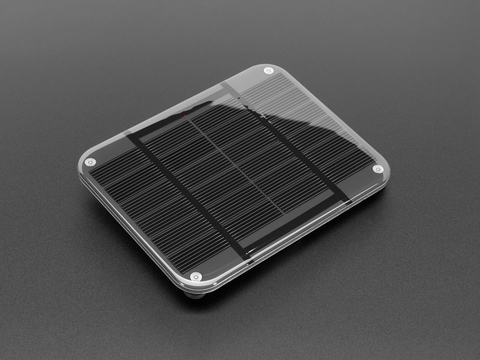
The common off-grid recipe is a lithium cell (an 18650 or a LiPo pack), a small solar panel, and a charge board such as a TP4056 or a dedicated solar LiPo charger that keeps the cell topped up. Power over Ethernet is the tidy answer for a wired node: one cable carries data and power. For the deep dives, see the solar charge controller and lithium batteries.
Sizing it, roughly.
You do not need precise math to get close. Estimate the node’s average current (a sleepy node might average well under a milliamp), multiply by the hours you want it to run, and that is the battery capacity in milliamp-hours, with generous margin on top. For solar, the panel has to make back a day’s use in the few good sun-hours you actually get, so size it for your worst season, not your best: a winter week of clouds is what kills an under-sized setup. When in doubt, oversize the panel and undersize your expectations.
Where it fits, and where it doesn’t.
Where it fits
- Remote nodes far from an outlet: fields, tanks, gates.
- Sleepy sensors that wake briefly and report.
- LoRa nodes built to run for months untouched.
- Wired nodes that can take Power over Ethernet.
Where it doesn’t
- Always-on, hungry loads like a camera, on a tiny battery.
- A node that never sleeps; it will drain fast.
- Under-sized solar for winter; plan for the worst week.
- A Raspberry Pi in the field on a coin cell; it needs steady, real power.
Resources.
These open in a new tab:
Adafruit: solar LiPo charging ESP32 deep sleep guide Where to buy panels & cells
Frequently asked questions.
How do I power a remote sensor that has no outlet?
The common recipe is a lithium battery, a small solar panel, and a charge board that keeps the battery topped up. The key is to make the microcontroller sleep between readings, which can stretch a small battery to months. Size the solar panel for your worst season, not your best.
How long will an ESP32 run on a battery?
It depends almost entirely on sleep. Awake and using Wi-Fi, an ESP32 draws tens of milliamps and drains a small battery in a day or two. Sleeping at microamps between brief wake-ups, the same battery can last weeks or months. Deep sleep is the biggest factor by far.
What battery should I use for a field node?
A lithium cell is usual: an 18650 cell or a LiPo pack, paired with a charge board. Size the capacity from the node average current times the hours you want, with margin. For anything long-term outdoors, add a small solar panel to recharge it.
What is Power over Ethernet, and when should I use it?
Power over Ethernet (PoE) sends both data and power down one network cable. It is the tidy choice for a wired node within reach of a network run, since you do not need a separate power supply at the node. It needs a PoE switch or injector at the other end.
How big a solar panel do I need?
Enough to make back a day of use in the few good sun-hours you actually get, sized for your worst season. A sleepy node needs very little, so a small panel often does. When unsure, oversize the panel: a cloudy winter week is what kills an under-sized setup.