

A soil moisture sensor tells you how much water is in the root zone, which is the difference between watering on a hunch and watering on a number. The cheap ones come in two kinds that look almost identical and behave completely differently. Get this one choice right and a two-dollar sensor will serve you for years; get it wrong and it rots in a month.
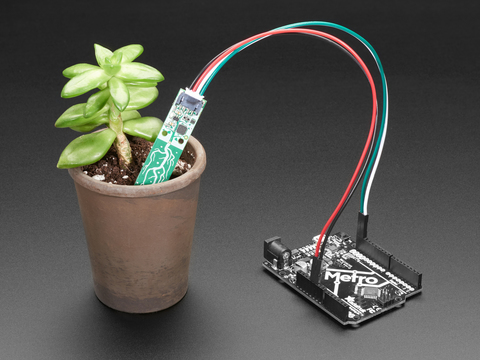
What they measure.
Most affordable probes do not sense water directly. They sense an electrical property that changes with water: a bare probe is, in effect, a sensor whose reading shifts as the soil around it gets wetter, and the microcontroller turns that shifting voltage into a number. That number is a stand-in for volumetric water content, the fraction of the soil that is water. It needs calibrating against your own soil to mean much, but even uncalibrated it shows the trend: drying out, just watered, holding steady.
The resistive trap.
The cheapest soil sensor, sold by the thousands, has two exposed metal prongs and measures the resistance between them. It works for about a week. Passing current through wet soil corrodes the prongs (electrolysis), the readings drift, and soon it is junk. Skip it for anything you want to leave in the ground. The fix is the capacitive sensor: it reads through a sealed surface with no exposed metal, so it does not corrode and lasts for years. It costs a dollar or two more and is worth every cent. If a listing does not say “capacitive,” assume it is the corroding kind.
Compare the types.
From the cheap-and-disposable to the research-grade. The tinted column is the everyday pick.
| Spec | Resistive | CapacitiveValue pick | Tensiometer | Pro probe |
|---|---|---|---|---|
| Measures | Water content (rough) | Water content | Tension (how hard to pull water) | Water content, often + EC, temp |
| Principle | Resistance between prongs | Capacitance (no bare metal) | Suction in a water-filled tube | Capacitance / TDR, lab-grade |
| Output | Analog voltage | Analog voltage | Gauge or analog | Digital (SDI-12 / I²C) |
| Corrodes? | Yes, fast | No | No | No |
| Calibration | Drifts badly | Per soil (air vs water) | Reads kPa directly | Factory-calibrated |
| Cost | About a dollar | A few dollars | Tens of dollars | Hundreds |
| Best for | Avoid for real use | The reliable cheap default | Irrigation by tension | Research and commercial |
Capacitive probes are usually analog (the microcontroller reads a voltage), though some come with a digital I²C output. Research probes like the METER TEROS line report calibrated water content, and often soil EC and temperature, over a digital bus. For the deep dive on the everyday probe, see the capacitive soil sensor page. The cheap two-prong resistive sensor, and why it corrodes, is on the resistive sensor page.
Content, or tension.
There are two honest ways to ask “does this plant need water,” and they are not the same. Water content (what capacitive probes read) is how much water the soil holds. Tension, or matric potential (what a tensiometer reads, in kPa), is how hard the plant has to pull to get it. Tension maps more directly to plant stress, which is why serious irrigators water by tension. For most growers a calibrated capacitive probe is plenty; reach for a tensiometer when you are dialing in irrigation and want the plant’s point of view, not the soil’s.
Where they fit, and where they don’t.
Where they fit
- Knowing when a bed, pot, or bench actually needs water.
- Triggering irrigation from a reading instead of a timer.
- Several cheap capacitive probes across a zone for the trend.
- Tension-based irrigation, with a tensiometer.
Where they don’t
- Anything permanent, if it is a resistive probe. It will corrode.
- An exact water-content percentage without calibrating to your soil.
- Hydroponics or pure water, where there is no soil to read.
- Burying the electronics. Only the sealed probe end goes in.
Which to buy.
Whatever you pick, calibrate it once (read it in air, then in a glass of water, then in your own moist soil) and read Trust Your Gauge before you let it run the irrigation.
Resources.
These open in a new tab:
DFRobot capacitive sensor METER TEROS (research) Irrometer (tensiometers) Open Agriculture Technology sensor comparison
Frequently asked questions.
What is the best cheap soil moisture sensor?
A capacitive soil moisture sensor. It costs a dollar or two more than the resistive kind but does not corrode, so it lasts for years instead of weeks. Look for the word capacitive on the listing.
Why do resistive soil sensors stop working?
They pass current through the soil between two exposed metal prongs, which corrodes the prongs by electrolysis. Within days to weeks the readings drift and the sensor becomes useless. Capacitive sensors avoid this because they have no exposed metal.
Do I need to calibrate a soil moisture sensor?
To read an actual water-content percentage, yes: the raw value depends on your soil. A quick calibration is to read the sensor in air and in water to set the dry and wet ends. Even uncalibrated, a capacitive probe reliably shows the trend of drying and wetting.
What is the difference between soil water content and soil water tension?
Water content is how much water the soil holds, which capacitive probes read. Tension, measured in kPa by a tensiometer, is how hard the plant must pull to get that water. Tension maps more directly to plant stress, so irrigators dialing things in often prefer it.
Can I use a soil moisture sensor in hydroponics?
Not usefully. These sensors read water in a solid medium. In hydroponics or deep water culture there is no soil to read; you would measure the nutrient solution with EC and pH sensors instead.