
LoRa is a radio built for one job: send a tiny message a long way on almost no power. A sensor on a coin cell can reach a base station a few kilometers off and run for years. That is exactly what a farm needs for the places Wi-Fi cannot reach: a far gate, a back field, a tank on the hill, a pump at the end of a long run. The trade-off is that the messages must stay small, so LoRa carries readings, not video.
What it is.
LoRa works on unlicensed radio bands (915 MHz in North America, 868 MHz in Europe), the same kind of free-to-use spectrum as Wi-Fi but much lower and slower. Low and slow is the trick: it travels far and passes through trees and buildings better than the 2.4 GHz a Wi-Fi board uses, and it sips so little power that a sensor can nap for an hour, wake, send a reading, and sleep again on a tiny battery.
LoRa vs LoRaWAN.
People use the words interchangeably, but they are two layers. LoRa is the radio itself: point one LoRa node at another and they talk directly, no network needed. Simple, and perfect for one sensor reporting to one base. LoRaWAN is a standard built on top of LoRa: nodes talk to gateways, the gateways forward to a network server, and from there your readings flow to wherever you keep them. LoRaWAN is what you want once you have many sensors, or want to use a shared network. For a single far sensor, plain LoRa is often enough.
When to use it.
The honest comparison for “how should my far-off sensor talk.” LoRa is unbeatable on range and power; it loses on data rate, so it is the wrong tool for a camera and the right tool for a number.
| By the job | LoRa (point to point) | LoRaWAN | Wi-Fi | Cellular |
|---|---|---|---|---|
| Range | A few km | A few km per gateway | About 100 m | Anywhere with coverage |
| Power draw | Very low | Very low | Moderate | Higher |
| Needs | Two radios | A gateway + network server | A router you already have | A modem + paid SIM |
| Data rate | Tiny | Tiny | High | High |
| Ongoing fee | None | None (TTN) or self-host | None | Monthly per SIM |
| Scales to many | No | Yes | Limited | Yes (at a cost) |
| Best for | One far sensor to one base | Many far sensors, at scale | Sensors near the building | Remote sites with no network |
Range is open-field and varies a lot with terrain, antennas, and obstructions. The Things Network is a free, community-run LoRaWAN you can join where there is coverage; ChirpStack is the common choice if you run your own network server. For the radio that goes on a node, see the RFM95W.
The parts you need.
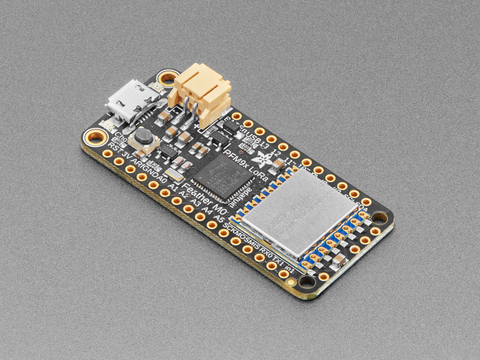
For a single point-to-point link you can skip the gateway and the network entirely: two LoRa boards, one at the sensor and one at the base, talking straight to each other.
Getting readings into Open Agriculture Technology, with no cloud.
LoRaWAN carries the reading the last mile; oat-ods is where it lives. The key choice is the network server. The Things Network is free and easy, but the data passes through someone else's cloud. The OAT-clean path is to run your own network server: a self-hosted ChirpStack on a Pi or a small server decodes the uplinks and publishes them to your own MQTT broker, the same broker the rest of Open Agriculture Technology uses. The chain stays on the property end to end:
end node → gateway → your ChirpStack → your MQTT → oat-ods → your endpoint
The last hop, ChirpStack's decoded uplink to oat-ods, is a thin map: a small bridge subscribes to the broker and turns each uplink into oat-ods, binding the device's devEUI to a stable stream so you can swap the radio without losing the history (the same logical-over-physical rule every Open Agriculture Technology sensor follows). One measurement per message, exactly like a wired node, at the endpoint, a far-field LoRaWAN sensor and a bench ESP32 look identical. Open Agriculture Technology ships a reference bridge for both ChirpStack and Meshtastic, so the gather tier is a config file, not a coding project.
The Open Agriculture Technology rule
Run the network server yourself and the data never leaves your property. The Things Network is a fine way to start, but a self-hosted ChirpStack is what keeps a LoRaWAN deployment genuinely sovereign, your radios, your broker, your data.
Where it fits, and where it doesn’t.
Where it fits
- A sensor far past Wi-Fi range: back field, tank, gate, pump.
- Battery or solar nodes that must run for months.
- Many small readings spread across acreage (LoRaWAN).
- Areas with poor or no cellular coverage.
Where it doesn’t
- Cameras or anything with real data. The messages are tiny.
- Sensors near the building. Plain Wi-Fi is simpler.
- Frequent updates. LoRa duty-cycle rules limit how often you send.
- Plug-and-play. It takes more setup than Wi-Fi.
Resources.
These open in a new tab:
The Things Network (free LoRaWAN) ChirpStack (self-hosted) LoRa Alliance: about LoRaWAN Dragino (gateways & nodes)
Frequently asked questions.
What is the difference between LoRa and LoRaWAN?
LoRa is the radio technology: two LoRa devices can talk directly. LoRaWAN is a network standard built on top of LoRa, where nodes talk to gateways that forward to a network server. Use plain LoRa for one sensor to one base; use LoRaWAN for many sensors or a shared network.
How far does LoRa reach?
A few kilometers in open country is typical, and more with good antennas and line of sight. Trees, hills, and buildings cut it down. It reaches much farther than Wi-Fi because it uses a low, slow sub-gigahertz signal.
Is LoRaWAN free to use?
The radio bands are unlicensed, so there is no airtime fee. The Things Network is a free community LoRaWAN you can join where there is coverage, or you can run your own network server with ChirpStack. You only pay for the hardware.
Can LoRa send a camera image?
No. LoRa is built for tiny messages like a sensor reading, and duty-cycle rules limit how much you can send. For images or video, use Wi-Fi or cellular instead.
What hardware do I need to start with LoRa?
For a single link, two LoRa boards (such as an ESP32-with-LoRa board) and matching antennas for your region. For LoRaWAN, add an 8-channel gateway and connect it to The Things Network or your own ChirpStack server.