

The RFM95W is the radio that gives a do-it-yourself sensor its reach. It is a small LoRa module, built on the Semtech SX1276 chip, that talks to any microcontroller over a few SPI wires and lets it send small messages kilometers across a property on a sip of power. It is the heart of most home-built field nodes: a soil sensor at the back fence, a gate contact, a water-level float, all reporting home on a battery that lasts for years.
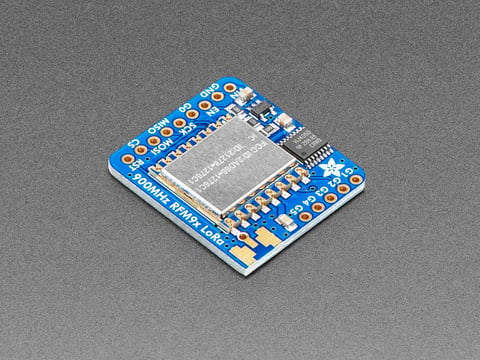
What it is.
A LoRa transceiver on a breakout board: you wire its SPI pins and a couple of control lines to a microcontroller, attach an antenna, and a small library does the talking. It only moves tiny messages, tens to a couple hundred bytes, and regulations cap how often it may transmit, but in exchange it reaches far on almost no power. The RFM95W is the node radio, the part on the sensor out in the field; the gateway that hears it is a separate device.
Raw LoRa vs LoRaWAN.
There are two ways to use it, and the difference trips people up. Raw LoRa is the simplest: two RFM95W radios talk directly to each other, point to point, with no network in between, which is perfect for a single sensor reporting to a single receiver you build. LoRaWAN adds a networking layer on top, so many nodes share a gateway and their data flows on to a server like The Things Network. The same RFM95W hardware does both; LoRaWAN just means running a LoRaWAN library on the microcontroller. Start with raw LoRa to learn, move to LoRaWAN when you have several nodes or want to use existing gateways.
Match the band and antenna.
Two things you must get right. The RFM95W is sold for a specific frequency band, and it has to match your region and your gateway: 915 MHz in North America, 868 MHz in Europe. A 915 radio will not talk to an 868 gateway, so check before you buy. And it needs an antenna tuned to that band, even a simple wire of the right length. Never transmit without an antenna attached, as it can damage the radio. Get the band and antenna right and the range is what LoRa promises; get them wrong and nothing works, or works badly.
Key facts.
Where it fits, and where it doesn’t.
Where it fits
- A home-built field sensor that reports over LoRa.
- Soil moisture, gate, water-level, or rain nodes far out.
- Battery or solar nodes that must run for years.
- A point-to-point link between two spots you build.
Where it doesn’t
Resources & where to buy.
Adafruit RFM95W The Things Network Gateways & coordinators LoRa & LoRaWAN overview
Frequently asked questions.
What is the RFM95W used for?
It is a LoRa radio module that gives a microcontroller long range on little power. You wire it to an ESP32, Arduino, or Pico over SPI, attach an antenna, and a small library lets the node send tiny messages kilometers to a gateway. It is the radio in most home-built field sensors: soil moisture, gate contacts, water level, and the like.
What is the difference between raw LoRa and LoRaWAN?
Raw LoRa is two radios talking directly, point to point, with no network, which is the simplest way to get one sensor reporting to one receiver. LoRaWAN adds a networking layer so many nodes share a gateway and reach a server like The Things Network. The same RFM95W does both; LoRaWAN just means running a LoRaWAN library on the microcontroller.
Which frequency band of RFM95W should I buy?
The one for your region, and it must match your gateway: 915 MHz in North America, 868 MHz in Europe, and 433 MHz in some places. A 915 radio will not talk to an 868 gateway, so check before buying. You also need an antenna tuned to that band, and you should never transmit without one attached.
Does the RFM95W reach the internet by itself?
No. It is the node radio, the part on the sensor. To get its messages onto your network or the internet, a LoRa gateway has to hear it and forward them. You either run your own gateway or use a public one where coverage exists. The RFM95W handles the long-range link; the gateway handles the bridge.