

A LoRaWAN gateway is the box that listens for your LoRa field nodes and forwards what they say onto your network. The RFM95W radios on your sensors do the long-range talking; the gateway is the one ear that hears them all and bridges their messages to a server and your hub. One well-placed gateway can cover a whole small farm, which is what makes a field of cheap, battery LoRa sensors practical.
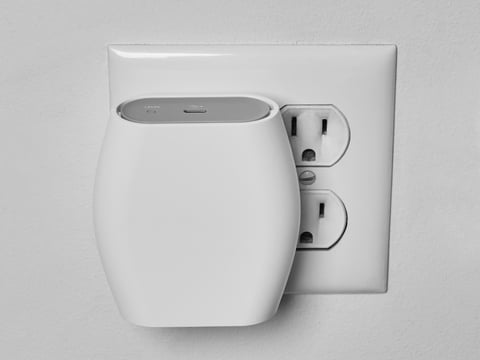
What it is.
A small appliance with a LoRa concentrator inside and a way to reach your network, by Wi-Fi or Ethernet. It receives the packets your nodes transmit and passes them up to a LoRaWAN network server like The Things Network or ChirpStack, which then hands the readings to Home Assistant or wherever you keep your data. It does not talk to the nodes much in return; mostly it listens, which is exactly what a field of sensors needs.
Single-channel vs 8-channel.
This is the buy-it-right decision. A real LoRaWAN gateway is 8-channel: it listens on all the channels at once, so it catches whatever a node sends. A cheap single-channel gateway, often a home-built microcontroller with one radio, only listens on one channel and misses much of the traffic. A single-channel build is a fine way to learn LoRaWAN on a bench, but for anything you rely on, use a proper 8-channel gateway. The difference is the gap between “sometimes hears a node” and “hears every node, every time.”
Indoor vs outdoor.
Two shapes, by how far you need to reach. An indoor gateway is cheap, plugs into a wall, and sits in a window; with its small antenna it covers a modest property. An outdoor gateway is weatherproof, takes a high-gain antenna up a mast, and reaches kilometers across open ground. Height and a clear horizon matter more than raw power: a gateway up high hears far-off nodes a ground-level one never will. Start with an indoor unit in a window, and move to an outdoor, elevated one when the far corners stop reporting.
Your own, or a public network.
You do not always have to own the gateway. Community networks like The Things Network have public gateways in some areas that your nodes can use for free, so where coverage already exists you may need no gateway at all. Out in rural ground, though, coverage is usually thin, and the own-your-data path is to run your own gateway: it covers exactly your property, costs nothing per month to operate, and keeps your readings on infrastructure you control. Most farms end up running their own.
Key facts.
Where it fits, and where it doesn’t.
Where it fits
- The hub of a LoRa field-sensor deployment.
- Covering a small farm from one well-placed unit.
- Keeping field readings on your own network.
- An outdoor, elevated unit for the far corners.
Where it doesn’t
- The node side; that is an RFM95W radio.
- Zigbee or BLE devices; those need their own coordinator.
- Anything reliable on a single-channel build.
- Dead spots; place it high or add a second.
Resources & where to buy.
The Things Indoor Gateway The Things Network ChirpStack (your own server) RFM95W (the node radio)
Frequently asked questions.
What does a LoRaWAN gateway do?
It listens for the LoRa packets your field nodes transmit and forwards them onto your network, passing them to a LoRaWAN network server like The Things Network or ChirpStack, which then hands the readings to your hub. The nodes do the long-range talking; the gateway is the one ear that hears them all and bridges them to the internet.
What is the difference between a single-channel and an 8-channel gateway?
An 8-channel gateway listens on all the channels at once, so it catches whatever a node sends. A single-channel gateway, often a home-built microcontroller with one radio, listens on only one channel and misses much of the traffic. Single-channel is fine to learn on, but for anything you rely on, use a proper 8-channel gateway.
Do I need my own LoRaWAN gateway?
Not always. Community networks like The Things Network have public gateways in some areas your nodes can use for free, so where coverage exists you may need none. In rural areas coverage is usually thin, so the reliable, own-your-data path is to run your own gateway: it covers exactly your property, costs nothing per month, and keeps your data on your own infrastructure.
Indoor or outdoor LoRaWAN gateway?
Start with an indoor gateway in a window; it is cheap and covers a modest property. Move to a weatherproof outdoor gateway with a high-gain antenna up a mast when the far corners stop reporting. Height and a clear horizon matter more than raw power, since a gateway up high hears distant nodes a ground-level one cannot.