
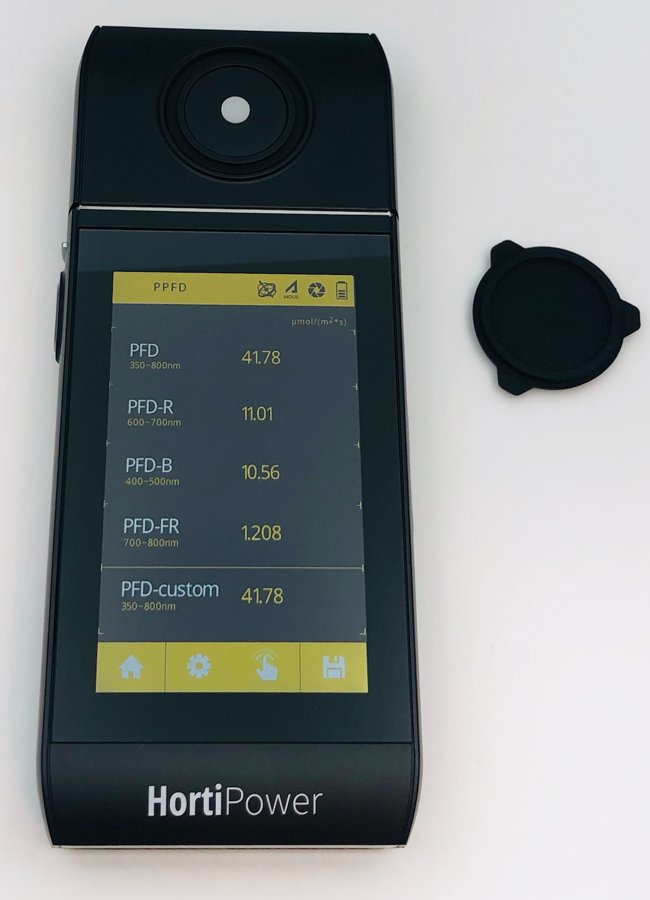
A PAR sensor, also called a quantum sensor, measures the light a plant can actually use to photosynthesize. It counts the photons in the 400 to 700 nanometre band, the photosynthetically active radiation, and reports them as PPFD: micromoles of photons per square metre per second. That is the number serious grow-light decisions rest on, because, unlike the lux a cheap sensor gives or the watts on a fixture’s box, it measures the right thing in the right unit.
What it measures.
A quantum sensor sees only the band plants run on, roughly 400 to 700 nanometres, and counts photons rather than weighting them by brightness or energy. The result, PPFD, is how many of those usable photons land on a square metre each second. Photosynthesis is driven by photon count, not by how bright the light looks or how many watts it draws, which is exactly why a sensor built to count photons in the right band is the one that tells you what a plant is getting.
Why lux and watts mislead.
Two everyday numbers fool growers. Lux weights light to the human eye, which peaks in the green that plants reflect and use least, so a sensor reading lux over-counts what a plant cares about and the weighting differs by light source. Watts measure the electricity a fixture draws, not the usable light it delivers. Two lights at the same lux, or the same wattage, can deliver very different PPFD, so picking or placing a grow light by either is guesswork. The quantum sensor cuts through it by measuring the photons themselves.
PPFD vs DLI.
Two related numbers do different jobs. PPFD is the instantaneous intensity, the photons arriving right now, which you use to set how bright a light is at the canopy and to check for even coverage. DLI, the daily light integral, is PPFD added up over the whole photoperiod, the total dose of light a crop receives in a day, in moles per square metre. PPFD tells you the brightness; DLI tells you whether the plant got enough light over the day. A quantum sensor reading plus your photoperiod gives the DLI, which the DLI calculator works out.
It is a precision instrument.
Here is the honest catch. A true quantum sensor (an Apogee SQ-series and the like) is a calibrated instrument, and it costs accordingly, often a couple of hundred dollars or more, with newer full-spectrum models corrected to read LED light accurately where older ones under-counted deep red and blue. The cheap alternative is to estimate PPFD from a lux reading using a conversion factor for your light source, which the grow light studio does and which is fine for relative checks and ballpark planning. But an estimate from lux is not a measurement: the conversion depends on the exact spectrum, so when an accurate number has to drive the lighting plan, the calibrated quantum sensor is the tool.
Key facts.
Where it fits, and where it doesn’t.
Where it fits
- Dialing in a grow light to a target PPFD at the canopy.
- Checking even coverage across a bench.
- Managing DLI for a crop’s daily light dose.
- Serious or research growing where the number matters.
Where it doesn’t
- A rough check; estimate from a lux sensor instead.
- Spectrum or color; that is an AS7341.
- Outdoor brightness logging; a TSL2591 is cheaper.
- A tight budget where ballpark light is good enough.
Resources & where to buy.
Apogee quantum sensors Grow light studio DLI calculator Light sensors overview
Frequently asked questions.
What is a PAR or quantum sensor?
It is a light sensor that measures the photons a plant can use for photosynthesis, in the 400 to 700 nanometre band, and reports them as PPFD: micromoles of photons per square metre per second. It is called a quantum sensor because it counts photons (quanta) rather than weighting light by brightness or energy. PPFD is the metric serious grow-light decisions rest on.
Why not just use a lux meter for grow lights?
Because lux weights light to the human eye, which is most sensitive to the green plants use least, and the weighting differs by light source. Two lights at the same lux can deliver very different PPFD, so choosing or placing a grow light by lux is guesswork. You can estimate PPFD from lux with a source-specific factor for a ballpark, but a quantum sensor measures the photons plants actually use directly.
What is the difference between PPFD and DLI?
PPFD is the instantaneous intensity, the usable photons arriving right now, which you use to set brightness at the canopy and check coverage. DLI, the daily light integral, is PPFD added up over the whole photoperiod, the total light dose a crop gets in a day, in moles per square metre. PPFD is the brightness; DLI is whether the plant got enough over the day. PPFD plus the photoperiod gives DLI.
Do I need an expensive quantum sensor?
Only when an accurate number has to drive the plan. A true quantum sensor is a calibrated instrument that costs a couple of hundred dollars or more, with full-spectrum models needed to read LED light accurately. For relative checks and ballpark planning, estimating PPFD from a cheap lux sensor is fine. For serious or research growing where the measurement matters, the calibrated sensor earns its price.