

The AS7341 is a small spectral light sensor that splits incoming light into roughly a dozen color bands across the visible range, for about fifteen dollars over I²C. Where a lux sensor says only “how bright,” the AS7341 shows you the shape of a light: how much red, green, blue, and so on. For a grower that is the cheap way to see what a grow light is actually emitting.
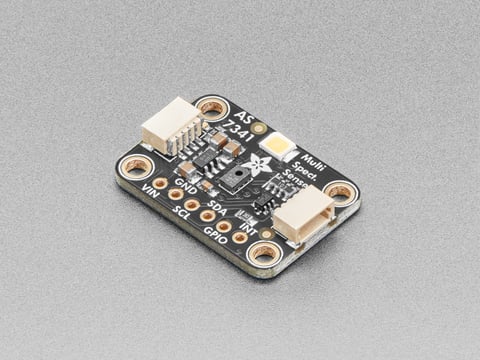
What it is.
The AS7341, from ams, has eight photodiodes tuned to different bands of visible light, plus clear and near-infrared channels, and it reports the strength in each over I²C. The result is a rough spectrum: not a single brightness number, but a profile of color. It is a measuring instrument for the quality of light rather than its intensity, and it does not, on its own, give a calibrated PAR or PPFD value.
What growers use it for.
The honest use is checking and comparing grow lights. Point it at a fixture and you can see whether a “full-spectrum” light really has the red and blue plants lean on, compare two lights, or watch how a tunable fixture shifts its mix. It is great for understanding and verifying spectrum. What it is not is a replacement for a quantum (PAR) sensor: it tells you the colors present, not the calibrated photon count a crop receives. Use it to judge the light’s character, and a PAR sensor to set the dose.
Key facts.
How to wire it.
Four wires over I²C: VCC, GND, SDA, SCL to your microcontroller, sharing the bus with other I²C parts at address 0x39. In ESPHome it has a dedicated AS7341 component that exposes each channel, and there are Arduino libraries from the breakout makers. Some boards include a small white LED for illuminating a sample up close.
Where it fits, and where it doesn’t.
Where it fits
- Checking what a grow light actually emits.
- Comparing two fixtures, or tuning an adjustable one.
- Understanding the color side of light, cheaply.
- Reading per-channel data with ESPHome.
Where it doesn’t
- Setting a crop’s light dose; that needs a PAR sensor.
- A single brightness number; a lux sensor is simpler.
- Calibrated, lab-grade spectral data.
- Outdoor full-sun without care; it can saturate.
Resources & where to buy.
ESPHome: AS7341 Adafruit AS7341 guide Where to buy Light sensors overview
Frequently asked questions.
What does the AS7341 measure?
It measures the spectrum of light, splitting it into about a dozen color bands across the visible range plus clear and near-infrared. Instead of a single brightness number it gives you the shape of the light, which is useful for seeing what a grow light emits.
Can the AS7341 measure PAR or PPFD?
Not as a calibrated value. It shows the relative strength of color bands, which tells you the character of a light, but it is not a calibrated quantum (PAR) sensor. For an accurate PPFD or daily light integral, use a dedicated PAR sensor.
What would a grower use an AS7341 for?
Checking and comparing grow lights: whether a full-spectrum claim holds up, how two fixtures differ, or how a tunable light shifts its mix. It is the cheap way to understand the color quality of a light, alongside a PAR sensor for the dose.
How do I read an AS7341 with ESPHome?
Wire it to an ESP32 over I2C at address 0x39 and use ESPHome's AS7341 component, which exposes each channel as a sensor. Arduino libraries from the breakout makers also work if you prefer code.