
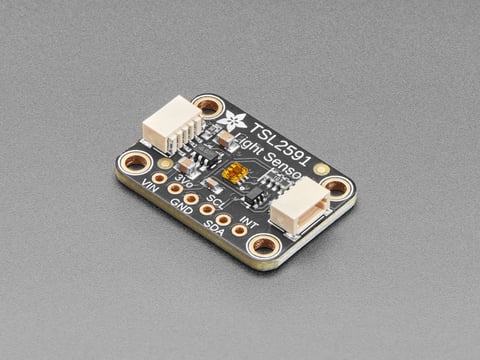
The TSL2591 is a digital light sensor with an unusually wide range: it reads from near-darkness up to bright, direct sun without losing its footing. That makes it the one to reach for when a basic BH1750 maxes out, which it does in full daylight. For logging how much light a greenhouse or an outdoor bed actually gets, dawn to noon to dusk, the TSL2591’s range is its whole appeal. Just keep one thing clear: it measures lux, which is light as the human eye sees it, not the light a plant runs on.
What it is.
A small I²C light sensor on a breakout that hands a microcontroller a calibrated light reading in lux. It has separate channels for full-spectrum and infrared light, and an adjustable gain and timing, which is how it covers such a wide span of brightness. Wire it to two pins, and a small library returns a number you can log or act on.
Why the range matters.
Light outdoors covers an enormous span: moonlight is a fraction of a lux, an overcast day is a few thousand, and direct sun is over a hundred thousand. A cheap sensor like the BH1750 reads the indoor and shade end well but saturates in bright sun, pinning at its maximum and telling you nothing about how much light a plant in full exposure is really getting. The TSL2591 handles that whole range, from a dim corner to noon sun, so a single outdoor sensor logs the real daily curve instead of flat-lining every clear afternoon.
Lux is not PAR.
This is the honest limit of any lux sensor, and it matters for growing. Lux weights light to the human eye, which is most sensitive to green, the very color plants reflect and use least. PAR (photosynthetically active radiation), measured as PPFD, counts the photons a plant actually uses, and it is what serious grow-light decisions rest on. A true PAR reading needs a quantum sensor (an Apogee-class instrument). A lux sensor like the TSL2591 is excellent for logging trends, comparing spots, and tracking the daily cycle, and you can roughly estimate PPFD from lux with a light-source-specific factor (the grow light studio does this), but treat that as an estimate, not a measurement. For spectrum, the AS7341 is the tool.
Key facts.
Where it fits, and where it doesn’t.
Where it fits
- Outdoor or greenhouse light logging in full sun.
- Tracking the daily light curve, dawn to dusk.
- Comparing how much light different spots get.
- Anywhere a BH1750 saturates in bright light.
Where it doesn’t
Resources & where to buy.
Adafruit TSL2591 BH1750 (basic lux) AS7341 (spectrum) Grow light studio
Frequently asked questions.
What is the TSL2591 good for?
Logging light across a very wide range, from near-darkness up to direct sun. That makes it the choice for outdoor and greenhouse light logging, where a cheaper sensor like the BH1750 saturates in bright daylight. It reads lux over I2C and is ideal for tracking the daily light curve and comparing how much light different spots get.
Why use a TSL2591 instead of a BH1750?
For its range. The BH1750 reads indoor and shade levels fine but pins at its maximum in full sun, so it cannot tell you how much light a plant in direct exposure is getting. The TSL2591 covers the whole span from a dim corner to noon sun, so one outdoor sensor logs the real daily curve instead of flat-lining every clear afternoon.
Can the TSL2591 measure PAR or PPFD?
Not directly. It measures lux, which weights light to the human eye, while PAR and PPFD count the photons a plant actually uses, which is what grow-light decisions rest on. A true PAR reading needs a quantum sensor like an Apogee. You can roughly estimate PPFD from lux with a light-source-specific factor, but treat that as an estimate, not a measurement.
What is the difference between lux, PAR, and spectrum?
Lux is overall brightness as the human eye perceives it, measured by sensors like the TSL2591 and BH1750. PAR (as PPFD) is the count of photosynthetic photons a plant uses, measured by a quantum sensor. Spectrum is the breakdown of light by color, measured by a sensor like the AS7341. They answer different questions, and a serious light setup may use more than one.