

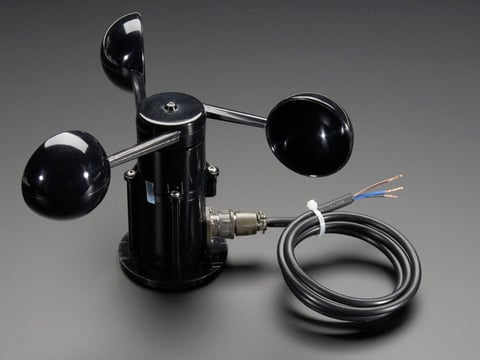
An anemometer measures wind speed; a wind vane measures wind direction; and the two usually travel together. The classic anemometer is the cup type, three little cups on a spindle that spin faster the harder the wind blows. For a grower, wind is the reading that decides whether a spray will drift, whether a frosty night is dangerous, and how fast the crop is losing water, so a wind sensor turns “it feels breezy” into a number you can act on.
What they are.
Two instruments. The cup anemometer spins in the wind, and its rate of spin tracks wind speed. The wind vane swings to point into the wind, and its position tells you the direction the wind is coming from. They often share a mast and plug into the same microcontroller, alongside a rain gauge, as a weather-meter set.
How they read wind.
The anemometer reports speed one of two ways. Some give a pulse per rotation, so you count pulses over time and multiply by a speed factor; others, like the one pictured, output an analog voltage that rises with wind speed, which you read on an ADC pin and map to a speed from the datasheet. The wind vane is usually analog too: a magnet swings over a ring of resistors, giving a voltage that maps to one of eight or sixteen compass directions. Neither is hard to read; both come down to a number plus a conversion.
Why wind matters.
Wind earns a sensor of its own for four reasons. Spray drift: above a threshold a spray blows off-target, wasting product and risking neighbours, so a wind reading gates the sprayer. Frost: a still, clear night is the dangerous one, because calm air lets cold settle, while wind mixes warmer air down, so wind speed sharpens a frost warning. Evapotranspiration: wind pulls moisture from leaves and soil, so it is a direct input to how much water the crop needs. And protection: a high-wind alert tells you to close vents, secure covers, or batten down a tunnel before damage happens.
Siting and calibration.
Wind is the reading most ruined by placement. Mount the anemometer high and unobstructed, because buildings, trees, and the crop canopy all slow and swirl the wind near them; the meteorological standard is ten metres, and in practice you go as high and clear as you reasonably can. Orient the vane to true north when you install it so its directions are right. For speed accuracy, the sensor’s factor is usually good enough, but you can check it against a handheld meter, and remember the bearings wear over years and icing will stop it spinning.
Key facts.
Where it fits, and where it doesn’t.
Where it fits
- Gating sprays when the wind is too high to apply safely.
- Sharpening frost warnings on still, clear nights.
- Feeding evapotranspiration and irrigation need.
- High-wind alerts to secure tunnels and covers.
Where it doesn’t
- Indoor or in-canopy air movement; this is for open wind.
- A spot blocked by buildings or trees; it reads low.
- Lab-grade precision; a cup anemometer is field-grade.
- Through ice; a frozen anemometer stops.
Resources & where to buy.
Adafruit anemometer Adafruit weather meter (kit) Rain gauge Weather station overview
Frequently asked questions.
What is the difference between an anemometer and a wind vane?
An anemometer measures wind speed, usually with spinning cups whose rate of spin tracks how hard the wind blows. A wind vane measures wind direction, swinging to point into the wind. They are different instruments that answer different questions, and they are often sold and mounted together as a wind-sensing pair.
How do I read an anemometer with a microcontroller?
It depends on the type. A pulse anemometer gives one pulse per rotation, so you count pulses over time and multiply by its speed factor. An analog one outputs a voltage that rises with wind speed, which you read on an ADC pin and map to a speed using the datasheet. A wind vane is usually analog too, a voltage from a resistor ring that maps to a compass direction.
Why does wind speed matter for growing?
Four reasons. It gates spraying, since above a threshold the spray drifts off-target. It sharpens frost warnings, because calm clear nights are the dangerous ones while wind mixes warmer air down. It drives evapotranspiration, the water a crop loses, so it feeds irrigation need. And it triggers protection, telling you to close vents or secure covers before high wind does damage.
Where should I mount an anemometer?
High and unobstructed. Buildings, trees, and the crop canopy all slow and swirl the wind near them, so a low or sheltered anemometer reads too low and erratically. The meteorological standard is 33 feet (10 meters); in practice mount it as high and clear as you reasonably can. Orient the wind vane to true north on install so its directions are correct.