

The eTape is a slim, flexible strip that reads liquid level continuously along its length. Where an ultrasonic sensor reads from above, the eTape lives against the tank wall and the liquid’s own weight tells it the level. It is a tidy answer for a narrow or oddly shaped tank where a sound beam would bounce off the walls, and it gives a smooth, continuous reading rather than a single on/off point.
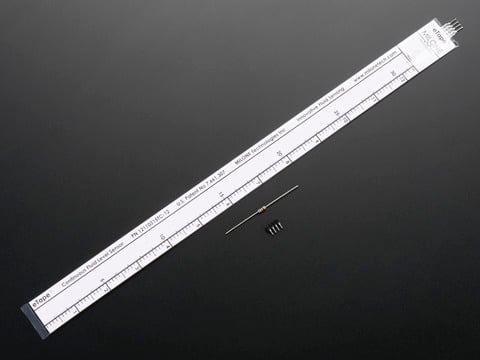
What it is.
A printed resistive tape, sealed in a thin envelope, that you mount vertically in or against a tank. It is a continuous level sensor: the higher the liquid, the more of the tape is affected, and its resistance changes in step. A microcontroller reads that resistance as an analog value, usually through a simple voltage divider, and turns it into a level.
How it works.
Inside the envelope are two layers separated by a gap. The hydrostatic pressure of the liquid presses the layers together up to the height of the liquid, and the more they touch, the lower the tape’s resistance. So the resistance maps almost linearly to the liquid height: full tank, low resistance; empty tank, high resistance. You read it like any analog sensor, calibrate two points (empty and full), and the value between becomes a level.
When it beats ultrasonic.
Ultrasonic is the default for most tanks, but the eTape wins in a few spots. A narrow or stepped tank confuses a sound beam with wall echoes; the eTape, flat against the wall, does not care about shape. There is no dead zone, so it reads right up to the top and bottom where ultrasonic loses the first stretch. And it is slim and self-contained, with no clearance needed above the water. When the tank is awkward or you cannot mount a sensor above the surface, the eTape is the neat fit.
The contact caveats.
The flip side of living in the liquid. The eTape touches the water, so over time it can foul with scale or biofilm, and in a nutrient solution that happens faster, which drifts the reading until you clean it. The standard tape suits water; for harsher liquids choose the chemical-resistant (Teflon) version. It comes in fixed lengths, so it is best for small to mid-size tanks, and it is a specialty part, pricier than a float switch or an ultrasonic board. For a clean-water tank where ultrasonic does not fit, it is worth it; for a fouling-prone reservoir, a non-contact sensor is the safer call.
Key facts.
Where it fits, and where it doesn’t.
Where it fits
- Narrow or stepped tanks that confuse ultrasonic.
- A continuous reading with no dead zone, top to bottom.
- Tanks with no room to mount a sensor above the water.
- Clean-water tanks where fouling is slow.
Where it doesn’t
- Fouling-prone nutrient reservoirs; use ultrasonic.
- Deep tanks beyond its fixed length.
- The cheapest job; a float switch costs far less.
- Harsh liquids, without the chemical-resistant version.
Resources & where to buy.
Adafruit eTape Ultrasonic (non-contact) Water level overview The Sketches
Frequently asked questions.
How does an eTape level sensor work?
It is a sealed resistive tape mounted vertically in a tank. The liquid’s pressure presses two internal layers together up to the liquid’s height, and the more they touch, the lower the tape’s resistance. So resistance maps almost linearly to level: full tank, low resistance; empty, high. A microcontroller reads it as an analog value through a voltage divider.
When should I use an eTape instead of ultrasonic?
When the tank is narrow or stepped, where a sound beam bounces off the walls, or when there is no room to mount a sensor above the water. The eTape sits flat against the wall, does not care about tank shape, and has no dead zone, so it reads right to the top and bottom. For most open tanks, though, non-contact ultrasonic is the easier default.
Will an eTape foul in a nutrient reservoir?
It can. Because it sits in the liquid, scale and biofilm build up over time and drift the reading until you clean it, and a nutrient solution speeds that up. The standard tape suits water; a chemical-resistant version handles harsher liquids. For a fouling-prone reservoir, a non-contact ultrasonic sensor is usually the safer choice.
Is the eTape worth it over a float switch?
Only when you need a continuous reading, not just an on/off point. A float switch is far cheaper and perfect for a low-water alarm or pump protection, but it tells you only above-or-below one level. The eTape gives the actual level along its length, so you can chart the trend, at a specialty price. Pick by whether you need a gauge or just an alarm.