

A water flow sensor tells you how much water is moving through a pipe: the rate right now and the total over a day or a season. For a grower that answers questions a level sensor cannot: how much water did this irrigation zone actually get, is something leaking when nothing should be running, did the dosing pump really pump, and how much water is the whole place using. The everyday tool is a cheap inline turbine sensor; pricier non-invasive options exist for when cutting the pipe is not an option.
Why flow matters.
Flow is where irrigation goes from guesswork to numbers. Metering each zone tells you whether a bed got the water you intended or a clogged emitter starved it. A flow reading when the system should be off is the clearest leak alarm there is. Watching a dosing pump confirms it actually moved nutrient instead of running dry. And a meter on the main line turns water into a budget you can track and cut. None of that is visible from a tank level; it only shows up when you measure what moves.
Rate vs total.
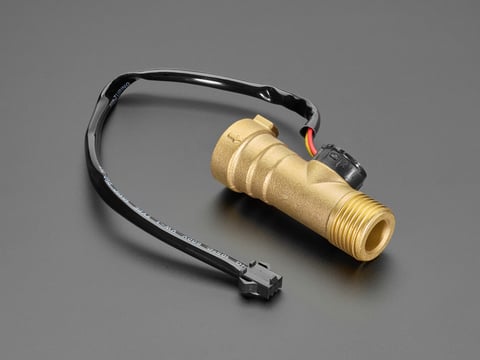
A flow sensor really gives two readings from one signal. The rate is how fast water is moving right now, in liters or gallons per minute, which is what you watch for “is it flowing, and is it flowing right.” The total is the rate added up over time, the volume that has passed, which is what you want for “how much did this zone use today.” A turbine sensor produces a stream of pulses: their frequency is the rate, and their count is the total. Both come from the same little sensor; the code just reads them differently.
Compare the methods.
Four ways to measure flow, from a few-dollar inline sensor to an industrial clamp-on. The tinted column is the do-it-yourself standard for an irrigation line.
| Spec | Hall-effectOur pick | Clamp-on ultrasonic | Electromagnetic | Pulse-output meter |
|---|---|---|---|---|
| How | A pinwheel counts pulses | Sound timed through the pipe | Magnetic field, conductive liquid | A mechanical meter with a pulse out |
| Plumbing | Inline, cut the pipe | Clamps on, no cutting | Inline | Inline (a water meter) |
| Moving parts | Yes, a rotor | None | None | Yes |
| Cost | Cheap | High | High | Moderate |
| Best for | DIY irrigation lines | Non-invasive on an existing pipe | Accurate industrial flow | Totalizing whole-property use |
For the deep dive on the everyday choice, see the hall-effect flow sensor. A clamp-on ultrasonic meter straps onto the outside of an existing pipe and measures flow without cutting or touching the water, which is excellent but costs far more. Electromagnetic meters are the accurate industrial option for conductive liquids, with no moving parts. And a plain water meter with a pulse output is a tidy way to totalize the whole property’s use.
The dirty-water caveat.
The catch with the cheap turbine sensor is its moving part. A small pinwheel spins inside it, and grit, sand, or debris in the water can jam or wear it, which is a real risk on well water, pond water, or an unfiltered line. Put a filter upstream, use it on clean or treated lines, and check it occasionally. Where the water is genuinely dirty and you cannot filter, a non-invasive clamp-on ultrasonic meter, with nothing in the flow to clog, is the more durable answer despite the price.
Where they fit, and where they don’t.
Where they fit
- Metering how much water each irrigation zone gets.
- Leak detection: flow when the system should be off.
- Confirming a dosing or transfer pump actually moved liquid.
- Budgeting and tracking total water use.
Where they don’t
- How full a tank is; that is water level.
- What is in the water; that is water chemistry.
- Gritty, unfiltered water through a turbine sensor; it clogs.
- Very low drip flows below the sensor’s minimum.
Resources.
The deep dive and a place to send the reading; external links open in a new tab:
Hall-effect flow sensor Water level Water chemistry All sensors
Frequently asked questions.
What is the best way to measure irrigation water flow?
For most growers, a cheap inline hall-effect turbine sensor cut into the line: it counts pulses as water spins a small rotor, giving both flow rate and total volume to a microcontroller. Where you cannot cut the pipe or the water is too dirty for a moving part, a clamp-on ultrasonic meter reads from the outside, at a much higher price.
What is the difference between flow rate and total volume?
Flow rate is how fast water is moving right now, in liters or gallons per minute, which you watch for whether it is flowing correctly. Total volume is the rate added up over time, the amount that has passed, which tells you how much a zone used. A turbine sensor gives both from one pulse signal: the pulse frequency is the rate, the pulse count is the total.
Can a flow sensor detect a leak?
Yes, and it is one of the best uses. If the sensor reads flow when the irrigation system is supposed to be off, something is leaking or a valve is stuck open. Wire it to a hub like Home Assistant with a rule that alerts on any flow during off hours, and a slow leak that would otherwise run for days gets caught the same night.
Will a flow sensor work on dirty or well water?
A cheap turbine sensor has a moving pinwheel that grit and debris can jam or wear, so on well, pond, or unfiltered water it is a risk. Put a filter upstream and use it on clean lines, and check it now and then. For genuinely dirty water you cannot filter, a non-invasive clamp-on ultrasonic meter has nothing in the flow to clog and lasts longer, though it costs much more.