
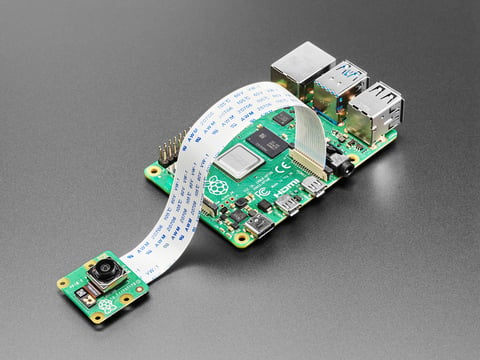
The Raspberry Pi Camera Module is the step up from a cheap all-in-one board: a proper camera sensor on a small board that ribbons into a Raspberry Pi. With the Pi behind it, it becomes a recorder, a time-lapse maker, or an AI watcher that can flag pests and disease, all on hardware you own. When the picture has to be good, or a computer has to read it, this is the path.
What it is.
A camera sensor on a small board that connects to a Raspberry Pi over a flat ribbon cable into the Pi’s camera (CSI) port. Unlike an ESP32-CAM, it has no radio and no brain of its own: the Pi does the capturing, with the modern libcamera and picamera2 software. That pairing is the whole point, because a real computer can do far more with the image than a tiny chip can.
The versions.
A short family, picked by how much quality you need. The Camera Module v2 is the long-serving 8-megapixel workhorse. Camera Module 3 is the current pick: 12 megapixels with autofocus, in a normal or wide-angle lens. The HQ Camera takes interchangeable C and CS mount lenses for serious, sharp work, including macro for inspecting a leaf up close. Each version also comes in a NoIR variant, covered next.
The near-infrared option.
Each module is sold in a normal version and a NoIR version with the infrared-blocking filter removed. That lets the sensor see near-infrared light, which buys two things for a grower. With an infrared illuminator it gives night vision in the dark. And because healthy leaves reflect near-infrared strongly, a NoIR camera is a starting point for crude plant-health imaging. Be clear-eyed about that last one: a true vegetation index like NDVI needs a calibrated filter and careful processing, so a bare NoIR camera is a first step toward it, not a finished measurement.
Why it is the quality path.
The sensor is only half of it; the Pi behind it is the rest. A Raspberry Pi running Frigate or Home Assistant can record the camera, build time-lapses, and run on-device object detection to flag pests, disease, or canopy changes, with the footage staying on your own network. That is the difference between a camera that takes a picture and a camera that tells you something.
Key facts.
Where it fits, and where it doesn’t.
Where it fits
- Sharp images and crisp, focused time-lapse.
- AI plant vision: pests, disease, canopy cover.
- Night and near-infrared work, with a NoIR module.
- Local recording on a Pi you own, no cloud.
Where it doesn’t
- Standalone use; it needs a Raspberry Pi.
- A cheap throwaway snapshot; an ESP32-CAM is cheaper.
- Battery-only field nodes; the Pi wants steady power.
- Calibrated NDVI from a bare NoIR module; that needs more.
Resources & where to buy.
Pi Camera Module 3 Adafruit Camera Module 3 Frigate (local camera AI) Cameras overview
Frequently asked questions.
What is the Raspberry Pi Camera Module used for?
It is the quality camera for a grower’s setup: sharp images and time-lapse, and, paired with the Raspberry Pi it plugs into, AI plant vision that can flag pests, disease, or canopy changes. It connects by ribbon cable to the Pi’s camera port and is run by the Pi’s libcamera software.
What is the difference between the Pi camera versions?
The Camera Module v2 is the older 8-megapixel workhorse. Camera Module 3 is the current pick at 12 megapixels with autofocus, in normal or wide-angle. The HQ Camera takes interchangeable C and CS mount lenses for serious, sharp, or macro work. Each also comes in a NoIR version that sees near-infrared.
What is a NoIR camera, and can it do NDVI?
NoIR means the infrared-blocking filter is removed, so the sensor sees near-infrared light. That gives night vision with an infrared illuminator, and because healthy leaves reflect near-infrared strongly, it is a starting point for plant-health imaging. A true NDVI measurement needs a calibrated filter and careful processing, so a bare NoIR camera is a first step toward it, not a finished index.
Should I use a Pi camera or an ESP32-CAM?
Use a Pi camera when the picture has to be good or a computer has to read it: quality images, AI vision, near-infrared. Use an ESP32-CAM when you just want a cheap networked snapshot and do not want a Raspberry Pi behind it. The Pi camera costs more and needs a Pi, but it is far more capable.