

A thermostat holds something at a target temperature by switching a heater or a cooler when the reading drifts off. It is the same closed loop as the CO₂ controller and the pH/EC controller, pointed at heat: read a temperature sensor, compare it to a setpoint, and switch a heater or fan through a relay. In growing it runs heat mats for germination, greenhouse heaters, frost protection, fermentation, brooders, and reservoir temperature.
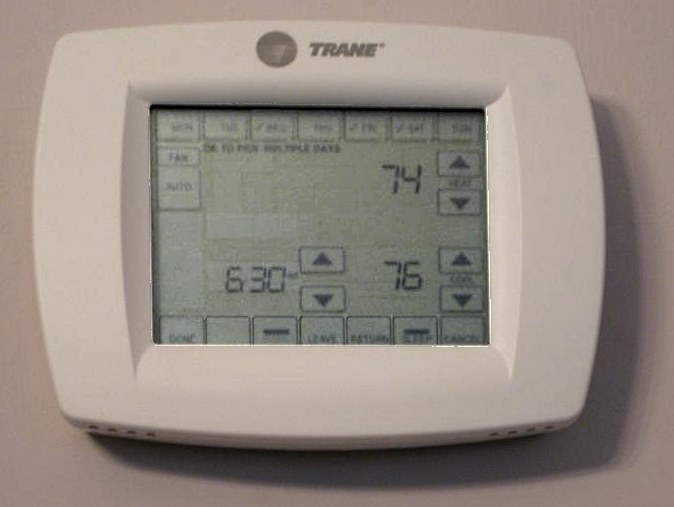
What it is.
A temperature sensor, a controller, and a heater or cooler, wired into a loop. The controller can be a cheap plug-and-play unit (an Inkbird ITC-308 or an STC-1000, a probe and a switched outlet for a few dollars) or a microcontroller running the logic itself. Either way the job is the same: keep the temperature where the crop wants it without you watching a thermometer. The simplest builds switch one device; a dual-stage unit switches a heater and a cooler from the same probe.
Hysteresis is the game.
If you remember one thing about a thermostat, remember this. You never switch on the exact setpoint, because the temperature wobbles across it by tenths of a degree and the heater would chatter on and off many times a minute. That rapid cycling, called short-cycling, wears out the equipment, wastes energy, and holds nothing steady. The fix is hysteresis, a deadband around the setpoint: turn the heat on at 18 °C and off at 20 °C, and between those two points nothing switches. A wider band means fewer, longer cycles and a softer hand; a narrower band holds tighter but cycles more. Set the smallest band your gear can live with.
Heat and cool in one loop.
A dual-stage controller can run both ends. It switches a heater when the reading falls below a low band and a cooler or fan when it rises above a high band, with an idle zone in the middle so the two never fight each other. The gap between the heat band and the cool band matters: if they overlap, the heater and the cooler trade blows and burn power for nothing. Leave a comfortable dead zone where neither runs, and let the space drift gently inside it.
On/off or PID.
There are two ways a controller can decide, and for growing the simple one usually wins:
| Spec | On/off (bang-bang) our pick | PID |
|---|---|---|
| How it acts | Switches fully on or off at a band | Eases the output toward the target |
| Precision | Cycles a degree or two around the setpoint | Holds close, with little overshoot |
| Equipment | Needs a deadband to avoid short-cycling | Gentler, fewer hard on/off cycles |
| Setup | Simple: setpoint plus a deadband | Tuning of three terms (P, I, D) |
| Best for | Heat mats, rooms, most grow tasks | Tight jobs: water baths, reflow |
Most cheap controllers are on/off (also called bang-bang): the output is either full on or full off, and hysteresis keeps it from chattering. For a heat mat, a grow room, a reservoir, or a greenhouse, that is plenty. PID eases the output up and down to sit right on the target with little overshoot, which earns its keep in a precise water bath or a reflow oven, but it needs tuning and rarely pays off for a slow, forgiving grow space. Start with on/off and a sensible band.
Where to put the probe.
A thermostat is only as good as where it reads. Measure the thing you actually care about, not the air nearby. A heat mat for seeds or clones should hold the medium, so put a waterproof DS18B20 in the soil or tray, not in the room; a degree of air drift means little, but root-zone temperature is the whole point. A room or greenhouse wants air at canopy height, shielded from direct sun and away from the heater’s own blast, or it will read the heater and switch off early. A reservoir wants the probe in the water. Bad placement gives good numbers for the wrong spot, and the control follows the probe, not your intent.
A word on switching heat.
A heater is one of the heavier loads a controller will ever switch, so the switch has to match it. A small panel-mount relay can handle a heat mat or a small fan, but a mains space heater or a greenhouse heater draws real current and wants a contactor sized above its rating. The other hazard is a stuck relay: a contact that welds closed leaves the heater on with nothing to stop it, which is how a stuck thermostat turns into a fire. For anything that can run away, add an independent thermal cutoff or over-temperature limit that kills power regardless of the controller. Never trust a single relay to be the only thing between a heater and a hot room.
Key facts.
Where it fits, and where it doesn’t.
Where it fits
- Heat mats for germination and cloning.
- Greenhouse and tunnel heaters, frost protection.
- Fermentation, curing, brooders, reservoir temperature.
- Walk-in coolers and cold storage on the cool side.
Where it doesn’t
- Tight, overshoot-free control without PID.
- A big mains heater on an undersized relay.
- A job a simple mechanical thermostat already does.
- Any runaway-risk heater with no independent cutoff.
Resources.
The sensor it reads, the switch it uses, and the deeper reading:
Temperature sensors Relays & contactors CO₂ controller Home Assistant
Frequently asked questions.
What does a thermostat do?
It holds something at a target temperature by switching a heater or a cooler when the reading drifts off the setpoint. It reads a temperature sensor, compares it to the setpoint, and switches the heater or fan through a relay. It is the same closed control loop as a CO2 controller or a pH/EC controller, pointed at heat instead of air or water chemistry.
What is hysteresis on a thermostat?
Hysteresis is a deadband around the setpoint so the heater does not switch on the exact target. For example, heat turns on at 64 °F (18 °C) and off at 68 °F (20 °C), and nothing switches in between. Without it the temperature wobbles across the setpoint and the heater chatters on and off many times a minute, which wears out equipment and wastes energy. A wider band cycles less and runs softer; a narrower band holds tighter.
On/off or PID for a grow thermostat?
On/off (bang-bang) control is enough for almost every grow task: heat mats, rooms, reservoirs, and greenhouses. The output is fully on or off and hysteresis keeps it from short-cycling. PID eases the output up and down to sit right on the target with little overshoot, which matters for a precise water bath or a reflow oven, but it needs tuning and rarely pays off for a slow, forgiving grow space. Start with on/off.
Where should the temperature probe go?
Measure the thing you care about, not the air nearby. A heat mat should hold the growing medium, so put a waterproof DS18B20 in the soil or tray, not in the room. A room or greenhouse wants air at canopy height, shielded from the sun and away from the heater's blast, or it reads the heater and switches off early. A reservoir wants the probe in the water. The control follows the probe, so place it where the temperature matters.
Is a DIY thermostat safe for a heater?
It can be, with the right switch and a backstop. Size the relay or contactor above the heater's current; a small relay suits a heat mat, but a mains space heater wants a contactor. The real danger is a stuck relay that welds closed and leaves the heater on, so add an independent thermal cutoff or over-temperature limit that kills power no matter what the controller does. Never let a single relay be the only thing between a heater and a hot room.