

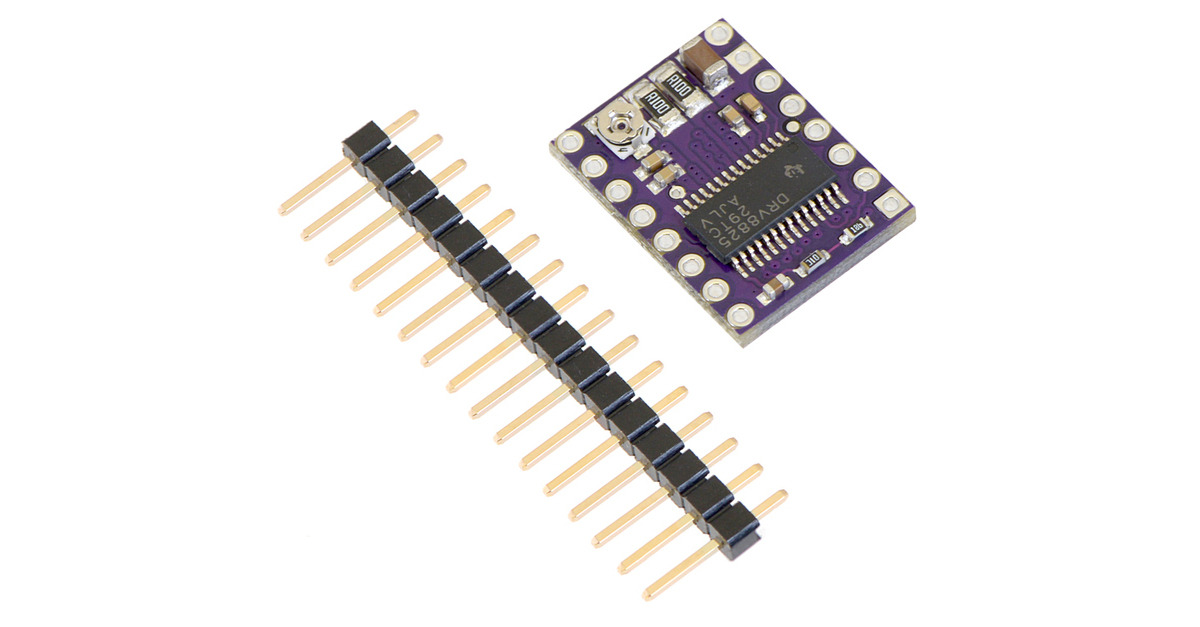
The DRV8825 is the natural step up from the A4988. It is the purple carrier board built around a Texas Instruments DRV8825 chip, and it fits the exact same socket, so it is a drop-in upgrade when a motor needs more current, a higher voltage, or finer microstepping. For a grower running a bigger dosing pump or a stronger valve actuator, it is the one with headroom to spare.
What it is.
A single stepper driver on the same little carrier outline the A4988 made standard, so it works in the same boards and shields. It drives one bipolar stepper from STEP and DIR pulses, limits the coil current through a potentiometer, and offers microstepping. The differences are all about capacity: more current, more voltage, and finer steps.
How it differs from the A4988.
Three things. It carries more current, roughly 1.5 A bare and up to about 2.2 A with a heatsink and airflow, against the A4988’s 1 to 2 A. It takes a higher motor voltage, up to 45 V, which helps a motor keep torque at speed. And it microsteps finer, down to one thirty-second of a step against the A4988’s sixteenth, for smoother motion. Because it is pin-compatible, a build can begin on an A4988 and move up to a DRV8825 with no rewiring. Two cautions: the DRV8825 stands a little taller, and its current-limit math is different, so do not reuse an A4988 Vref setting.
Setting Vref (note the difference).
Set the current limit before running the motor hard, the same way: turn the potentiometer, measure Vref with a multimeter, and aim for the target from your motor’s rated current. The catch worth repeating is that the DRV8825 uses a different formula and a different sense resistor from the A4988, so the same Vref means a different current. Always use the DRV8825 datasheet figure, not a number you remember from an A4988, or you will set the current wrong and overheat something.
Key facts.
Where it fits, and where it doesn’t.
Where it fits
- A bigger or stronger stepper than an A4988 can feed.
- Higher motor voltage for torque at speed.
- Finer, smoother motion from 1/32 microstepping.
- A drop-in upgrade to an existing A4988 build.
Where it doesn’t
Resources & where to buy.
Pololu DRV8825 TI DRV8825 datasheet A4988 (the classic) Stepper drivers overview
Frequently asked questions.
What is the difference between the DRV8825 and the A4988?
The DRV8825 carries more current (about 1.5 A bare, 2.2 A cooled, versus 1 to 2 A), takes a higher motor voltage (up to 45 V), and microsteps finer (down to 1/32 versus 1/16). It is pin-compatible with the A4988, so it drops into the same socket as an upgrade. Note that it is slightly taller and uses a different current-limit formula.
Can I swap a DRV8825 in where I had an A4988?
Yes, the boards share the same outline and pinout, so it drops straight into the same socket or shield. The one thing you must redo is the current limit: the DRV8825 has a different sense resistor and formula, so recalculate Vref from its datasheet rather than reusing the A4988 setting.
When should I choose a DRV8825 over an A4988?
When the motor needs more current or a higher voltage than the A4988 comfortably supplies, or when you want the smoother motion of finer microstepping. For light-duty motion on a budget, the A4988 is enough. For quiet running, neither is the answer; a TMC2209 is.
Why does the DRV8825 need a different Vref than the A4988?
Because it uses a different current-sense resistor and a different formula. The same Vref voltage sets a different coil current on the two boards, so a number carried over from an A4988 would set the current wrong. Always calculate Vref from the DRV8825 datasheet for your motor.