

A stepper motor moves in precise, fixed steps and holds its place when it stops, so you can position a thing exactly without any sensor telling you where it is. That makes it the motor for jobs that need repeatable motion: a syringe or peristaltic pump that dispenses an exact volume of nutrient, a motorized valve set to a known angle, a small gantry or camera slide. A stepper driver is the board that turns simple step-and-direction pulses from a controller into the careful coil sequence the motor needs.
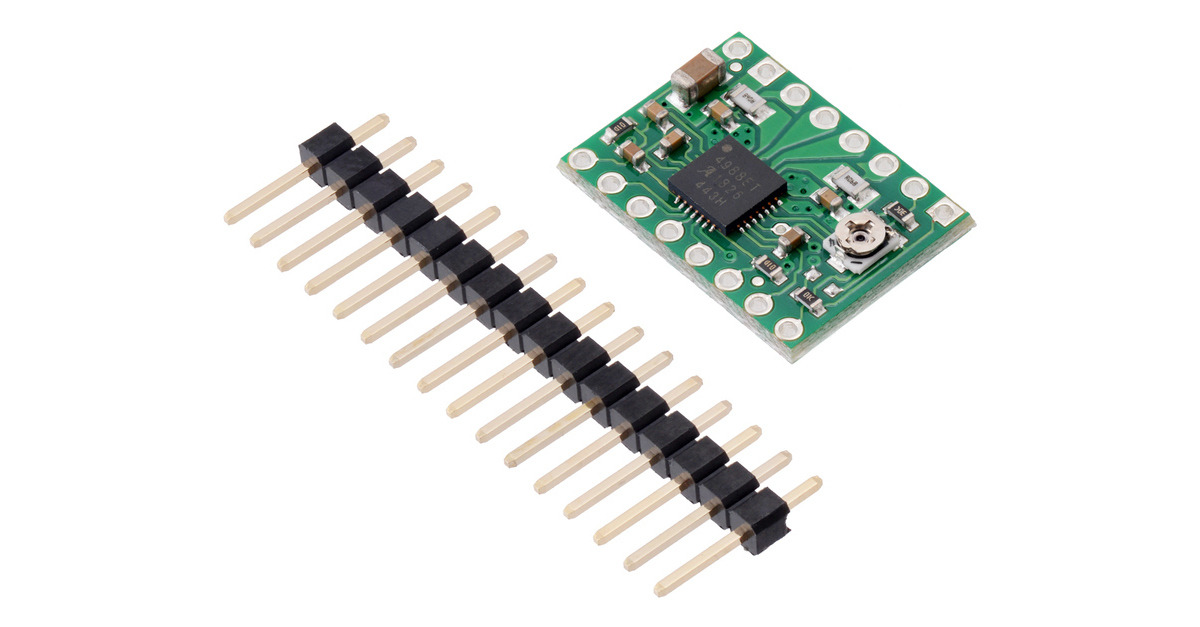
What a stepper does.
A common stepper turns in 1.8 degree steps, 200 of them to a full revolution, and it stops exactly on a step and stays there. There is no guesswork and no feedback loop: tell it to take 50 steps and it moves a quarter turn, every time. That open-loop precision is the whole appeal. A plain DC motor spins until you cut the power and coasts to a vague stop, which is fine for a fan but useless when the amount of motion is the point.
Why a stepper needs a driver.
A stepper has two coils that must be energized in the right order, with current pushed each way in turn, to make the shaft step. Doing that by hand from a controller would take many pins and careful timing, and the same current and voltage problems as any motor apply. The driver chip does all of it. You send two signals, STEP (one pulse, one step) and DIR (which way), and the driver handles the coils. It also offers microstepping, splitting each physical step into smaller electrical ones for smoother, quieter, finer motion.
Setting the current limit.
This is the one step people skip and regret. A stepper driver pushes a set current through the coils, and you have to tell it how much by turning a tiny potentiometer on the board and measuring the reference voltage (Vref) with a multimeter. Set it too high and the motor and driver overheat; too low and the motor is weak and skips steps. The right value comes from the motor’s rated current and the formula in the driver’s datasheet. Set it once, carefully, and the driver runs cool and the motor holds its torque.
Compare the drivers.
The carriers a grower meets, side by side. The first three share the same little board outline and pinout, so they drop into the same socket. The tinted column is the value all-rounder; the TMC2209 is the one to pick when you want the motion to be quiet.
| Spec | A4988 | DRV8825Open Agriculture Technology pick | TMC2209 | 28BYJ-48 + ULN2003 |
|---|---|---|---|---|
| Maker chip | Allegro A4988 | TI DRV8825 | Trinamic TMC2209 | Unipolar darlington |
| Max current | ~1 A (2 A cooled) | ~1.5 A (2.2 A cooled) | ~1.4 A (2 A peak) | ~0.3 A (tiny motor) |
| Motor voltage | 8 to 35 V | 8.2 to 45 V | 4.75 to 29 V | 5 to 12 V |
| Microstepping | Up to 1/16 | Up to 1/32 | Up to 1/256 | Full step only |
| Noise | Audible | Audible | Near silent | Audible, buzzy |
| Control | STEP + DIR | STEP + DIR | STEP + DIR (or UART) | 4 coil pins |
| Best for | Cheap, classic, light duty | A bit more power and finesse | Quiet, continuous, smooth | Tiny cheap geared motion |
The A4988 and DRV8825 are pin-compatible, so a build can start on the cheaper A4988 and swap up to the DRV8825 for more current and finer steps with no rewiring. The TMC2209 is the upgrade when noise matters: it runs a stepper almost silently and can even home without a limit switch. The 28BYJ-48 with its ULN2003 board is a different, tiny, cheap geared motor for light jobs, not a carrier in the same family.
Where they fit, and where they don’t.
Where they fit
- Dosing an exact volume with a syringe or peristaltic pump.
- Setting a motorized valve to a precise angle.
- A small gantry, slide, or camera move.
- Anything where the amount of motion must repeat.
Where they don’t
Datasheets and carriers.
Straight from the makers; these open in a new tab:
Frequently asked questions.
What does a stepper driver do?
It turns simple step-and-direction signals from a microcontroller into the precise, current-controlled coil sequence a stepper motor needs. You send STEP and DIR pulses; the driver energizes the two coils in the right order, limits the current, and offers microstepping for smoother motion.
What is the difference between the A4988 and the DRV8825?
They are pin-compatible carriers, so they fit the same socket. The DRV8825 handles a bit more current and voltage and offers finer microstepping (down to 1/32 versus 1/16), while the A4988 is cheaper and the long-standing classic. Start on an A4988 and swap up to a DRV8825 if you need the extra headroom.
Why is setting the current limit important on a stepper driver?
The driver pushes a fixed current through the motor coils, and you set it with a small potentiometer and a Vref measurement. Set it too high and the motor and driver overheat; too low and the motor is weak and skips steps. Set it once from the motor’s rated current and the datasheet formula, and everything runs cool and strong.
Which stepper driver is the quietest?
The TMC2209. Its design runs a stepper almost silently, where the A4988 and DRV8825 are audible. It also offers very fine microstepping and can home against a hard stop without a limit switch. It costs more, so it is the pick when quiet, smooth motion is worth it.
Should I use a stepper or a DC motor?
Use a stepper when the amount of motion matters and must repeat, like dosing a set volume or setting a valve angle. Use a DC motor and a motor driver when you just need something to spin or to open and close, like a fan or a vent, where exact position is not the point.