

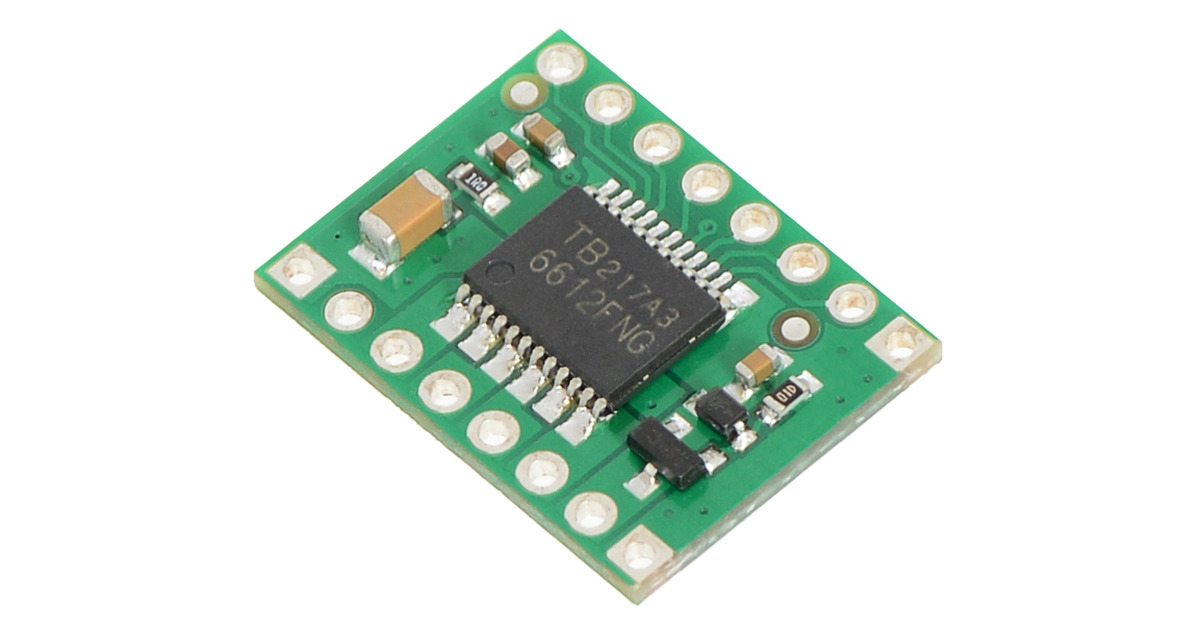
The TB6612FNG is a dual H-bridge motor driver on a small breakout board, and it is the one we reach for first. It runs two DC motors (or one stepper) from any microcontroller, and because its switches are MOSFETs rather than the old bipolar transistors of an L298N, it wastes little power and stays cool. For the small vent motors, dosing pumps, and fans a grower runs, it is efficient, cheap, and tidy.
What it is.
At its heart is a Toshiba TB6612FNG chip: two complete H-bridges in one small package. Each bridge drives one DC motor forward or backward with speed control, so a single board handles two motors at once. Wire the two channels together and it can instead drive one bipolar stepper at low current. It takes a separate logic supply (the controller’s voltage) and motor supply (whatever the motor needs), which keeps the noisy motor power away from the controller.
Why it beats the L298N.
The L298N is the driver in every starter kit, and it works, but it is an old bipolar design that drops around two volts across itself and turns the difference into heat, which is why it ships bolted to a chunky heatsink. The TB6612FNG switches with MOSFETs instead, so the voltage loss is small and it runs cool without a heatsink. On a battery that means more of your power reaches the motor; in an enclosure it means less heat to get rid of. Same dual-channel job, in a fraction of the size, for similar money.
How you drive it.
Per motor, three signals from the controller. Two direction pins (IN1 and IN2) set forward, reverse, brake, or coast by which one is high. One PWM pin sets the speed, by switching the power on and off quickly. A shared STBY (standby) pin wakes the chip up; hold it low and both motors stop dead, which is a handy hardware off-switch. That is six control pins for two motors, plus standby. In practice a small library or an ESPHome output block hides the detail and you just say forward at half speed.
Key facts.
Where it fits, and where it doesn’t.
Where it fits
- Small DC vent or louver motors that reverse.
- Peristaltic dosing pumps run forward and back.
- Small fans and circulation pumps with PWM speed.
- A small bipolar stepper at modest current.
Where it doesn’t
- Big motors or actuators past a couple of amps.
- Motors over 13.5 V; check your supply first.
- Switching mains; that is a relay.
- A serious stepper; use a stepper driver.
Resources & where to buy.
Pololu TB6612FNG Adafruit TB6612 SparkFun TB6612FNG Motor drivers overview
Frequently asked questions.
What is the TB6612FNG used for?
It is a dual motor driver: it runs two DC motors forward and backward with speed control from a microcontroller, or one bipolar stepper at low current. In a grow setup that means small vent motors, dosing pumps, and fans driven from an ESP32 or similar board.
Is the TB6612FNG better than the L298N?
For most jobs, yes. Both are dual H-bridges, but the L298N is an old bipolar design that drops about two volts and needs a heatsink, while the TB6612FNG uses MOSFETs that waste little power and run cool. The TB6612 is smaller and more efficient for similar money. The L298N still works for learning or higher voltages it happens to suit.
How many pins does the TB6612FNG need?
Three control signals per motor: two direction pins and one PWM speed pin, plus a shared standby pin that disables both motors when held low. So six pins for two motors, plus standby. A small library or an ESPHome output block handles the detail.
Can the TB6612FNG drive a stepper motor?
It can drive one small bipolar stepper by using its two channels as the stepper’s two coils, at modest current. For a stepper you intend to run hard or position precisely, a dedicated stepper driver like the A4988 or DRV8825 is the right tool.