
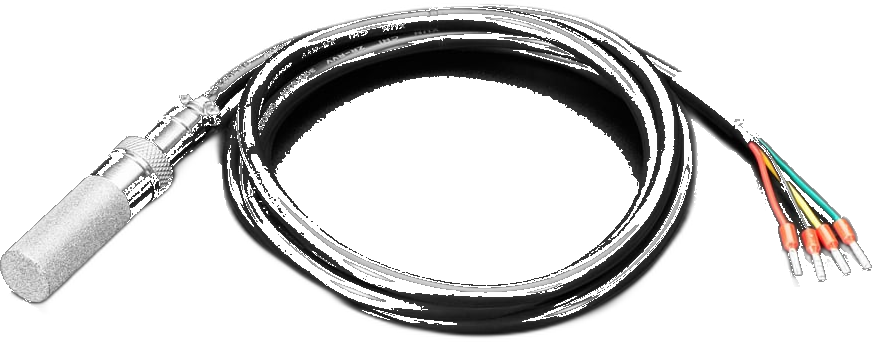
The SHT-30 probe with its mesh cap unscrewed: the sensing element inside
Sensor
SHT-30 weatherproof probe
A research-grade temperature and humidity sensor in a weatherproof mesh tube on a 1 meter cable. Wires straight to an ESP32: four wires.
This is the wired path: no Bluetooth, no batteries in the cold space, just a probe on a cable reporting every time the board asks. Accuracy is a step up from the hobby pucks: half a degree C and 2 percent humidity, as Adafruit rates the finished probe.
Specs.
| Measures | Temperature and relative humidity, both from the one probe |
|---|---|
| Humidity accuracy | ±2 % RH typical at 25 °C for the SHT30 chip. The datasheet also plots a maximal tolerance, and it widens toward 0 and 100 % RH |
| Temperature accuracy | ±0.2 °C typical from 0 to 65 °C for the chip. Adafruit rates the assembled probe ±0.5 °C, and that is the number to plan against |
| Humidity range | 0 to 100 % RH |
| Temperature range | -40 to 125 °C for the chip; in practice the cable and the mesh cap are the limit |
| Repeatability, high mode | 0.08 % RH · 0.04 °C sample to sample, which is what you see between consecutive readings |
| Resolution | 0.01 % RH · 0.01 °C |
| Long-term drift | Under 0.25 % RH a year · under 0.03 °C a year |
| Response time, 63 % | 8 s humidity · over 2 s temperature |
| Interface | I2C at address 0x44, pullups built into the cable; four wires: red power, black ground, yellow clock, green data |
| Cable | 1 meter, weatherproof mesh-protected tip (breathes air, not for submersion) |
| Power | 3.3 V from the board; no batteries |
Numbers from the Sensirion SHT3x-DIS datasheet, December 2022, version 7 (Tables 1 and 2). Assembly ratings are Adafruit's, for product 4099. The same figures are on the build page for the SHT-30 node.
How to pick a good one.
- Adafruit part 4099 is the reference: mesh-protected SHT-30 with pullups already on the cable.
- Four wires: power, ground, clock, data. Any ESP32 board in this store reads it over I2C.
- The mesh tip breathes, so it reads humidity honestly; do not submerge it. For liquids, use the DS18B20 instead.