
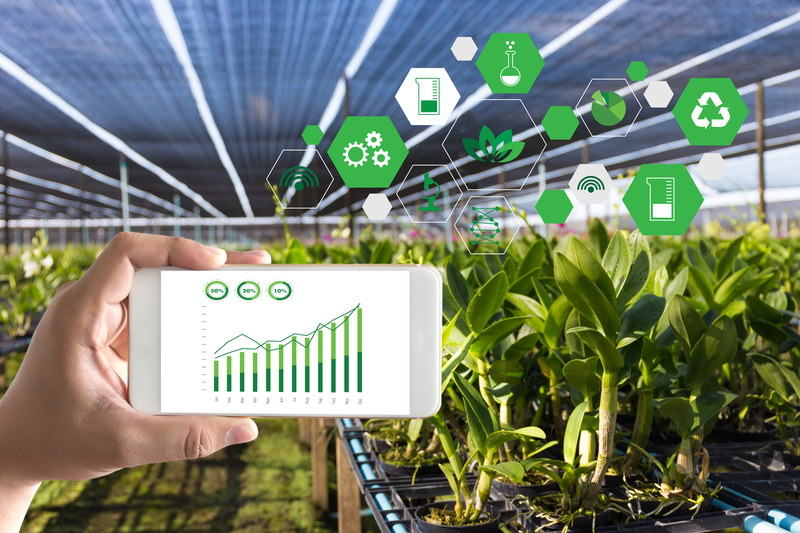
For a decade, the automation conversation in controlled environment agriculture split growers into two camps: the venture-funded mega-facilities that could amortize a million-dollar robotics line across acres of production, and everyone else, who priced out a single gantry system, winced, and went back to hiring. That line is dissolving. As one industry observer put it bluntly this month, "technologies which only belonged to certain industrial businesses have now become affordable for growers."
That sentence should change how mid-sized operators plan their next three years. But it should not change how they make the decision. We've watched well-capitalized indoor farms automate themselves into bankruptcy and we've watched scrappy 3-acre greenhouses use one well-chosen piece of equipment to flip their unit economics. The difference was never the technology. It was the discipline behind the purchase order.
The Affordability Inflection Point Is Real
The cost curve in CEA hardware has bent the way nearly every maturing technology category eventually bends. Three forces are driving it.
First, component deflation. The sensors, servo motors, programmable controllers, and edge-compute boards that make modern automation work are now commodity electronics, manufactured at smartphone and EV scale. A precision dosing controller that cost $8,000 in 2018 is built around silicon that now costs a fraction of that.
Second, competition and standardization. Early CEA automation was bespoke: custom integrators charging custom margins. The market has since matured into productized systems with published specs, which compresses pricing and lets a buyer compare apples to apples. HAWE's newly launched AIR Gutter is a good marker of where the frontier sits: a mobile NFT gutter engineered to optimize airflow, irrigation, and rooting in leafy greens production. "Our new gutter is more than a carrier of plants," the company says, and the meaningful part is that this kind of integrated airflow-and-irrigation precision, once the province of industrial installations, is now sold as a catalog product to mid-market growers.
Third, a deeper used and refurbished market, as first-generation vertical farms get restructured or liquidated, putting capable hardware into circulation at steep discounts.
The net effect: automation is "increasingly accessible to greenhouse and nursery operations, driven by the falling cost of technologies." For a mid-sized operation, the question is no longer can we afford it. It's which pieces actually pay us back.
The AeroFarms Lesson: Technology Is Not the Strategy
If you want evidence that affordability and success are different problems, look at what's happening at the top of the market. AeroFarms, one of the most technically sophisticated vertical farms ever built, came through bankruptcy and was acquired by an affiliate of Palm Ventures. The new CEO's stated priority isn't a more advanced grow algorithm. It's bringing CPG discipline to indoor farming: cost control, margin discipline, demand planning, and the unglamorous operational rigor that consumer packaged goods companies live by.
Read that as the industry's most expensive lesson, delivered for free. The most automated farm in the world still has to answer for its cost per unit, its yield consistency, and whether anyone will pay a premium for the bag of greens at the end of the line. Technology was never the constraint at AeroFarms. Business fundamentals were.
That is the right frame for any automation decision. Automation is a means to operational efficiency and defensible unit economics, not an end, and certainly not a trophy. When affordability removes the cost barrier, it also removes the natural friction that used to stop operators from buying things they didn't need. Cheap technology makes undisciplined buying easier, not safer.
What's Actually Affordable Now, by Operation Size
"Affordable" means different things at different scales. Here's how the threshold has moved across the main categories.
Sub-5 acres (small greenhouse, single-room vertical): The clear wins are climate and irrigation automation: integrated environmental controllers, automated fertigation and dosing, and precision airflow management like the HAWE gutter approach. These were borderline-justifiable at this scale five years ago. Today the payback math is straightforward, often inside 18–24 months when measured against labor and crop-loss reduction. Full robotic material handling generally still doesn't pencil out here.
5–20 acres (mid-market, the heart of the shift): This is where the inflection point bites hardest. Automated transplanting, conveyance between zones, semi-automated harvest assist, and unified environmental control platforms have crossed from aspirational to routine. Operators in this band are the ones most likely to either capture real advantage or overspend dramatically, because almost everything is now affordable, and "we can afford it" is the most dangerous phrase in the building.
20+ acres (industrial): Full robotics, autonomous mobile platforms, and vision-based grading were always reachable here. What's changed is the cost of redundancy and integration: running multiple automated lines without a custom integration team on retainer. The frontier at this scale is data and orchestration, not the machines themselves.
The Questions to Ask Before You Sign Anything
Falling prices don't make the evaluation easier; they make it more important, because more options now clear the cost hurdle. Here is a checklist worth working through before you talk to a vendor.
- Labor cost comparison, fully loaded. What does the task actually cost today (wages, turnover, training, error and crop loss), and how much of that does the system genuinely remove? A machine that replaces 0.6 of a position you still have to staff isn't a savings.
- Crop-type compatibility. A system tuned for uniform leafy greens may be useless for vining crops, microgreens, or a mixed program. Affordable and wrong for your crop is still a write-off.
- Scalability and growth stage. Does this fit the operation you'll run in three years, or only the one you run today? Buying for the wrong stage cuts both ways: over- and under-sized.
- Integration with existing systems. Will it talk to your current controls and data stack, or does it become an island that needs its own babysitter?
- Vendor support and training. When it breaks at 2 a.m. during a heat event, who answers? What's the real training burden on your team?
If you can't get clean answers to all five, the price tag doesn't matter yet.
The Part Nobody Sells You: Integration
Here is the most common failure mode, and it has nothing to do with the equipment being bad. Affordable automation gets purchased, installed, and then quietly underperforms because the implementation was treated as an afterthought.
Automation reshapes work. It demands workflow redesign: the old labor sequence rarely maps onto the new one. It demands training that goes beyond the vendor's two-day commissioning visit. And it generates data that has to be captured, trusted, and acted on, or the "smart" system is just an expensive timer. The operations that win with automation are the ones that treat the install as the beginning of a change-management project, not the end of a procurement decision.
This is precisely where a business-first, technology-agnostic frame earns its keep, and it is what this site is for. The people who write and review these pages have grown crops, run rooms, and installed the systems, not just read the spec sheets. This site sells nothing; the point is to leave you able to make the call yourself, whether that means buying the new line, buying the used one, or fixing the workflow before buying anything.
Do the Homework Before You Sign
The affordability shift is the best news mid-market CEA has had in years. It is also the moment when disciplined operators pull away from the ones who confuse a lower price with a better decision.
If you're evaluating an automation investment (climate control, irrigation, harvest assist, robotics), run the numbers before anyone's pitch deck runs them for you. The free calculators in the Library carry most of the load: greenhouse ROI for the payback math, the energy audit for the operating cost side, and the cycle cost-of-goods calculator for what a unit really costs you today. Pair them with the five questions above and you'll know which investments pay back and which don't, before you sign anything. That is the real gift of newly affordable technology: the analysis got affordable too.