

A solid-state relay switches a load with a semiconductor instead of moving contacts. There is nothing to click, nothing to wear out, and it can switch on and off millions of times, which makes it the right relay when something has to cycle often, like a heat mat held at a set temperature. A small DC signal on the input switches the AC (or DC) load on the output, with no mechanical parts in between.
What it is.
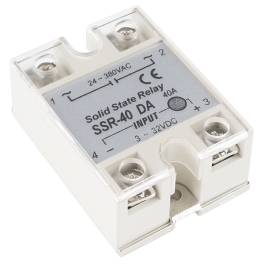
Inside, a small input voltage lights an internal optocoupler that switches a power semiconductor: a triac or SCR for an AC load, a MOSFET for a DC one. The control side is fully isolated from the load, and the input takes a wide DC range, often 3 to 32 volts, so a microcontroller pin can drive one directly, sometimes through a small resistor. No coil, no contacts, no click.
Why pick one.
Two reasons stand out. Lifespan: a mechanical relay’s contacts wear and eventually weld or fail after enough switching, while a solid-state relay has nothing to wear, so it shrugs off the constant cycling a temperature controller demands. Speed and silence: it switches fast and without a sound, which suits slow on-off control of a heater or grow light where a clicking mechanical relay would drive you mad. For anything that toggles more than occasionally, the solid-state relay is the durable choice.
The AC versus DC trap.
This catches people, so check it before you buy. A solid-state relay is built for one kind of load: an AC SSR will not switch a DC load, and a DC SSR will not switch AC. The very common cheap modules (you will see them labeled like “SSR-25DA”) take a DC control input and switch an AC load, which is right for a mains heater or light but wrong for a 12 volt DC pump. Match the relay to your load’s type, not just its voltage and current.
Heat and honest sizing.
A solid-state relay drops about a volt across its output while conducting, and that volt times the load current becomes heat it has to shed. Past a few amps it needs a heatsink, and the cheap rebranded units are wildly optimistic about their ratings: treat a “25 amp” bargain SSR as good for perhaps a third of that without serious cooling. Size generously, bolt it to metal or a finned heatsink with thermal paste, and give it air. A starved, overloaded SSR fails shorted, which means the load stays on.
Leakage current.
One more thing to know: a solid-state relay leaks a tiny current even when it is “off.” It is small, but it is enough to make a neon indicator glow faintly or trickle through a very low-power load. More importantly, that leakage means an SSR is not a true disconnect. Never rely on one to make a circuit safe to touch; use a proper switch or breaker to isolate before you work on anything.
Key facts.
Where it fits, and where it doesn’t.
Where it fits
- Holding a heat mat or heater at a set temperature.
- Anything that switches on and off often.
- Quiet operation, with no relay click.
- Direct drive from a microcontroller pin.
Where it doesn’t
- A DC load on an AC SSR, or the reverse.
- A true safety disconnect; it leaks when off.
- Dimming by phase angle; it switches at zero-cross.
- High current with no heatsink or airflow.
Resources & where to buy.
SparkFun solid-state relay Sensata Crydom SSRs Relay module (mechanical) Relays overview
Frequently asked questions.
What is a solid-state relay used for?
It switches a load with a semiconductor instead of moving contacts, so it is silent and lasts millions of cycles. That makes it the right choice when something has to switch on and off often, like a heat mat or heater held at a set temperature, where a mechanical relay would wear out and click constantly.
What is the difference between a solid-state relay and a mechanical relay?
A mechanical relay uses physical contacts moved by a coil; it clicks and wears over time but truly disconnects the load and switches AC or DC. A solid-state relay switches with a semiconductor: silent, fast, and long-lived, but built for one load type, leaking a little when off, and needing a heatsink at higher current. Use a mechanical relay for occasional switching, a solid-state relay for frequent cycling.
Can a solid-state relay switch a DC load?
Only if it is a DC solid-state relay. SSRs are built for one load type, and the common cheap modules labeled like SSR-25DA take a DC control input but switch an AC load, so they will not switch a 12 volt DC pump. For a DC load, buy an SSR rated for DC switching.
Does a solid-state relay need a heatsink?
Past a few amps, yes. It drops about a volt across the output while conducting, and that becomes heat. The cheap units are also rated optimistically, so treat a 25 amp bargain SSR as good for roughly a third of that without serious cooling. Bolt it to metal with thermal paste and give it air.
Is a solid-state relay safe as an off switch?
Not as a disconnect. It leaks a small current even when off, enough to make an indicator glow, so it never makes a circuit safe to touch. Use a proper switch or breaker to isolate the load before working on it.