
The ESP32 covers most grower projects: cheap, with Wi-Fi and Bluetooth built in. But it is not the only microcontroller, and a handful of others each do one thing better. Knowing them keeps you from forcing an ESP32 into a job it is wrong for, and most of them program with the same Arduino tools you already know.
Why the ESP32 usually wins.
For a connected sensor, the ESP32’s combination of price and built-in wireless is hard to beat, which is why it is the default here. The families below have no Wi-Fi (mostly), cost more, or take more effort to learn. So the rule is simple: start with an ESP32, and reach for a specialist only when a project has a need the ESP32 genuinely cannot meet. When that day comes, here is the map.
The specialists.
Four families, each strong at one thing. The prose is the guide, since each answers a different need.
| Spec | STM32 | Teensy | Nordic nRF52 | Feather / XIAO |
|---|---|---|---|---|
| Strength | Industrial, precise peripherals | Very fast, great USB and audio | Ultra-low-power Bluetooth | A form-factor ecosystem |
| Wireless | None, mostly | None | BLE (+ Thread, Zigbee) | Depends on the board |
| Difficulty | Steeper | Arduino-easy | Moderate | Arduino-easy |
| Program with | STM32Cube or Arduino | Arduino (Teensyduino) | nRF SDK or Arduino | Arduino |
| Best for | Serious or industrial control | DSP, audio, high-speed I/O | Battery BLE devices | Tidy, stackable builds |
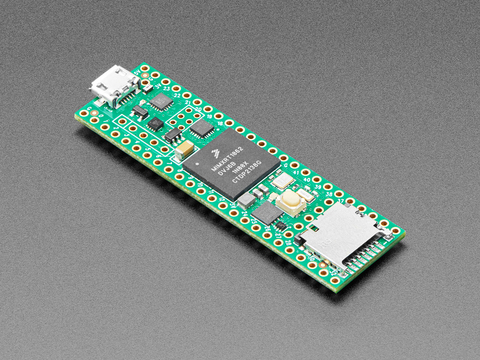
STM32 is the industrial workhorse: a vast range of ARM chips with precise peripherals, used in real products. Teensy is the speed demon, beloved for audio and high-rate USB. Nordic nRF52 is the Bluetooth specialist behind many commercial battery devices. Most can be programmed from the Arduino IDE, so the skills carry over.
Feather and XIAO are ecosystems.
Two names on the list are not chips but form factors. Adafruit’s Feather is a board shape with a huge range of stackable add-ons (“FeatherWings”), sold with many different chips inside, including ESP32, nRF52, and RP2040. Seeed’s XIAO is a thumbnail-sized board in the same spirit, also offered with several chips. You are not choosing a processor so much as buying into a tidy ecosystem of parts that fit together. If you like things neat and modular, that is the draw.
Where they fit, and where they don’t.
Where they fit
- Precise, industrial control (STM32).
- Audio, DSP, or very high-speed I/O (Teensy).
- Battery devices that live on Bluetooth (Nordic nRF).
- Neat, modular, stackable builds (Feather, XIAO).
Where they don’t
Resources.
These open in a new tab:
STMicroelectronics STM32 PJRC Teensy Nordic Semiconductor Adafruit Feather
Frequently asked questions.
When should I use an STM32 instead of an ESP32?
When you need industrial-grade reliability or precise peripherals and do not need built-in wireless, such as serious motor or process control. STM32 offers a huge range of chips and is widely used in real products, at the cost of a steeper learning curve, though an Arduino core eases that.
What is a Teensy good for?
Speed and signal work. The Teensy 4 line is one of the fastest hobby microcontrollers, excellent for audio, DSP, and high-rate USB. It is Arduino-compatible and easy to use, but it has no wireless and costs more than an ESP32.
What is a Nordic nRF chip used for?
Ultra-low-power Bluetooth. Nordic nRF52 and nRF53 chips are behind many commercial battery-powered BLE devices and some Adafruit and Seeed boards. Choose one when a project lives on Bluetooth and must run a long time on a small battery; some also do Thread and Zigbee.
What are Feather and XIAO?
They are board form factors, not chips. Adafruit Feather is a standard shape with stackable add-on boards called FeatherWings, sold with various chips inside. Seeed XIAO is a tiny thumbnail-sized board in the same spirit. You buy into an ecosystem of parts that fit together rather than choosing a processor first.
Can STM32, Teensy, and Nordic boards be programmed with the Arduino IDE?
Mostly yes. STM32, Teensy, Nordic, and the Feather and XIAO boards all have Arduino support, so the same tools and much of the same code carry over from the ESP32. STM32 also has its own STM32Cube tools for deeper work.